
Quick answer
Abhayagiri is a great monastery in northern Anuradhapura, founded by King Valagamba in the 1st century BC and once home to thousands of monks, as recorded by the Chinese pilgrim Faxian in the 5th century. Its restored stupa stands about 75 metres high. The complex includes the Samadhi Buddha, Kuttam Pokuna twin ponds, the Ratnaprasada guardstone, the finest moonstone at so-called Mahasen's Palace and the Abhayagiri museum. Allow two to three hours, ideally by bicycle in the early morning or late afternoon.
Key takeaways
- Abhayagiri was founded by King Valagamba, also called Vattagamani Abhaya, in the 1st century BC.
- The Chinese pilgrim Faxian visited Abhayagiri in the early 5th century and recorded around 5,000 monks living there.
- Abhayagiri's restored stupa stands about 75 metres high, second only to Jetavanaramaya in Anuradhapura.
- The Samadhi Buddha, Kuttam Pokuna and the Ratnaprasada guardstone are all within the Abhayagiri complex.
- The Abhayagiri museum, built with Chinese support, displays finds from the monastery and honours Faxian's visit.
History
Abhayagiri was founded in the 1st century BC by King Valagamba, also called Vattagamani Abhaya, after he regained his throne. It grew into one of the three great monasteries of Anuradhapura and became known for openness to ideas from India and beyond, including Mahayana teachings, which brought it into rivalry with the orthodox Mahavihara.
The Chinese monk Faxian visited in the early 5th century and recorded around 5,000 monks. He described a jade Buddha image and a merchant's offering of a Chinese silk fan, which moved him to tears. Abhayagiri's international connections are visible in the finds displayed in its museum.
After Anuradhapura's fall in 1017, Abhayagiri was abandoned to the forest, and its restoration began in the 20th century.
Abhayagiri was also a centre of learning, with monks travelling between Sri Lanka, India, China and Southeast Asia. Texts and ideas developed at Abhayagiri influenced Buddhism well beyond the island. For a first-time visitor, this international history explains why Abhayagiri feels different from the more orthodox Mahavihara sites around the Sri Maha Bodhi.
- →1st century BC: founded by King Valagamba.
- →5th century: visited by Faxian, around 5,000 monks.
- →1017: abandoned after Anuradhapura's fall.
The stupa
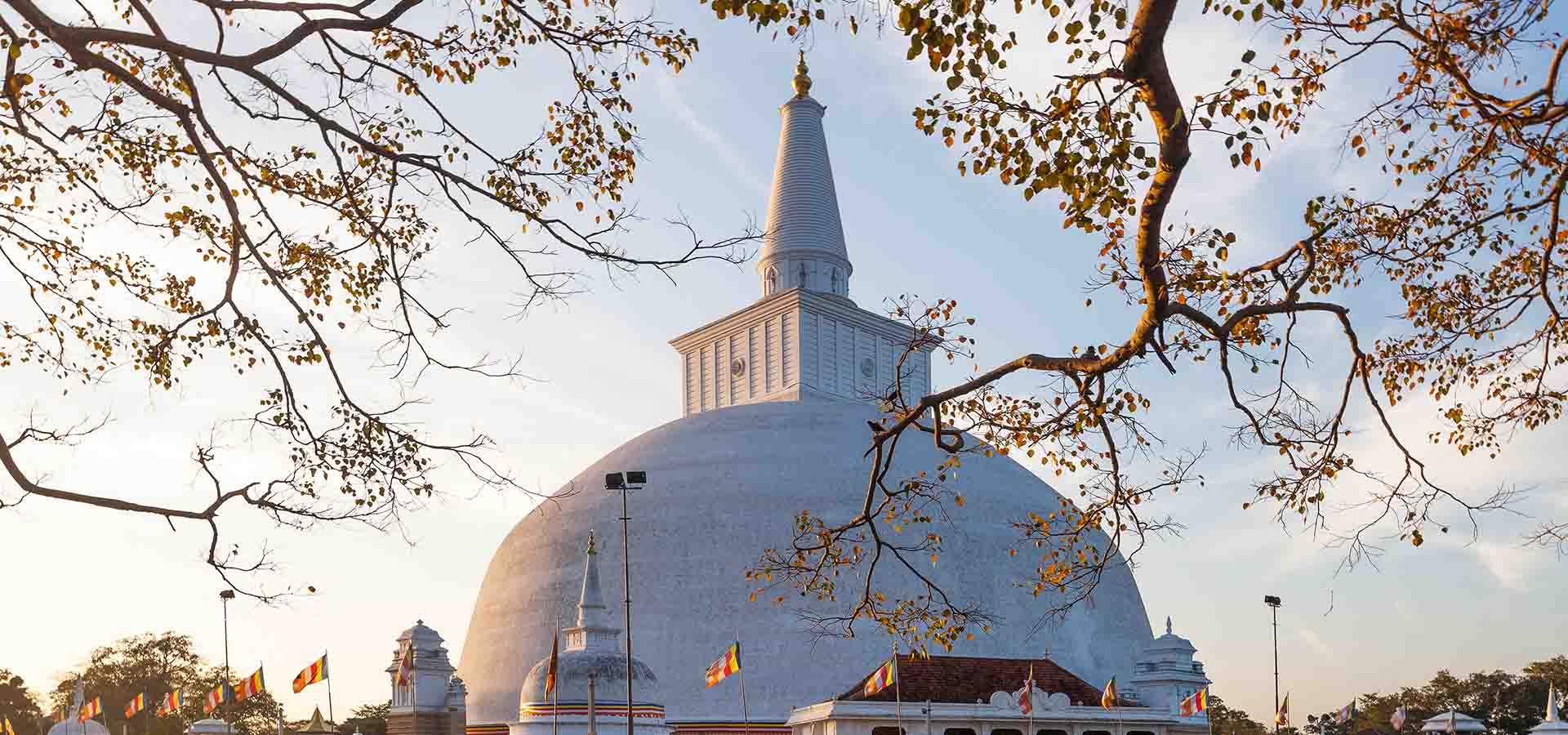
Abhayagiri's stupa is the centrepiece of the monastery. Restored in recent decades, it stands about 75 metres high, second only to Jetavanaramaya in Anuradhapura. Its white-plastered upper part rises above the forest and is visible from far across the sacred city.
Walk around the terrace clockwise, shoes off. Look for the frontispieces at the cardinal points and the large flower altars. Pilgrims visit, but it is calmer than Ruwanwelisaya.
The Abhayagiri stupa was for centuries a broken, overgrown mound, and photographs from the 20th century show trees growing from its dome. Its restoration, finished in recent years, revealed the original profile. Some visitors prefer the unrestored brick of Jetavanaramaya, others the restored whiteness of Abhayagiri; seeing both on the same day shows two approaches to conservation.
Highlights of the complex
Abhayagiri's complex holds many of Anuradhapura's finest pieces. The Samadhi Buddha, seated in meditation, is a short walk from the stupa. Kuttam Pokuna, the twin ponds, shows superb stonework and a clever water system. The Ratnaprasada has the most celebrated guardstone in Sri Lanka, and the building called Mahasen's Palace has the finest moonstone.
Other remains include refectories with huge stone troughs for rice, monks' residences and image houses. Monkeys and birds are everywhere in the trees.
The Abhayagiri refectory is a good stop to imagine daily life. Its long stone trough, many metres in length, is thought to have held rice for hundreds of monks at a single meal. Nearby, stone pillars and platforms mark residences and halls where monks lived, studied and met.
- →Samadhi Buddha: seated meditation statue.
- →Kuttam Pokuna: twin bathing ponds.
- →Ratnaprasada: the finest guardstone.
- →Mahasen's Palace: the finest moonstone.
- →Refectory: a giant stone rice trough.
The Abhayagiri museum
The Abhayagiri museum, built with Chinese support and sometimes called the Fa-Hien museum, displays finds from the monastery, including jewellery, pottery, carvings and coins. It honours Faxian's visit and Abhayagiri's links across Asia.
It is a good midday stop when the open site is hot. Check opening days locally, as museums in Anuradhapura sometimes close one day a week.
The museum's collection includes beads, coins, bronze Buddha and Bodhisattva figures and carved panels found during excavations of the Abhayagiri complex. Bodhisattva images in particular reflect the monastery's openness to Mahayana ideas. A short visit before exploring the site gives useful context for what you see outside.
Visiting tips
Abhayagiri is best seen by bicycle or tuk-tuk, as the complex is spread out. Allow two to three hours. Arrive early, around 7am, or after 3.30pm to avoid the heat, and carry water. The sites are covered by the Anuradhapura sacred city ticket, roughly US$25 to US$30 for foreign adults.
Lankan Stays & Trails guides often run an Abhayagiri loop in the late afternoon, ending at Kuttam Pokuna as the light softens, after a morning at Jetavanaramaya and the Sri Maha Bodhi.
- →Allow two to three hours.
- →Best by bicycle or tuk-tuk.
- →Early morning or late afternoon.
- →Covered by the sacred city ticket.
Frequently asked questions
What is Abhayagiri in Anuradhapura?
Abhayagiri is one of the three great ancient monasteries of Anuradhapura, founded in the 1st century BC by King Valagamba. Its complex includes a 75-metre stupa, the Samadhi Buddha, Kuttam Pokuna twin ponds, fine carvings and a museum.
How tall is the Abhayagiri stupa?
About 75 metres today, after restoration, making it the second tallest stupa in Anuradhapura after Jetavanaramaya. It was originally taller. Its white upper part rises above the forest. Visit early when the white dome glows in the light.
Who was Faxian?
Faxian, also written Fa-Hien, was a Chinese Buddhist monk who travelled to India and Sri Lanka in the early 5th century. He stayed at Abhayagiri and recorded around 5,000 monks there. The Abhayagiri museum honours his visit.
How long do you need at Abhayagiri?
Two to three hours to see the stupa, Samadhi Buddha, Kuttam Pokuna, Ratnaprasada and the museum. A bicycle or tuk-tuk helps, as the complex is spread out. Visit early morning or late afternoon.
Is Abhayagiri included in the Anuradhapura ticket?
Yes, the archaeological sites of Abhayagiri are covered by the main sacred city ticket, roughly US$25 to US$30 for foreign adults. Confirm current prices and museum access locally. Keep the ticket for checks.
Where is the Samadhi Buddha?
The Samadhi Buddha is in the Abhayagiri complex in northern Anuradhapura, a short walk or ride from the stupa. It sits under a protective shelter in a quiet grove. Kuttam Pokuna is nearby too.