
Quick answer
Aluvihare Rock Temple is a Buddhist cave temple about three kilometres north of Matale and roughly 30 kilometres north of Kandy, an hour's drive. According to tradition it is where the Pali Canon, the Tripitaka, was first written down on ola leaves in the first century BC, in the reign of King Valagamba. Stairs wind between giant boulders to several painted caves, a small dagoba and a library where monks demonstrate palm-leaf writing. Allow 45 minutes to an hour, and combine it with the drive to Dambulla.
Key takeaways
- Aluvihare is traditionally identified as the place where the Buddhist scriptures were first written down, in the first century BC.
- The Tripitaka was inscribed at Aluvihare on ola leaves, the dried and treated leaves of the talipot palm.
- The temple's ancient library was destroyed in 1848, when British troops put down the Matale rebellion.
- Aluvihare lies beside the A9, about three kilometres north of Matale and 45 kilometres south of Dambulla.
- One cave at Aluvihare contains vivid paintings and statues of the punishments of hell.
What Aluvihare is
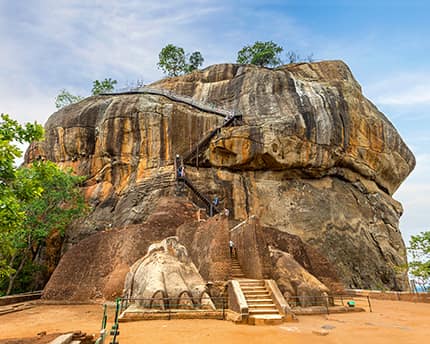
Aluvihare Rock Temple is built in and around a pile of enormous granite boulders that have split and tumbled into narrow passages. Caves under the overhangs were turned into shrines, and stairways were cut to link them. The effect is closer to a labyrinth than to a conventional temple.
The origins of Aluvihare go back to the third century BC, soon after Buddhism reached Sri Lanka. The existing shrines and their paintings are mostly from the Kandyan period and later, with repairs in the twentieth century.
Writing down the Tripitaka
Aluvihare's place in history rests on an event in the first century BC. Sri Lanka was suffering invasion and a long famine, and monks who knew sections of the teaching by heart were dying. Fearing the texts would be lost, a council of some 500 monks is said to have gathered at Aluvihare to write them down.
The work at Aluvihare produced the Pali Canon in written form for the first time. It was inscribed on ola leaves with a metal stylus, the lines blackened with resin and soot. Those leaves have long since perished, but the tradition of copying them carried the texts to Burma, Thailand and beyond.
What to see in the caves
The caves of Aluvihare are small and each has a different character. The main shrine holds a reclining Buddha about ten metres long, with painted ceilings of lotus flowers. Another cave honours Buddhaghosa, the fifth-century Indian scholar who is said to have worked here on his commentaries.
The most talked-about cave at Aluvihare shows the Buddhist hells. Painted panels and plaster figures depict demons punishing liars, thieves and adulterers in graphic detail. It was made as moral instruction for villagers and can alarm small children.
- →The reclining Buddha cave, with Kandyan-style ceiling paintings.
- →The hell cave, with painted and sculpted scenes of punishment.
- →The Buddhaghosa cave and its statue of the scholar.
- →The dagoba on top of the rocks, with a view over the Matale valley.
The library and ola-leaf writing
The library at Aluvihare is a modern building with an old purpose. The original collection of manuscripts was burnt in 1848, when British forces attacked the temple during the Matale rebellion. Monks spent much of the twentieth century re-inscribing the entire Canon by hand.
Ola-leaf writing is demonstrated for visitors in the Aluvihare library. A monk or lay assistant scratches a few words into a strip of prepared leaf, rubs it with ink and wipes it clean so the letters appear. You may be offered your name on a leaf for a donation.
Visiting from Kandy
Visiting Aluvihare from Kandy takes about an hour by road, north on the A9 through Matale. The temple gate is directly beside the highway. Most travellers stop for an hour on the way to Dambulla, Sigiriya or Habarana and do not return to Kandy.
Entry to Aluvihare is by a small ticket for foreign visitors, usually the equivalent of one to three US dollars. Dress with shoulders and knees covered and leave shoes at the foot of the steps. Lankan Stays & Trails treats it as the cultural stop on the Kandy to Sigiriya transfer, in place of a spice garden.
- →From Kandy: about 30 kilometres, roughly one hour.
- →Time at the temple: 45 minutes to an hour.
- →Steps: several short, steep flights between the boulders.
- →Best time: before 10 or after 3, when the rock is cooler underfoot.
What to combine it with
Aluvihare combines well with other stops on the A9. In Matale town the Sri Muthumariamman Temple, a large Hindu kovil with a tall painted gateway, is five minutes away. About 20 kilometres further north, a side road leads to the stone image house of Nalanda Gedige.
A full day north of Kandy could take in Aluvihare, Nalanda Gedige and the Dambulla cave temple, ending near Sigiriya. Travellers returning to Kandy can loop back through the Knuckles foothills. Either way, Aluvihare is the stop with the most history for the least time.
- →Choose Aluvihare if you want history and have under an hour.
- →Add Nalanda Gedige if you like quiet ruins and stone architecture.
- →Add the Matale kovil for colour and a contrast of faiths.
Frequently asked questions
Why is Aluvihare Rock Temple famous?
Aluvihare Rock Temple is famous as the place where, according to tradition, the teachings of the Buddha were first written down. In the first century BC, monks gathered there to record the Pali Canon on ola leaves after centuries of oral transmission.
How far is Aluvihare from Kandy?
Aluvihare is roughly 30 kilometres north of Kandy and about three kilometres beyond the town of Matale. The drive takes about an hour on the A9. Buses from Kandy to Dambulla pass the gate and will stop on request.
How long do you need at Aluvihare?
Allow 45 minutes to an hour at Aluvihare. That is enough to climb through the boulders, see the three main caves and the dagoba, and watch an ola-leaf writing demonstration in the library. The site is compact.
Is Aluvihare worth stopping at between Kandy and Sigiriya?
Aluvihare is worth a stop between Kandy and Sigiriya if you have an interest in Buddhist history. It lies directly on the road, takes under an hour and is far less crowded than Dambulla. Travellers short of time can pass it without a major loss.
What are ola leaf manuscripts?
Ola leaf manuscripts are books made from strips of dried talipot or palmyra palm leaf. Text is scratched in with a metal stylus and darkened with a mixture of resin and soot. Properly stored, they last for several hundred years.
Is the hell cave at Aluvihare suitable for children?
The hell cave at Aluvihare contains graphic painted scenes and statues of torture intended as moral warnings. Older children often find it fascinating. Young or sensitive children may be frightened, and it is easy to skip that cave and see the rest.