
Quick answer
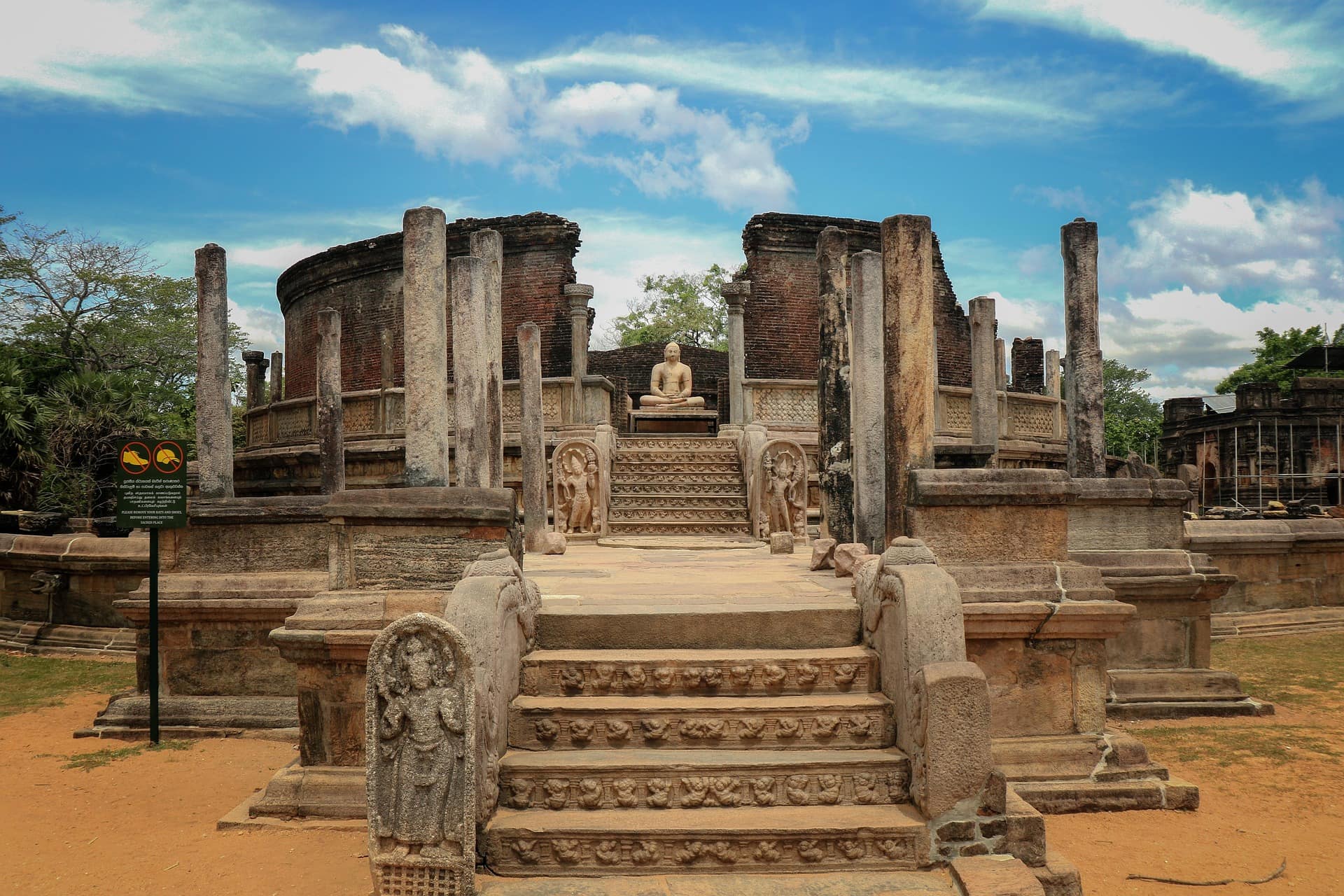
Nalanda Gedige is a small stone image house, built between about the eighth and tenth centuries, standing beside the Bowatenne reservoir roughly 50 kilometres north of Kandy and one kilometre east of the A9. It is designed like a South Indian Hindu temple but was used for Buddhist worship, and its carvings mix both traditions. The shrine was dismantled and rebuilt on higher ground in the 1980s when the reservoir was created. The drive from Kandy takes about an hour and a half; allow 30 to 45 minutes there.
Key takeaways
- Nalanda Gedige dates from roughly the eighth to tenth centuries and is built entirely of stone, without mortar.
- The shrine combines a Hindu temple plan of hall, vestibule and sanctum with Buddhist images and symbols.
- Nalanda Gedige was taken apart and rebuilt beside the Bowatenne reservoir in the 1980s to save it from flooding.
- The site is often described as the geographical centre of Sri Lanka.
- Nalanda Gedige lies about 20 kilometres north of Matale and 25 kilometres south of Dambulla.
What Nalanda Gedige is
Nalanda Gedige is a gedige, a type of image house with thick walls and a vaulted roof. It consists of a pillared entrance hall, a short passage and a square sanctum under a curved stone roof. The whole building is barely 20 metres long.
The date and patron of Nalanda Gedige are uncertain, since no inscription names them. The style points to the Pallava architecture of southern India in the seventh to ninth centuries. Scholars generally place it between the eighth and tenth centuries, when Indian influence at the Sri Lankan court was strong.
A Hindu design used by Buddhists
Nalanda Gedige looks Hindu at first sight. The horseshoe-shaped roof gable, the mandapa hall and the proportions of the doorway all follow South Indian temple practice. A figure of Kubera, the god of wealth, sits on a lotus in a niche on the southern side.
The use of Nalanda Gedige was Buddhist, however. Buddha images were found in the sanctum, and the carvings include bodhisattva-like figures linked with Mahayana and tantric Buddhism. One weathered panel of entwined figures is among the very few erotic carvings in Sri Lanka.
- →The southern gable with its seated Kubera.
- →Dwarf figures and floral bands on the basement mouldings.
- →The plain, heavy stone doorway to the sanctum.
- →A small eroded panel of tantric figures on the plinth.
How the shrine was moved
Nalanda Gedige was a ruin when British surveyors recorded it in the 1890s, and it was pieced together in an early restoration in 1912. Its original site lay in a valley that was to be flooded by the Bowatenne reservoir, part of the Mahaweli irrigation scheme.
The rescue of Nalanda Gedige took place in the 1980s. Each stone was numbered, lifted and reassembled on an embankment above the new waterline. Missing pieces were left as gaps, which is why parts of the roof and walls are incomplete. A causeway lined with trees now leads to it across the edge of the lake.
Visiting: what to expect
Visiting Nalanda Gedige is refreshingly simple. A lane from the A9 ends at a small car park and a ticket hut, from which a shaded path runs for a few hundred metres to the shrine. There is often nobody else there.
The site of Nalanda Gedige includes a brick dagoba beside the shrine and wide views over the reservoir to forested hills. It is managed by the archaeology department, and entry for foreign visitors is usually free or by a small donation. There are no guides on site, so read a little beforehand.
- →Time needed: 30 to 45 minutes.
- →Facilities: basic toilets at the car park; no shop.
- →Dress: modest clothing; shoes off on the shrine platform.
- →Light: late afternoon sun warms the stone and the lake.
Getting there from Kandy
Getting to Nalanda Gedige from Kandy means following the A9 north through Matale for about 50 kilometres. The turning, signposted on the right, is roughly 20 kilometres beyond Matale. The drive takes about an hour and a half.
Nalanda Gedige is a detour of ten minutes for anyone travelling between Kandy and Dambulla or Sigiriya, and that is how most people see it. As a return trip from Kandy it is three hours of driving for a small site. Lankan Stays & Trails adds it to the northbound transfer for travellers who like architecture.
- →From Kandy: about 50 kilometres, one and a half hours.
- →From Dambulla: about 25 kilometres, 35 to 45 minutes.
- →By bus: any Kandy to Dambulla bus; alight at Nalanda junction and walk one kilometre.
Who will appreciate it
Nalanda Gedige appeals to travellers who enjoy the lesser-known corners of the Cultural Triangle. Its interest lies in what it shows about the mixing of Hindu and Buddhist ideas, and in its setting beside the water.
Nalanda Gedige will not impress everyone. There are no paintings, no monks and no grand scale. Travellers who have already had their fill of ruins at Polonnaruwa or Anuradhapura may prefer to drive straight on.
- →Go if you like architecture, quiet places and a short walk.
- →Skip if the day is already long or children are tired of temples.
- →Combine with Aluvihare Rock Temple for two contrasting stops on the same road.
Frequently asked questions
Where is Nalanda Gedige?
Nalanda Gedige is about 50 kilometres north of Kandy, roughly one kilometre east of the A9 between Matale and Dambulla. It stands on the shore of the Bowatenne reservoir and is reached by a short signposted lane and a footpath.
How old is Nalanda Gedige?
Nalanda Gedige is thought to date from between the eighth and tenth centuries. There is no inscription to fix the date. Its architecture resembles the Pallava temples of southern India, which were built from the seventh century onwards.
Is Nalanda Gedige Hindu or Buddhist?
Nalanda Gedige was a Buddhist image house built in the form of a South Indian Hindu temple. Its carvings include the Hindu deity Kubera and figures associated with Mahayana and tantric Buddhism, making it one of the clearest examples of the two traditions meeting in Sri Lanka.
Is there an entrance fee for Nalanda Gedige?
Entry to Nalanda Gedige has generally been free or by a small donation for foreign visitors, unlike the larger Cultural Triangle sites. Arrangements can change, so carry a few small notes. There is no need to book.
Is Nalanda Gedige the centre of Sri Lanka?
Nalanda Gedige is popularly described as the geographical centre of Sri Lanka, and signs at the site repeat the claim. It lies close to the midpoint of the island by most measures. The description is a tradition more than a surveyed fact.
How long does it take to visit Nalanda Gedige from Kandy?
The drive from Kandy to Nalanda Gedige takes about an hour and a half each way, and the visit itself 30 to 45 minutes. As a return trip that is close to four hours, so it is better seen on the way north to Dambulla or Sigiriya.