
Quick answer
At Cultural Triangle sites you must remove your shoes at every shrine, stupa terrace and image house, and by late morning the stone and sand can become painfully hot. Visit open terraces such as Ruwanwelisaya, the Polonnaruwa Vatadage and Thuparamaya before about 10am or after 4pm. Thin white socks are usually accepted on outdoor terraces and make the biggest difference. Leave shoes at the shoe-minding stall for a small fee, and walk on the cooler mats or shaded paths where they exist.
Key takeaways
- Shoes come off at every sacred structure in the Cultural Triangle, including those inside the Anuradhapura and Polonnaruwa archaeological parks.
- Open stone terraces in the Cultural Triangle are usually comfortable before about 10am and after roughly 4pm, and hottest from late morning to mid-afternoon.
- Thin socks are usually allowed on outdoor terraces but may need to come off inside image houses and shrine rooms.
- Ruwanwelisaya's white platform, the Polonnaruwa Vatadage and Dambulla's rock steps are among the hottest surfaces at midday.
- Shoe-minding stalls at larger temples such as the Sri Maha Bodhi charge a small fee and are generally safe.
Why shoes come off in the Cultural Triangle
Removing shoes in the Cultural Triangle is a sign of respect at any place associated with the Buddha, including stupas, Bo trees and image houses. The rule applies at working temples such as Dambulla and the Sri Maha Bodhi and also at the ruined shrines inside Anuradhapura and Polonnaruwa, because many of them remain places of worship.
Where the sacred area starts is usually obvious: a step, a gateway, a moonstone or a line of shoes left by pilgrims. If in doubt, watch Sri Lankan visitors and follow them. Hats come off at the same point.
You will remove shoes many times in a day. On a typical Polonnaruwa visit, the Vatadage, Lankatilaka, Kiri Vehera and Gal Vihara each ask for it.
- →Stupa terraces: shoes off from the base of the platform.
- →Image houses: shoes and sometimes socks off.
- →Bo tree shrines: shoes off within the enclosure.
- →Palaces and council chambers: shoes usually stay on.
The hottest surfaces in the Cultural Triangle
Some Cultural Triangle surfaces become far hotter than others. Polished granite and pale sand platforms reflect and store heat, and by noon in March or April they can be impossible to stand on for more than a few seconds. Shaded image houses stay cooler.
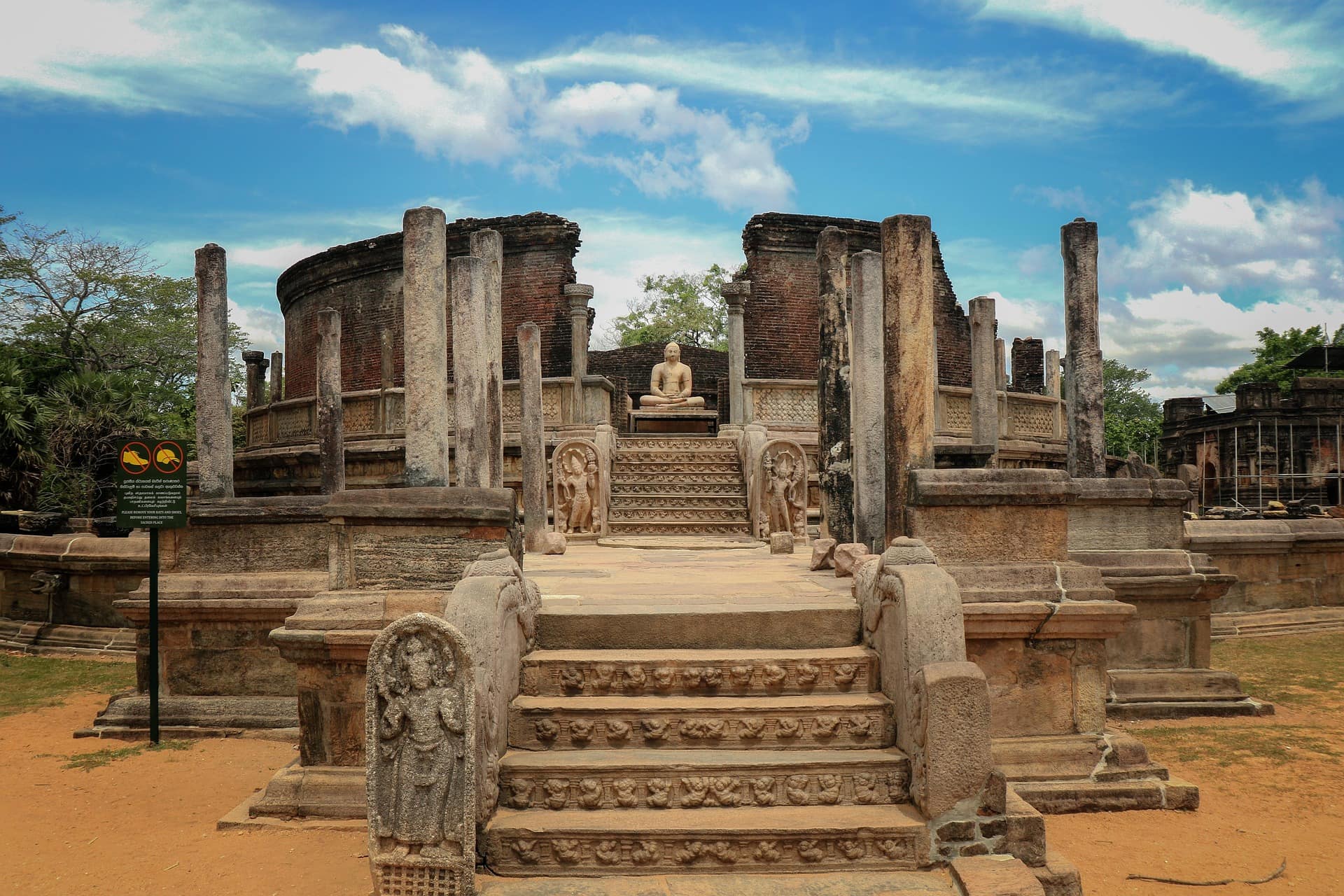
In Anuradhapura, the wide white sand terrace of Ruwanwelisaya and the stone platforms of Thuparamaya and Jetavanaramaya are the worst. In Polonnaruwa, the raised Vatadage platform and the Gal Vihara forecourt heat up quickly. At Dambulla, the rock steps down from the caves are hot in the afternoon sun.
- →Ruwanwelisaya terrace, Anuradhapura: very hot by late morning.
- →Polonnaruwa Vatadage: exposed stone platform, little shade.
- →Gal Vihara forecourt: sand and stone in full sun.
- →Dambulla's cave steps: hot rock in the afternoon.
Timing visits to protect your feet
The simplest fix for hot stone in the Cultural Triangle is to visit open terraces early or late. Before about 10am and after about 4pm, the surfaces are comfortable for bare feet on most days. That matches the advice for heat, light and crowds anyway.
On a full day at Anuradhapura, start with the big stupas at around 7am, move to shaded or indoor places such as the museum or Isurumuniya at midday, and return to the Sri Maha Bodhi for the evening puja when the stone has cooled. At Polonnaruwa, do the Sacred Quadrangle first and Gal Vihara before late morning.
Afternoon visits in the cooler months of December and January are more forgiving. In March, April and May, assume the stone is hot from mid-morning.
Socks, mats and other remedies
Thin white socks are the best remedy for hot stone at Cultural Triangle sites. They are generally accepted on outdoor terraces, are light to carry and dry fast. Some image houses and inner shrine rooms ask visitors to remove socks too, so follow signs and local example.
Larger temples lay coir mats or painted cool strips across the hottest stretches, and walking along them is normal. Moving between shade patches is another trick: pilgrims do it too. Lankan Stays & Trails guides carry spare socks for guests who forget theirs.
- →Thin white cotton socks: accepted on most terraces.
- →A spare pair in your day bag, in case the first gets dusty.
- →Walk on mats, painted strips and shaded edges where provided.
- →Wet wipes for the car afterwards.
Where to leave your shoes
Shoe-minding stalls at the busiest Cultural Triangle temples, such as the Sri Maha Bodhi and Dambulla, look after shoes for a small fee. They are generally reliable. At quieter sites, visitors leave shoes at the edge of the sacred area, and losses are rare.
Slip-on footwear makes everything easier. Lace-up boots that take minutes to remove become tiring by the tenth shrine. Carry a small bag for shoes if you prefer to keep them with you, though shoes should never be carried into the shrine itself.
- →Slip-on sandals: quickest on and off.
- →Keep valuables out of shoes left at stalls.
- →Never carry shoes into the sacred area, even in a bag.
Frequently asked questions
Do you have to take your shoes off at Anuradhapura?
Yes, at every stupa, image house and Bo tree shrine, including the Sri Maha Bodhi, Ruwanwelisaya, Thuparamaya and Jetavanaramaya. You can keep shoes on while walking between them. Slip-on sandals save time because you remove them many times.
Can you wear socks at Sri Lankan temples?
Usually yes on outdoor terraces, where thin socks protect you from hot stone. Some image houses and shrine rooms ask you to remove socks as well. Follow signs and what local pilgrims do, and keep a clean pair in your bag.
How hot does the stone get at Cultural Triangle temples?
Hot enough to hurt by late morning in March, April and May, especially on pale sand and polished granite in full sun. Before about 10am and after about 4pm, most terraces are comfortable. Shaded image houses stay noticeably cooler all day.
Is it safe to leave shoes outside temples?
Generally yes. At larger temples, shoe-minding stalls look after them for a small fee. At quieter sites, shoes left at the edge of the sacred area are rarely taken. Avoid leaving anything valuable inside them.
Do I need to take shoes off at Polonnaruwa?
Yes, at the Vatadage, the image houses, Kiri Vehera, Rankoth Vehera and Gal Vihara. You can wear shoes at the royal palace, council chamber and between sites. If you cycle, slip-on shoes that stay on securely are ideal.
What happens if I forget socks?
You can still visit, but plan to see open terraces before about 10am or after 4pm. Shops in Dambulla, Habarana and Anuradhapura sell cheap socks, and walking on mats and shaded edges helps in the meantime.