
Quick answer
At Cultural Triangle sites you may photograph most ruins and temples, but never pose with your back to a Buddha image, never touch or climb a statue for a photo, and switch off flash inside Dambulla's caves and image houses. Photography of the Sigiriya frescoes is banned. Drones need official permission and are not allowed over Anuradhapura, Polonnaruwa, Sigiriya or Dambulla. Ask before photographing monks or pilgrims at prayer, and never photograph people who are worshipping close up without consent.
Key takeaways
- Posing with your back to a Buddha image is considered disrespectful in Sri Lanka and has led to warnings and removal from sites.
- Photography of the Sigiriya frescoes is prohibited, and guards on the spiral staircase enforce the ban.
- Flash photography is banned or discouraged inside the Dambulla cave temple and in image houses, because it damages old paintings.
- Drones require permits from the Civil Aviation Authority and site authorities, and are effectively banned at the main Cultural Triangle sites.
- Monks are generally happy to be photographed if asked first, but avoid photographing people mid-prayer without consent.
The pose that causes most offence
The most important photography rule in the Cultural Triangle is never to turn your back on a Buddha image to pose for a photo. Selfies with a statue over your shoulder, or posed pictures in front of the Gal Vihara or Avukana, are seen as deeply disrespectful in Sri Lanka, and guards will intervene.
The safe approach is to photograph the Buddha image on its own, or to stand beside it facing the same direction rather than with your back to it. Never touch, sit on or climb a statue, stupa or ruin for a picture, and avoid playful poses such as pretending to hold up a stupa.
The same respect applies to clothing and tattoos featuring the Buddha. Covering them avoids awkward moments at the gate.
- →Do not stand with your back to a Buddha for a photo.
- →Do not touch, climb or sit on statues and ruins.
- →Do not pose playfully with sacred objects.
- →Photograph the image itself, with respect, from the front.
Site-by-site rules
Photography rules vary a little between Cultural Triangle sites. Sigiriya allows photos almost everywhere except the frescoes, where guards ask visitors to put cameras away. Dambulla allows photos in the caves without flash, though some visitors find the atmosphere better without a camera at all.
Anuradhapura and Polonnaruwa allow photography throughout the archaeological parks. Inside working shrine rooms, especially at the Sri Maha Bodhi and during puja, put the camera down and watch. Museums in both cities often ban photography inside, so check signs.
- →Sigiriya: photos fine, except the frescoes.
- →Dambulla caves: no flash; be discreet during worship.
- →Anuradhapura and Polonnaruwa: photos fine outdoors; check museums.
- →Sri Maha Bodhi: avoid photographing worship at close range.
Drones in the Cultural Triangle
Flying a drone in the Cultural Triangle needs approval from Sri Lanka's Civil Aviation Authority and, for heritage sites, the site authorities. In practice, recreational drones are not permitted over Sigiriya, Dambulla, Anuradhapura or Polonnaruwa, and staff will stop anyone who tries.
Drones may be confiscated at the airport if not declared, and fines are possible. If aerial footage matters to you, look into licensed local operators who already hold permits, or settle for the classic elevated views from Pidurangala and Sigiriya's summit.
Many hotels near Sigiriya also ban drones over their grounds because of nearby wildlife and guests.
Photographing monks and pilgrims
Monks and pilgrims in the Cultural Triangle are often photogenic subjects, especially in white at the Sri Maha Bodhi or at Ruwanwelisaya on poya days. Most monks are relaxed about being photographed if asked first with a gesture. Pilgrims mid-prayer are another matter: give them space.
Never offer money for a photograph of a monk, and do not ask monks to pose with you in a way that involves touch, especially women. Children at temples are often happy to be photographed, but ask a parent. Lankan Stays & Trails guides can help explain etiquette and ask on your behalf.
- →Ask before photographing monks, with a gesture if needed.
- →Do not photograph worshippers at close range during prayer.
- →Avoid physical contact with monks in photos.
- →Ask parents before photographing children.
When the light is best
Light in the Cultural Triangle is softest in the first two hours after sunrise and the last two before sunset. Those are also the coolest and quietest hours at Sigiriya, Polonnaruwa and Anuradhapura, so good photos and comfortable visits go together.
Midday light is harsh and flat, and white stupas such as Ruwanwelisaya can blow out. Use midday for museums and shaded interiors, then return outdoors after about 4pm. Dambulla's caves are dim at any hour, so a steady hand matters more than timing.
- →Sunrise: Pidurangala for Sigiriya, the stupas of Anuradhapura.
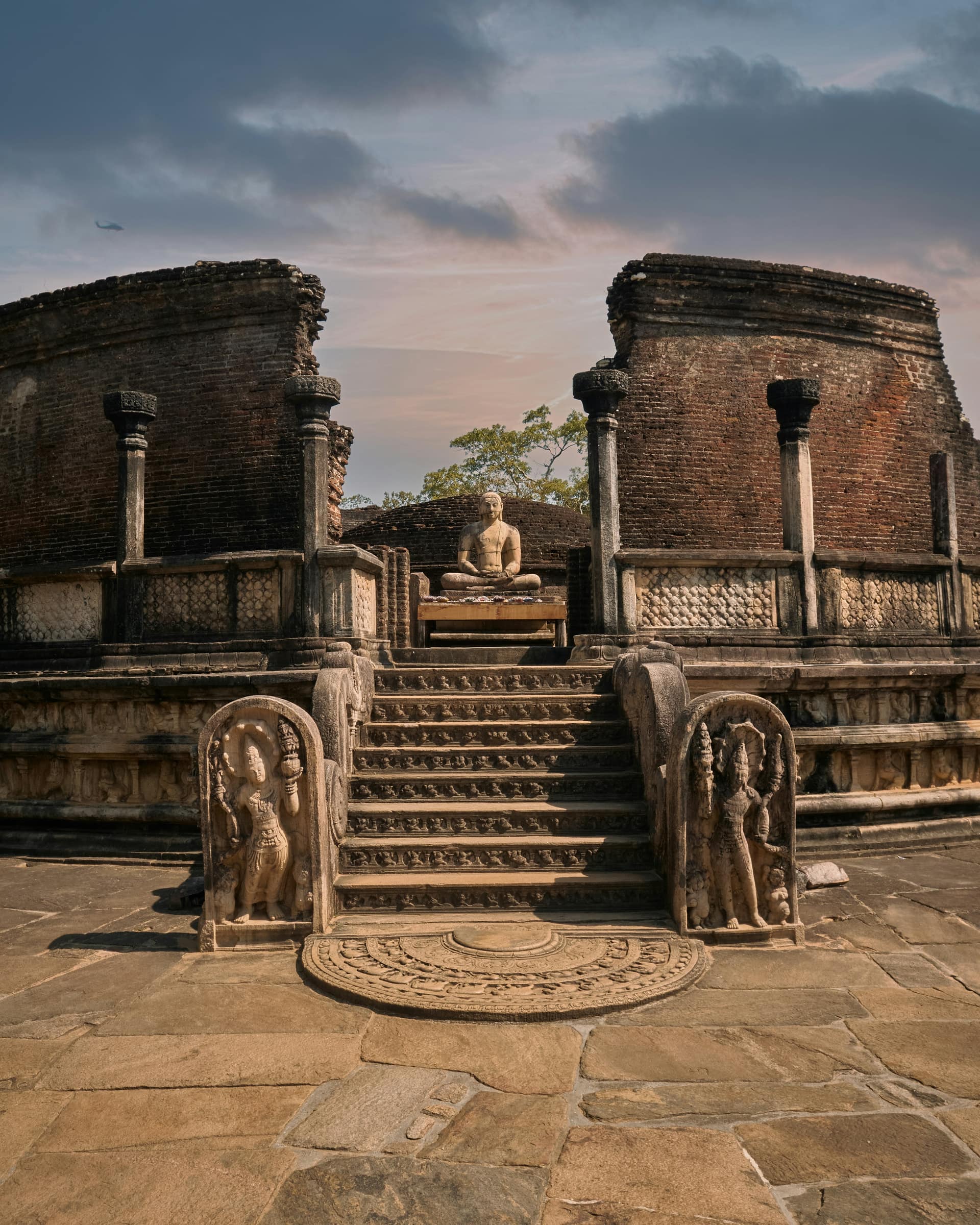
- →Late afternoon: Gal Vihara and the Polonnaruwa Vatadage.
- →Sunset: Mihintale's summit and Tissa Wewa in Anuradhapura.
Frequently asked questions
Can you take photos inside Sri Lankan temples?
Usually yes, without flash, but check for signs and avoid photographing people during worship. Some shrine rooms and museums ban photography. At the Dambulla caves photos are allowed without flash. When in doubt, ask a monk or attendant.
Why can't you turn your back on a Buddha in Sri Lanka?
Turning your back on a Buddha image for a photo is seen as disrespectful to the Buddha and to Buddhists. Sri Lanka takes this seriously, and guards at Cultural Triangle sites will stop visitors who pose that way.
Can I fly a drone at Sigiriya?
No, not without permits from the Civil Aviation Authority and the site authorities, which are rarely granted for recreational use. Drones are effectively banned at Sigiriya, Dambulla, Anuradhapura and Polonnaruwa, and staff will intervene.
Can you photograph the Sigiriya frescoes?
No. Photography of the frescoes is banned to protect the paintings, and guards enforce it on the spiral staircase. You can photograph the rest of Sigiriya freely, including the Lion's Paw terrace and summit.
Is flash allowed in the Dambulla caves?
No. Flash damages old paintings, and the Dambulla caves contain murals painted over several centuries. Photograph without flash, using a steady hand or a wall to brace against, or simply enjoy the caves without a camera.
Can I take photos of monks?
Usually, if you ask first. Most monks are relaxed about it. Avoid touch, never offer money for a photo, and do not photograph monks or pilgrims at prayer at close range. A gesture towards the camera is enough to ask.