
Quick answer
The best ancient capitals to visit in Sri Lanka are Anuradhapura, for its great stupas and the sacred Bo tree; Polonnaruwa, for its compact medieval ruins; Sigiriya, the fifth-century rock palace; Kandy, the last royal capital; and, for keen history travellers, Tissamaharama, Yapahuwa, Dambadeniya, Kurunegala, Gampola and Kotte. The first three and Kandy need a day each; the others are short stops.
Key takeaways
- Anuradhapura was the capital for over a thousand years.
- Polonnaruwa followed from roughly the eleventh to the thirteenth century.
- Sigiriya was a royal capital for only a short reign in the fifth century.
- After Polonnaruwa, the capital moved south-west through several short-lived seats.
- Kandy remained the capital until the British took control in 1815.
Why there were so many capitals
Sri Lanka's first great capital, Anuradhapura, lasted from roughly the fourth century BC to the eleventh century AD. Invasions from South India eventually forced the kings to Polonnaruwa, which flourished under Parakramabahu I in the twelfth century and fell in the thirteenth.
After that, the centre of power drifted south-west, away from the vulnerable northern plains, through Dambadeniya, Yapahuwa, Kurunegala, Gampola and Kotte. In the sixteenth century, as the Portuguese took the coast, the kingdom split, and Kandy became the last independent capital until 1815.
Meanwhile, in the south, the kingdom of Ruhuna had its own capital at Magama, near today's Tissamaharama, which played a key role in early history.
- →Anuradhapura: roughly 4th century BC to 11th century AD.
- →Polonnaruwa: roughly 11th to 13th centuries.
- →Kandy: 16th century to 1815.
The great capitals: Anuradhapura and Polonnaruwa
Anuradhapura is the most important. Its sacred city includes the Jaya Sri Maha Bodhi, the oldest documented tree in the world, and the giant stupas of Ruwanwelisaya, Jetavanaramaya and Abhayagiri. It is still a living pilgrimage site, and white-clad pilgrims give it a special atmosphere.
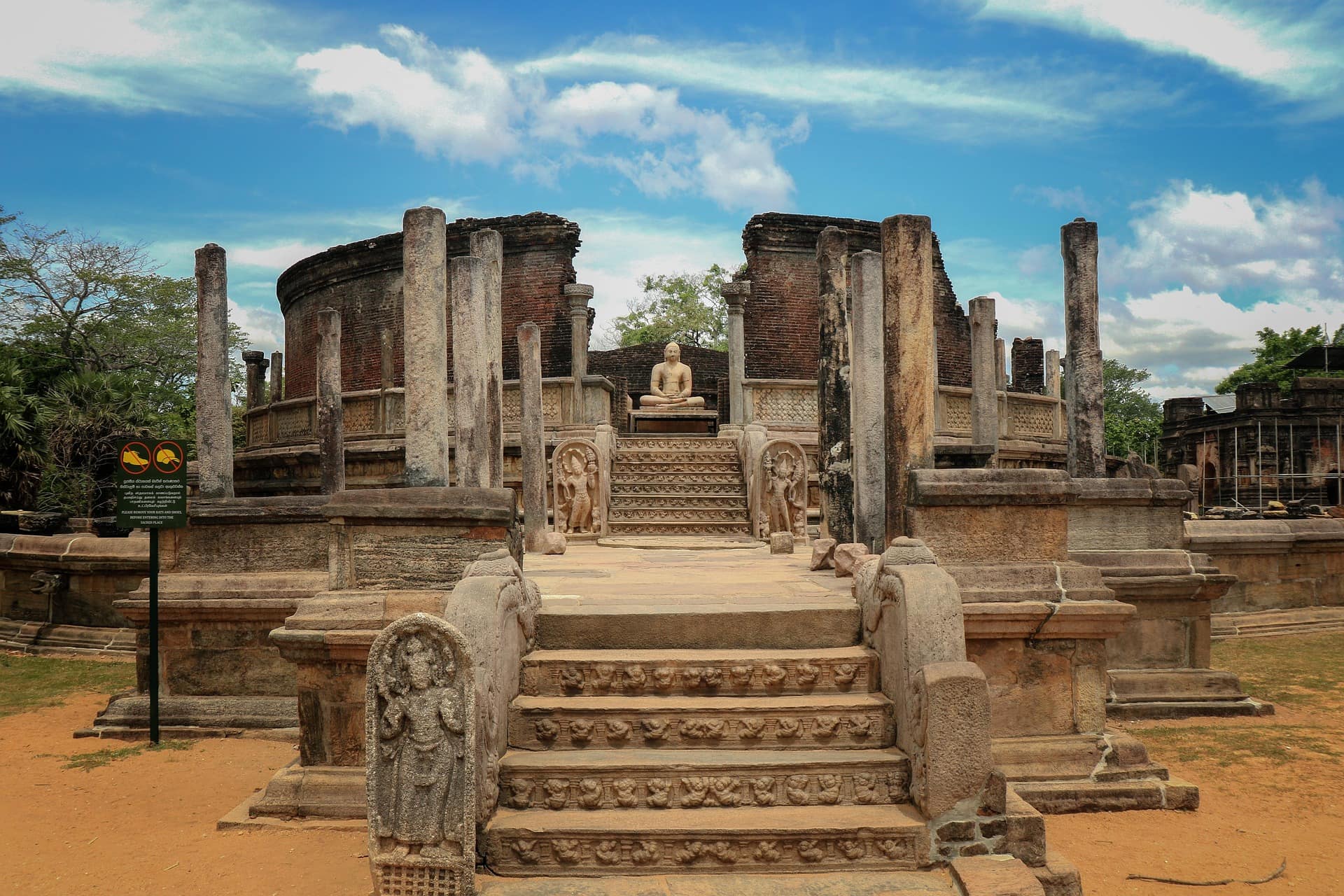
Polonnaruwa is smaller and easier to explore. The royal palace, the Quadrangle with its circular Vatadage and the four giant Buddhas of the Gal Vihara are among the island's finest sights. The huge Parakrama Samudra reservoir shows the scale of medieval engineering.
Each deserves a full day. If you have time for only one, Polonnaruwa is more compact, while Anuradhapura is older and more spiritual.
- →Anuradhapura: stupas and the sacred Bo tree.
- →Polonnaruwa: palace, Quadrangle and Gal Vihara.
- →Each needs a full day, ideally by bicycle.
Sigiriya and Kandy
Sigiriya was the capital of King Kashyapa in the fifth century, built on and around a giant rock. The frescoes, the mirror wall, the lion's paws and the palace ruins on the summit make it Sri Lanka's most famous site. After Kashyapa's death, it became a monastery again.
Kandy, the last royal capital, held out against the Portuguese and Dutch before falling to the British in 1815. The Temple of the Sacred Tooth Relic, the royal palace buildings and the lake built by the last king, Sri Vikrama Rajasinha, remain at the heart of the city.
Lankan Stays & Trails usually builds its cultural routes around these four capitals, adding one of the smaller seats where it fits the journey.
- →Sigiriya: rock palace and frescoes.
- →Kandy: the Temple of the Tooth and the royal lake.
- →Both: one full day each.
The smaller capitals worth a stop
Yapahuwa, near Maho, is the most impressive of the later capitals: a rock fortress with an ornate lion-guarded staircase where the Tooth Relic was kept in the thirteenth century. Dambadeniya, near Kurunegala, has a rock and temple remains. Kurunegala itself was briefly a capital and has Ethagala rock above the town.
Gampola, south of Kandy, was the capital in the fourteenth century. Its main legacy is a group of fine temples nearby, Lankatilaka, Gadaladeniya and Embekka, often visited from Kandy. Kotte, now Sri Jayawardenepura Kotte, was the capital in the fifteenth and sixteenth centuries, and a few remains survive among its suburbs and wetlands.
Sitawaka, near Avissawella, was the seat of a sixteenth-century kingdom that fought the Portuguese, and has the unfinished Berendi Kovil ruins. Tissamaharama, in the south, has large stupas and ancient reservoirs from the Ruhuna kingdom.
- →Yapahuwa: the lion staircase.
- →Gampola's temples: Lankatilaka, Gadaladeniya, Embekka.
- →Tissamaharama: Ruhuna's stupas and lakes.
Which capitals to choose
For most travellers, Sigiriya, Kandy and one of Anuradhapura or Polonnaruwa are enough. History enthusiasts can add the other great capital, then Yapahuwa on the drive between Colombo and the Cultural Triangle, and Gampola's temples from Kandy.
Tissamaharama is easiest when visiting Yala, and Kotte when spending time in Colombo. Sitawaka suits travellers driving between Colombo and Ratnapura or Kitulgala.
The northern capitals are hot, so visit early and late in the day. Dress codes apply at all sacred sites, with shoulders and knees covered and shoes removed.
- →Essential: Sigiriya, Kandy, and Anuradhapura or Polonnaruwa.
- →For enthusiasts: Yapahuwa, Gampola's temples, Tissamaharama.
- →Near Colombo: Kotte and Sitawaka.
Frequently asked questions
How many ancient capitals does Sri Lanka have?
Sri Lanka had more than a dozen capitals over two thousand years, including Anuradhapura, Polonnaruwa, Sigiriya, Dambadeniya, Yapahuwa, Kurunegala, Gampola, Kotte, Sitawaka and Kandy, as well as Magama in the southern kingdom of Ruhuna. Some lasted centuries, others only a few decades.
Which is the oldest capital of Sri Lanka?
Anuradhapura is the oldest major capital of Sri Lanka, serving as the seat of kings from roughly the fourth century BC to the eleventh century AD. Earlier settlements existed, but Anuradhapura is the first great capital whose ruins can be visited today.
Is Sigiriya an ancient capital?
Sigiriya was a royal capital for a short time in the fifth century, under King Kashyapa, who built his palace on the rock. After his death, the capital returned to Anuradhapura, and Sigiriya became a Buddhist monastery again.
Which ancient capital should I visit if I only have one day?
If you only have one day, Polonnaruwa is usually the best choice. It is compact, well preserved and close to Sigiriya and Minneriya. Anuradhapura is more spread out and needs a full day at least, but is older and more spiritual.
What was the last royal capital of Sri Lanka?
The last royal capital of Sri Lanka was Kandy, which remained independent until the British took control in 1815. The Temple of the Sacred Tooth Relic, the royal palace buildings and the lake built by the last king still stand at the heart of the city.
Is Kotte worth visiting?
Kotte is worth a short visit for history enthusiasts staying in Colombo. Few royal remains survive, but its wetland parks, temples and the sense of a former capital among modern suburbs make an interesting half-day. It is now Sri Lanka's administrative capital.