
Quick answer
Older travellers can enjoy the Cultural Triangle comfortably by choosing low-step sites, travelling by car or tuk-tuk between ruins and sightseeing only in the cooler early mornings and late afternoons. Polonnaruwa and Anuradhapura are largely flat, with vehicles allowed close to most monuments. Sigiriya's climb, roughly 1,200 steps, is demanding, but its water gardens and museum are at ground level. Dambulla has a steady climb of several hundred metres. Choose December to February for the mildest heat, and stay three or four nights at one base.
Key takeaways
- Polonnaruwa and Anuradhapura are largely flat, and cars or tuk-tuks can reach close to most monuments.
- Sigiriya's climb involves roughly 1,200 steps, but the water gardens, boulder gardens and museum are at ground level.
- Dambulla's cave temple involves a steady uphill walk on rock and steps, usually taking 15 to 25 minutes.
- December to February brings the most comfortable temperatures in the Cultural Triangle, with highs around 28 to 32°C.
- Wheelchair access at Cultural Triangle sites is limited, with uneven paths, steps and sand.
A gentle approach
A gentle approach makes the Cultural Triangle very rewarding for older travellers. Stay three or four nights at one base, so there is no daily packing. Plan one main site each morning and one shorter visit in the late afternoon, with a long rest in between.
Use a car and driver throughout, and tuk-tuks inside the ancient cities where cars cannot go. A licensed guide helps choose the shortest routes and the best viewpoints, avoiding unnecessary walking in the sun.
Travel insurance covering pre-existing conditions and a list of medications are essential.
- →One base for three or four nights.
- →One main site each morning.
- →Car and driver, plus tuk-tuks inside sites.
- →A licensed guide to plan short routes.
The easiest sites
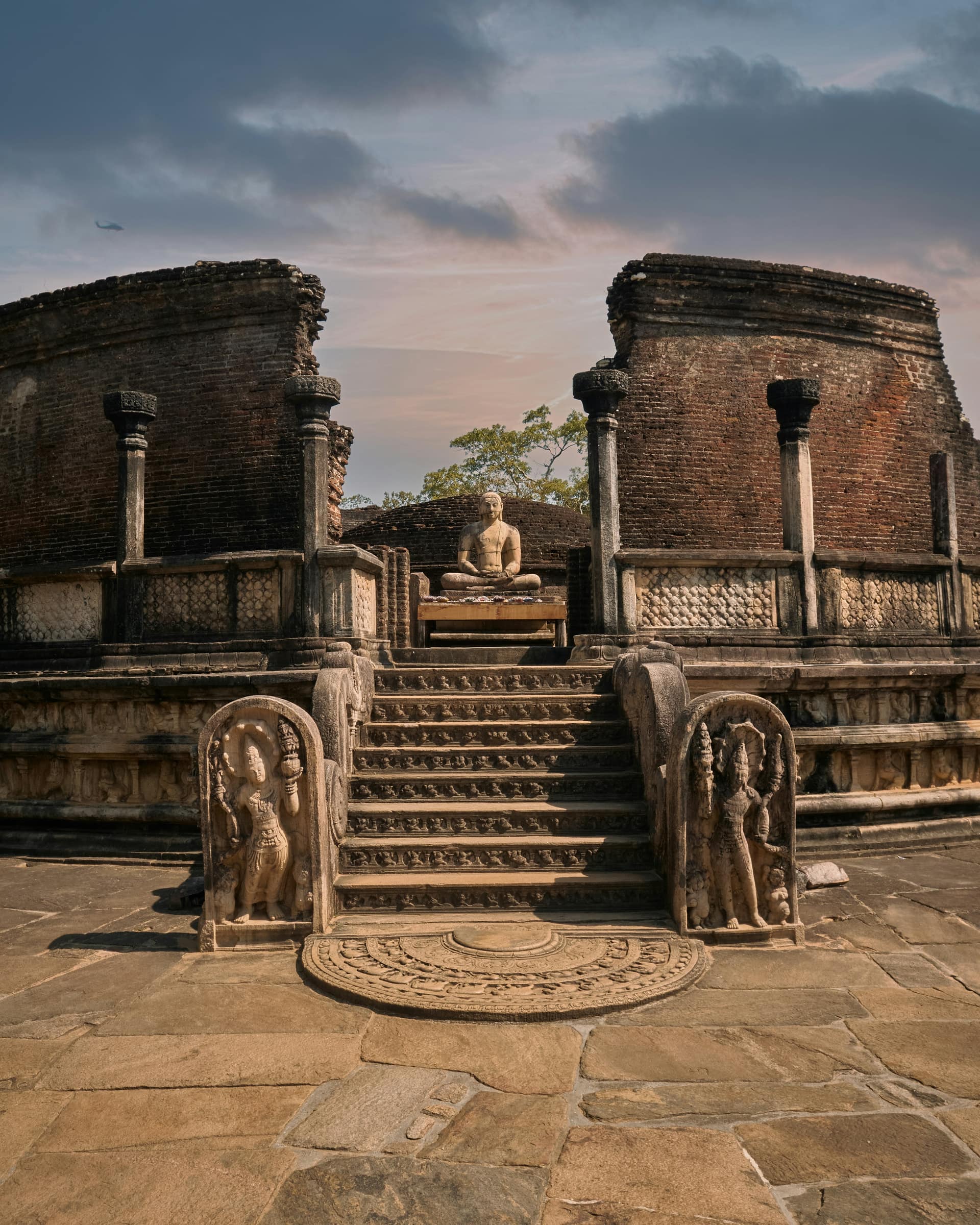
The easiest Cultural Triangle sites for older travellers are the ancient cities. Polonnaruwa is flat and compact, and vehicles can drive close to the royal palace, the Sacred Quadrangle, Rankoth Vehera and Gal Vihara, so walking is minimal. Anuradhapura is spread out but flat, with parking near the great stupas and the Sri Maha Bodhi.
Shoes come off at shrines, and stone terraces can be hot or uneven, so thin socks and a steady arm help. Benches and shade exist at the larger sites but not everywhere.
The museums at Anuradhapura and Polonnaruwa are flat, shaded and a good use of midday.
- →Polonnaruwa: flat, vehicles close to monuments.
- →Anuradhapura: flat, parking near main stupas.
- →Museums: shaded and step-free inside.
Sites with more steps
Some Cultural Triangle sites involve more effort. Sigiriya's climb, roughly 1,200 steps with an exposed spiral staircase and narrow sections, is demanding. Its water gardens, boulder gardens and museum at ground level are still rewarding, and the rock is spectacular from below.
Dambulla's cave temple requires a steady uphill walk on rock and steps, usually 15 to 25 minutes. Mihintale has long flights of steps. Pidurangala's final scramble is rough and not advisable for those unsteady on their feet.
- →Sigiriya: roughly 1,200 steps; ground-level gardens are easy.
- →Dambulla: a steady 15 to 25-minute climb.
- →Mihintale: long flights of steps.
- →Pidurangala: rough final scramble.
Heat and comfort
Heat affects older travellers more in the Cultural Triangle. Choose December to February for the mildest temperatures, and sightsee from about 7am to 10.30am and after 4pm. Drink steadily, use rehydration salts and wear sun protection.
Lankan Stays & Trails often books ground-floor rooms near the pool and plans gentle afternoon activities, such as a village visit by bullock cart or a sunset at a tank, that involve little walking.
Hotels with lifts, level paths and shaded gardens make a real difference. Ask before booking.
- →December to February for mild weather.
- →Early and late sightseeing.
- →Ground-floor rooms near the pool.
Wheelchair access
Wheelchair access in the Cultural Triangle is limited. Paths are uneven, with sand, grass, steps and stone thresholds. Polonnaruwa is the most manageable, with a companion to help, as vehicles reach close to most monuments. Anuradhapura's main stupas have hard paths in places.
Sigiriya's gardens are partly accessible, but the rock is not. Dambulla's caves are not wheelchair accessible. A specialist operator or experienced driver-guide can plan routes around these limits.
- →Polonnaruwa: most manageable with help.
- →Anuradhapura: hard paths in places.
- →Sigiriya rock and Dambulla caves: not accessible.
A sample gentle plan
A sample gentle plan for older travellers spends four nights at a Sigiriya or Habarana base. Day two is Sigiriya's water gardens and museum at 7.30am, with a pool afternoon and a sunset at a tank. Day three is Polonnaruwa by car, museum first, then an afternoon elephant safari, which involves no walking at all.
Day four is Anuradhapura by car, with the Sri Maha Bodhi, Ruwanwelisaya and the Samadhi Buddha, back by mid-afternoon. Day five continues to Kandy.
Frequently asked questions
Is the Cultural Triangle suitable for older travellers?
Yes. Polonnaruwa and Anuradhapura are largely flat, with vehicles reaching close to most monuments, and museums offer shaded midday visits. Sigiriya's climb and Dambulla's steps are harder, but alternatives exist. Plan early starts, midday rests and a single base for comfort.
Can older people climb Sigiriya?
Many fit older travellers do, with an early start and plenty of rests, but it involves roughly 1,200 steps, an exposed spiral staircase and narrow sections. Those with heart, knee or balance concerns should consult a doctor and consider the ground-level gardens instead.
Is Polonnaruwa easy to walk?
Yes, by Cultural Triangle standards. It is flat and compact, and cars or tuk-tuks can reach close to the main monuments. Walking at each site is short, though shoes come off at shrines and terraces can be uneven or hot.
Is the Dambulla cave temple hard to reach?
It involves a steady uphill walk on rock and steps, usually 15 to 25 minutes, with shade in places. Take it slowly, carry water and visit in the late afternoon when the steps are in shade. Some travellers rest halfway.
What is the best time of year for older travellers in the Cultural Triangle?
December to February, when temperatures are mildest, with highs around 28 to 32°C and cooler mornings. March to May is the hottest period and best avoided by travellers sensitive to heat. October to December brings rain.
Is there wheelchair access at the Cultural Triangle sites?
It is limited. Paths are uneven, with sand, steps and stone. Polonnaruwa is the most manageable with a companion, while Sigiriya's rock and Dambulla's caves are not accessible. An experienced driver-guide can plan around the limits.