
Quick answer
The Cultural Triangle works well with kids if you keep to one base, limit sightseeing to early mornings and late afternoons, and mix ruins with animals and activity. Polonnaruwa by bicycle, an afternoon elephant safari, Pidurangala or Sigiriya for older children and a village lunch are family highlights. Anuradhapura suits older children with an interest in history. Three or four nights at a Sigiriya or Habarana hotel with a pool, a midday rest and plenty of water keep everyone happy.
Key takeaways
- A single base with a pool, at Sigiriya or Habarana, is the most important choice for a family visit to the Cultural Triangle.
- Polonnaruwa is the most child-friendly ancient city, compact and easy to explore by bicycle in three to four hours.
- An afternoon elephant safari at Minneriya, Kaudulla or Hurulu is usually the highlight for children.
- Sigiriya's climb, with roughly 1,200 steps, suits most children from about six or seven, with an early start.
- Midday rests from roughly 11am to 3.30pm protect children from the dry-zone heat.
One base, short days
The most important decision for a family visit to the Cultural Triangle is a single base. A hotel at Sigiriya or Habarana with a pool and space to run around means no repacking, and every site within an hour or so.
Keep days short. One main site in the morning, a midday swim and rest, and a gentle activity in the late afternoon is the rhythm that works. Long days of temple after temple lose children quickly.
Three nights covers the essentials. Four gives slack for tired days.
- →One base with a pool.
- →One main site each morning.
- →Midday swim and rest.
- →Late-afternoon activity.
Which sites suit children
Some Cultural Triangle sites suit children better than others. Polonnaruwa is compact and fun by bicycle, with monkeys and a royal palace to explore. Sigiriya's climb, roughly 1,200 steps, suits most children from about six or seven with an early start; Pidurangala is shorter but rougher at the top.
Dambulla's caves are short and atmospheric, though the climb up is in the sun and monkeys are bold. Anuradhapura is spread out and suits older children or teenagers with an interest in history, best by bicycle or tuk-tuk.
- →Polonnaruwa: compact, bicycles, monkeys.
- →Sigiriya: from about six or seven, early start.
- →Dambulla: short, but watch the monkeys.
- →Anuradhapura: better for older children.
Activities beyond the ruins
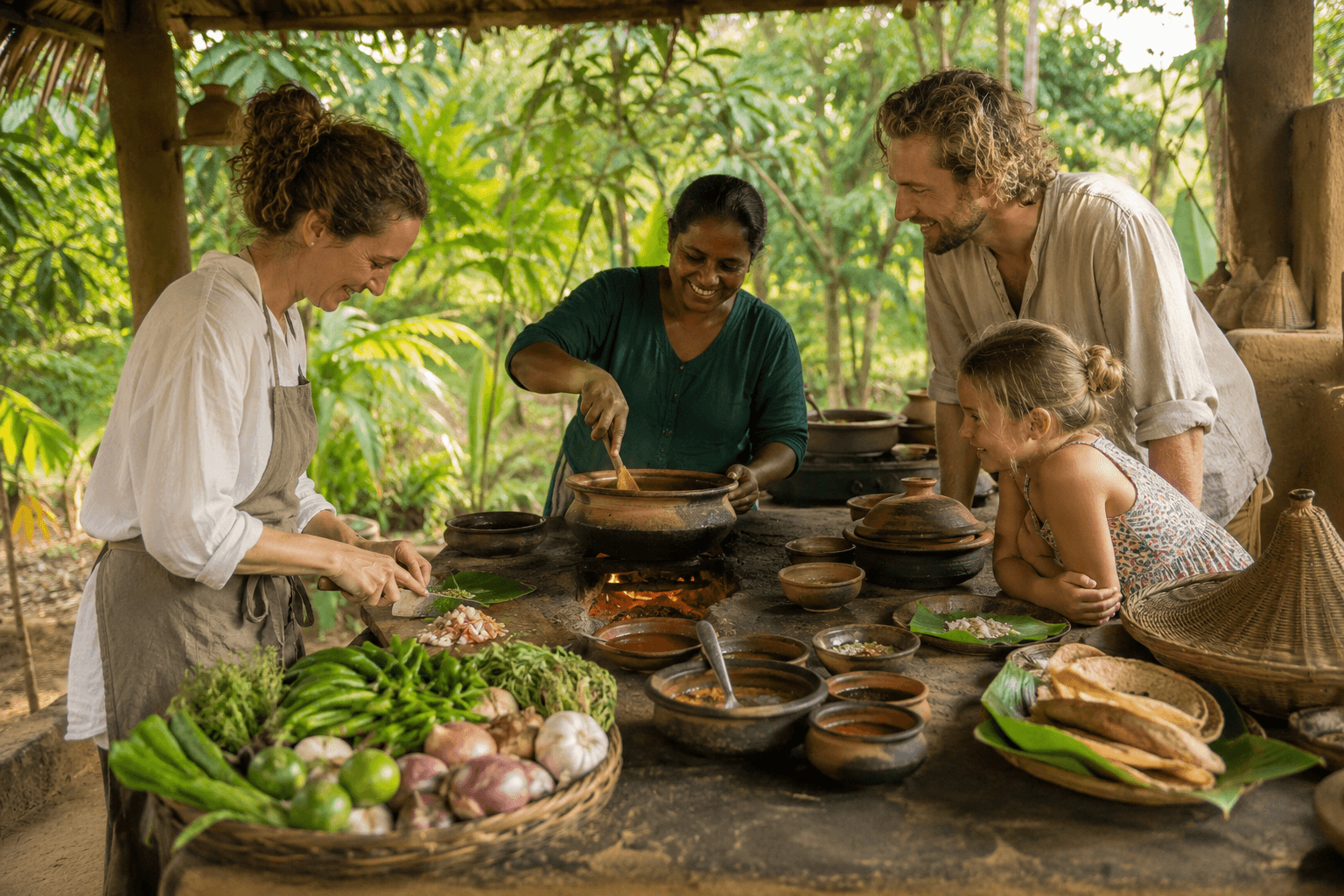
Activities beyond the ruins make a family visit to the Cultural Triangle. An afternoon elephant safari at Minneriya, Kaudulla or Hurulu is usually the highlight. A village visit, with a bullock cart ride, a catamaran crossing on a tank and a lunch on lotus leaves, keeps children engaged.
Bicycle rides through paddy fields, birdwatching at the tanks and a cookery class are other good options. Lankan Stays & Trails often builds family days around one site and one activity, so there is always something to look forward to.
Children also enjoy the small details of Cultural Triangle sites: spotting monitor lizards at Polonnaruwa, counting elephants on the Vatadage friezes or finding the crocodile spouts at Kumara Pokuna. Giving them a simple list of things to find turns a ruin into a treasure hunt.
- →Elephant safari.
- →Village visit and lunch.
- →Bicycle rides and birdwatching.
- →Cookery class.
Heat, health and safety
Heat is the biggest challenge for children in the Cultural Triangle. Keep outdoor sightseeing to early mornings and late afternoons, carry plenty of water and rehydration salts, and use hats and sun cream. Watch for tiredness and headaches.
Keep food out of sight of monkeys, wash hands often, and use insect repellent at dawn and dusk. Child car seats are not standard in Sri Lanka, so arrange one in advance if needed.
Explain temple rules to children before each site, such as shoes off and no posing with backs to a Buddha. Most children enjoy the rituals.
- →Water, hats and sun cream.
- →Monkeys: no visible food.
- →Repellent at dawn and dusk.
- →Car seats arranged in advance.
A sample family plan
A sample family plan for the Cultural Triangle spends four nights at a Sigiriya or Habarana base. Day one is the arrival drive and a swim. Day two is Sigiriya early, a midday rest and a village visit in the afternoon. Day three is Polonnaruwa by bicycle, a rest and an elephant safari. Day four is Dambulla's caves in the late afternoon after a lazy morning.
Older children and teenagers might add Anuradhapura on a fourth day, with bicycles and a sunset at Isurumuniya.
- →Day 1: arrival, swim.
- →Day 2: Sigiriya, rest, village visit.
- →Day 3: Polonnaruwa, rest, safari.
- →Day 4: lazy morning, Dambulla's caves.
Frequently asked questions
Is the Cultural Triangle good for kids?
Yes, with the right pacing. Children usually love elephant safaris, cycling through Polonnaruwa, climbing Sigiriya and village visits. Keep sightseeing to early mornings and late afternoons, use one base with a pool and rest through the middle of the day.
Can young children climb Sigiriya?
Most children from about six or seven manage the climb, roughly 1,200 steps, with an early start and rests. Younger children may need carrying in places. The spiral staircase and exposed sections can worry some, so judge your child's comfort with heights.
Which ancient city is better for kids, Anuradhapura or Polonnaruwa?
Polonnaruwa, for most families. It is compact, easy by bicycle in three to four hours and has monkeys and a royal palace to explore. Anuradhapura is spread out and suits older children and teenagers with an interest in history.
How many days should a family spend in the Cultural Triangle?
Three to four nights at one base. That allows one main site each morning, a midday rest and an afternoon activity such as an elephant safari or village visit, without rushing or long drives.
Are elephant safaris safe for children?
Yes, with a responsible jeep driver who keeps a safe distance. Children must stay seated and quiet near elephants. Afternoon safaris at Minneriya, Kaudulla or Hurulu last about three hours, which suits most children.
What should I pack for kids in the Cultural Triangle?
Light clothes covering shoulders and knees, hats, sun cream, water bottles, rehydration salts, insect repellent, slip-on sandals and trainers, snacks in a zipped bag and a small first-aid kit. Binoculars make safaris more fun.
Are there good family hotels in the Cultural Triangle?
Yes. Many hotels around Sigiriya, Habarana and Dambulla have pools, gardens and family rooms or villas, and some offer nature walks for children. Choose one with shade and a pool, and book early in school holiday periods.