
Quick answer
An early morning bird walk around Sigiriya usually starts at about 6 am and lasts two to three hours, following tank edges, scrub and village lanes with a local guide. Common sightings include kingfishers, bee-eaters, egrets, herons, peafowl, parakeets and hornbills, with endemics such as the Sri Lanka junglefowl and Sri Lanka grey hornbill possible. Bring binoculars, a hat and water, and expect easy, flat walking.
Key takeaways
- Bird walks start around dawn and last two to three hours on easy, mostly flat ground.
- Tanks, scrub, forest edges and village gardens each hold different birds.
- Kingfishers, bee-eaters, egrets, herons, peafowl and hornbills are commonly seen.
- Endemic species such as the Sri Lanka junglefowl and Sri Lanka grey hornbill occur in the area.
- A local guide with good eyes and ears makes the biggest difference.
Why dawn is best for birds
Dawn is the best time for birds around Sigiriya because they are most active in the cool first hours, feeding and calling before the heat. By about 9 or 10 am, many retreat into shade and fall quiet. The light is also soft and good for seeing colour.
The dry zone's mix of habitats makes it rich for birds. Tanks attract waterbirds, scrub and forest edges hold forest species, and village gardens and fields bring parakeets, mynas and bee-eaters. A walk that passes through several habitats can produce a long list in a short time.
Where the walk goes
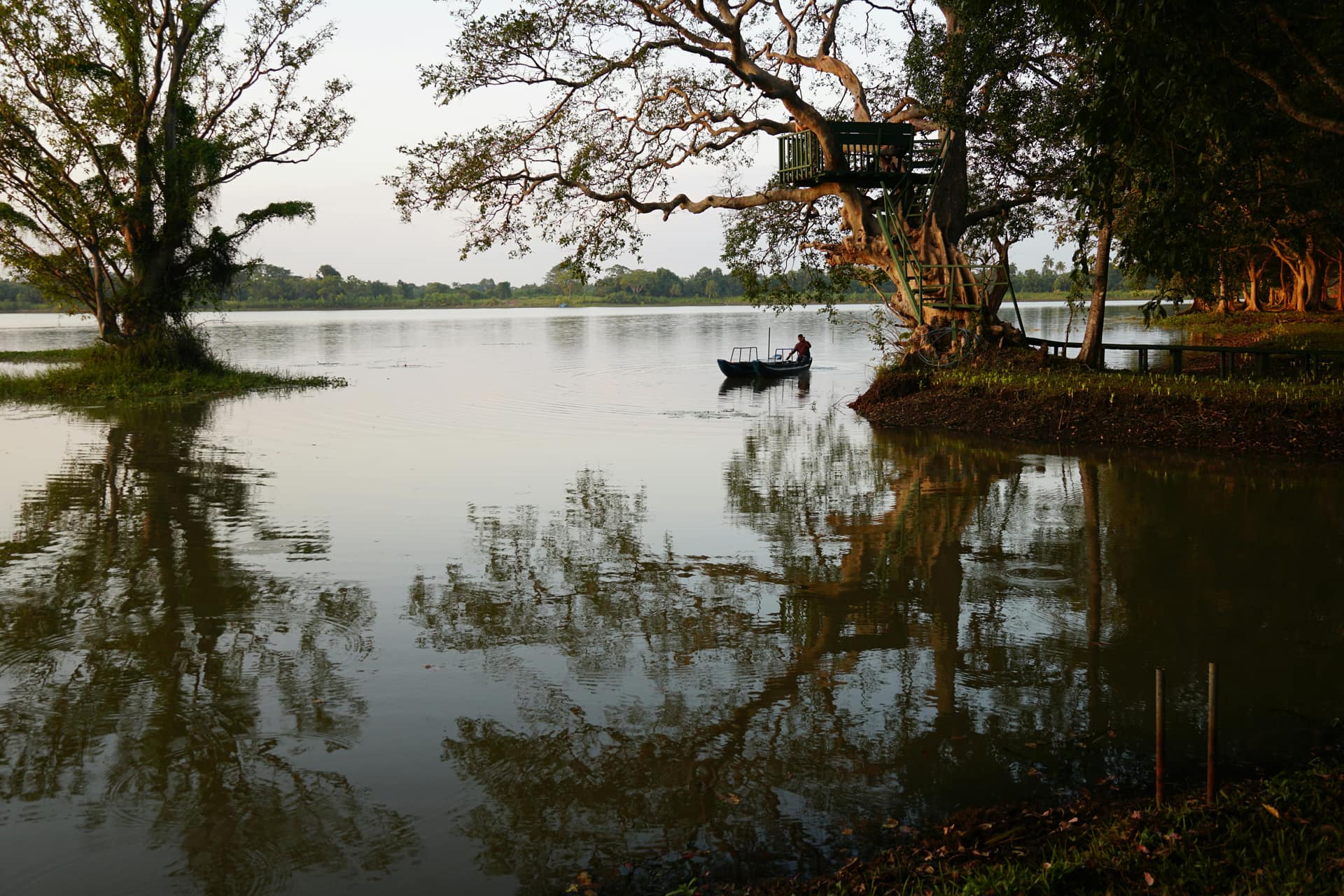
Where a bird walk around Sigiriya goes depends on the guide, but most combine a tank edge, a stretch of scrub or forest and village lanes with gardens and fields. The Sigiriya tank, village tanks nearby and the forest around Pidurangala are common choices.
The walking is easy and mostly flat, on bunds, tracks and quiet roads. Expect to cover two to four kilometres slowly, with frequent stops to watch and listen. Some walks end at the guide's home or a café for breakfast.
- →Tank edges for waterbirds.
- →Scrub and forest edges for forest birds.
- →Village gardens and fields for open-country birds.
- →Distance: roughly 2 to 4 km at a slow pace.
Birds you may see
Birds you may see around Sigiriya include common and striking species. Kingfishers, including the white-throated and pied kingfishers, hunt over tanks. Little green bee-eaters perch on wires. Egrets, herons, cormorants and darters work the water, and painted storks sometimes appear.
In scrub and gardens, look for peafowl, rose-ringed and other parakeets, orioles, drongos, barbets and bulbuls. Hornbills, including the endemic Sri Lanka grey hornbill and the Malabar pied hornbill, visit fruiting trees. Birds of prey such as the crested serpent eagle and the white-bellied sea eagle are possible.
Endemics such as the Sri Lanka junglefowl are often heard and sometimes seen. Sightings vary with the season, water levels and luck.
- →Waterbirds: egrets, herons, cormorants, darters, kingfishers.
- →Open country: bee-eaters, parakeets, peafowl, drongos.
- →Fruiting trees: hornbills, barbets, orioles.
- →Raptors: serpent eagles and fish eagles.
Choosing a guide
Choosing a guide makes the biggest difference to a bird walk around Sigiriya. A good local guide knows the calls, the regular perches and where the hornbills feed that week. Many have spotting scopes and bird books. Ask your hotel or a nature-focused lodge for a recommended birding guide.
Agree the route, duration and fee in advance. For keen birders, say which species you hope to see so the guide can plan. Beginners should mention that too, as a good guide will explain more and spend longer on each bird.
- →Local knowledge of calls and perches.
- →Binoculars or a scope.
- →Clear route, duration and fee.
- →Interests shared in advance.
What to bring
What to bring on a Sigiriya bird walk is simple: binoculars, a hat, water, sun cream and insect repellent. Wear neutral colours and shoes you can walk in on dusty or muddy tracks. A notebook or a birding app helps beginners keep track.
Camera users will want a telephoto lens of at least 300 mm for most birds. Keep noise low and move slowly, as quiet walkers see more.
- →Binoculars.
- →Hat, water, sun cream and repellent.
- →Neutral clothes and walking shoes.
- →A telephoto lens for photography.
Fitting it into a stay
Fitting a bird walk into a Sigiriya stay is easy. It suits a morning when you are not climbing, such as the last morning before a mid-morning departure, or a rest day. Combine it with the tank bund at sunrise for a gentle dawn.
At Lankan Stays & Trails, we arrange bird walks with local guides around Sigiriya and often suggest them for guests who have already seen both rocks.
Frequently asked questions
What birds can I see around Sigiriya?
Common sightings include kingfishers, bee-eaters, egrets, herons, cormorants, darters, peafowl, parakeets, drongos and barbets. Hornbills, including the endemic Sri Lanka grey hornbill, visit fruiting trees. Endemics such as the Sri Lanka junglefowl and raptors such as serpent eagles are also possible.
When is the best time for a bird walk in Sigiriya?
Early morning, from about 6 am to 9 am, when birds are most active and the air is cool. Late afternoon also works but is usually less productive. Winter months bring migrant birds from roughly October to April.
Do I need a guide for birdwatching in Sigiriya?
A guide is strongly recommended. Local guides know the calls, the regular perches and where birds are feeding, and many carry scopes. You will see far more with one than alone, especially as a beginner.
Is a bird walk in Sigiriya suitable for beginners?
Yes. The walking is easy and mostly flat, and a good guide will explain what you are seeing. Mention that you are a beginner so the guide spends longer on each bird. Binoculars make a big difference.
Are there endemic birds near Sigiriya?
Yes. The Sri Lanka junglefowl and Sri Lanka grey hornbill occur in the area, among others. Many endemics prefer wetter forests elsewhere on the island, so a Sigiriya walk focuses mostly on dry-zone and widespread species.
How long is a bird walk around Sigiriya?
Usually two to three hours, covering roughly two to four kilometres at a slow pace with frequent stops. Some walks end with breakfast. Longer walks can be arranged for keen birders.
Can I combine a bird walk with sunrise at Sigiriya?
Yes. Start at the Sigiriya tank bund at sunrise, when waterbirds are active and the rock is lit, then continue along the tank edge and into nearby scrub and village lanes with your guide.