
Quick answer
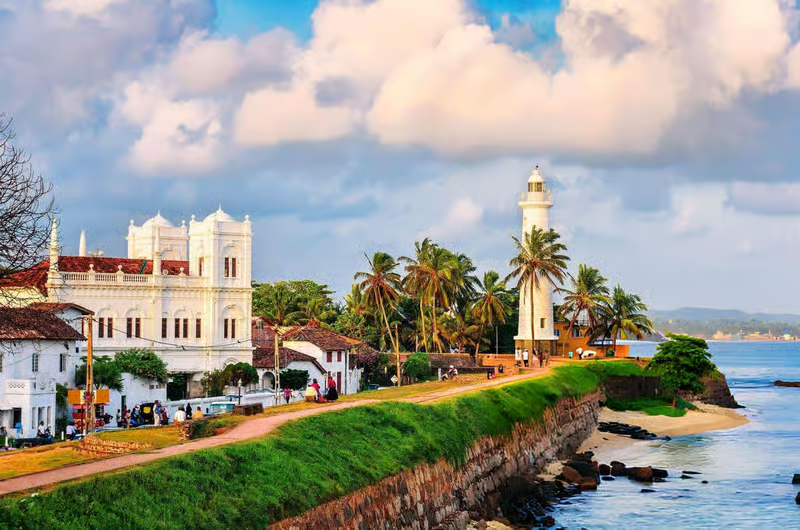
Galle is far stronger than Mirissa for history and culture. Galle Fort is a UNESCO World Heritage site founded by the Portuguese in 1588, taken by the Dutch in 1640 and held by the British from 1796, with ramparts, churches, a mosque, museums and merchant houses still in daily use. Mirissa has no historic monuments of note; its culture is a working fishing harbour, a hilltop Buddhist temple and village life behind the beach road.
Key takeaways
- Galle Fort was inscribed as a UNESCO World Heritage site in 1988 as the best-preserved European-built fortified town in South Asia.
- The Portuguese fortified Galle from 1588, the Dutch captured it in 1640 and the British took over in 1796.
- The fort's walls largely shielded the old town from the 2004 tsunami, which devastated the area outside.
- Mirissa harbour is one of the south coast's busiest fishing ports and is most active before seven in the morning.
- Weherahena temple near Matara, roughly 25 to 35 minutes from Mirissa, has a large seated Buddha and painted tunnels.
The history you can see in Galle
Galle's history is written in its walls. The Portuguese built the first defences on the landward side after 1588. The Dutch East India Company seized the port in 1640 and spent the next decades building the bastions, the sea walls and the drainage system flushed by the tide that still works today.
The British left the layout almost untouched, adding the Main Gate in 1873, the clock tower in 1883 and the present lighthouse. Inside are the Dutch Reformed Church of 1755, the Anglican All Saints' Church, the Meeran Jumma Mosque with its baroque facade, and warehouses that once held cinnamon and now hold a maritime museum.
- →Old Gate: the Dutch East India Company crest dated 1669.
- →Dutch Reformed Church: gravestones set into the floor.
- →Meeran Jumma Mosque: built in a style resembling a church.
- →National Maritime Museum: in a long Dutch warehouse by the Old Gate.
Galle as a living culture
Galle Fort's culture is as interesting as its monuments. A community of Sri Lankan Moors has lived inside the walls for generations beside Sinhalese, Burgher and more recently foreign residents. Children go to school in the fort, the courts sit there, and cricket is played on the green below the clock tower.
The fort also has a contemporary cultural life. Galleries show Sri Lankan painters and photographers, a literary festival is usually held in January or February with dates that change each year, and Test cricket at the stadium outside the Main Gate is watched for free from the ramparts. None of this has an equivalent in Mirissa.
- →Mixed community: Moor, Sinhalese and Burgher families.
- →Arts: galleries, bookshops and an annual literary festival.
- →Cricket: international matches beside the fort walls.
- →Worship: mosque, churches and a Buddhist temple inside the walls.
What culture Mirissa has
Mirissa's culture belongs to the sea. The harbour at the western end of the bay shelters a large fleet of multi-day trawlers and smaller boats, and from about half past five the catch of tuna, seer and sailfish is landed and auctioned on the quay. Visitors are tolerated if they keep out of the way.
Above the harbour a small Buddhist temple sits on the headland with a view over the bay. Inland, the lanes pass coconut gardens, cinnamon plots and village shrines. On poya days families dress in white and walk to the temple. A bicycle or tuk-tuk ride through these lanes shows a Mirissa that the beach strip conceals.
- →Harbour auction: busiest from half past five to seven.
- →Headland temple: quiet, with a bay view; dress modestly.
- →Village lanes: coconut, cinnamon and paddy.
- →Poya days: temple visits and no alcohol sales.
History and culture near each
Cultural day trips are possible from both Galle and Mirissa. From Galle, the Japanese Peace Pagoda on Rumassala, the folk museum and stilt fishermen at Koggala, mask workshops in Ambalangoda and lowland tea estates are all within an hour. The old Dutch fort at Matara and its star fort are roughly an hour east.
From Mirissa, Matara is roughly 20 to 30 minutes away, with Weherahena temple beyond it and the lighthouse at Dondra Head marking the southern tip of the island. Mulkirigala, a rock temple with painted caves reached by several hundred steps, is roughly an hour and a quarter inland from Mirissa and is the nearest thing the far south has to Dambulla.
Visiting with respect and with a guide
Visiting Galle and Mirissa for their culture goes better with a little preparation. Cover shoulders and knees for temples, mosques and churches, remove shoes and hats where asked, and never pose with your back to a Buddha image. Swimwear belongs on the beach, not in the streets of the fort or the village.
A guided walk is worth the money in Galle, where the details are easy to miss: the crests, the sewers, the stories of families who sheltered behind the walls in 2004. Lankan Stays & Trails works with resident guides in the fort and can arrange a dawn harbour visit in Mirissa with someone who knows the boat owners.
- →Dress: shoulders and knees covered at religious sites.
- →Guides: a two-hour fort walk adds a great deal.
- →Harbour: go early, stay clear of the auction floor.
- →Photography: ask before photographing people at work or at prayer.
Frequently asked questions
Is Galle or Mirissa better for culture?
Galle is far better for culture and history. Galle Fort is a UNESCO World Heritage site with Portuguese, Dutch and British layers, churches, a mosque, museums and galleries. Mirissa is a beach and fishing village whose cultural interest lies in its harbour, a small temple and everyday village life.
How old is Galle Fort?
Galle Fort dates from 1588, when the Portuguese first fortified the headland. The Dutch captured it in 1640 and built most of the ramparts and bastions that stand today over the following decades. The British took control in 1796 and added the Main Gate, the clock tower and the lighthouse.
Is there anything historical to see in Mirissa?
Mirissa has no major historic monuments. Its interest is a working fishing harbour with a dawn fish auction and a small Buddhist temple on the headland. For history, visitors travel roughly 20 to 30 minutes to Matara's Dutch forts or 45 minutes to an hour to Galle Fort.
Did the 2004 tsunami damage Galle Fort?
The tsunami of December 2004 caused heavy loss of life and destruction in Galle town, including the bus station and cricket ground. The old town inside the fort was largely protected by its seventeenth-century ramparts, which broke the force of the water, and its historic buildings survived mostly intact.
Do I need a guide for Galle Fort?
You can walk Galle Fort without a guide, since it is small and safe. A local guide for two hours adds stories and details that are otherwise easy to miss, such as the tidal sewer system, family histories and the meaning of the crests above the gates. It is recommended for a first visit.
Can I visit the fish market at Mirissa harbour?
Yes, with care. Mirissa harbour is a working port, and the catch is landed and sold from about half past five to seven in the morning. Wear closed shoes, keep out of the way of workers and vehicles, and ask before taking photographs. It is not a staged attraction.