
Quick answer
The best south coast places for history lovers are Tissamaharama and Kirinda, centres of the ancient kingdom of Ruhuna more than 2,000 years ago; Kushtaraja Gala at Weligama, a rock-cut Bodhisattva of the late first millennium; Mulkirigala, where manuscripts used to translate the Mahavamsa were found; Dondra Head, whose great temple was destroyed by the Portuguese; Galle Fort, a UNESCO World Heritage Site since 1988; Matara's Dutch Star Fort of the 1760s; and the Peraliya tsunami memorials. A history route from east to west takes three to five days.
Key takeaways
- Tissamaharama was a capital of the ancient southern kingdom of Ruhuna, with stupas over 2,000 years old.
- Kushtaraja Gala at Weligama is a rock-cut figure often dated to the late first millennium, linked to Mahayana Buddhism.
- Manuscripts found at Mulkirigala in the nineteenth century helped George Turnour translate the Mahavamsa in the 1830s.
- Galle Fort, rebuilt by the Dutch from the mid-seventeenth century, became a UNESCO World Heritage Site in 1988.
- The Peraliya memorials mark the 2004 tsunami, the worst natural disaster in Sri Lanka's recorded history.
The south coast through history
The history of Sri Lanka's south coast begins in the ancient kingdom of Ruhuna, centred on the dry plains around Tissamaharama more than 2,000 years ago. Ruhuna was a refuge and power base for kings who later unified the island, and its legends are still told at Kirinda and Kataragama.
Later centuries brought Buddhist monasteries, Hindu shrines and trade with Arab, Indian and Chinese ships. From the early sixteenth century, the Portuguese, Dutch and British fought over and ruled the coast, leaving forts, churches and lighthouses. The twentieth century added the novels of Martin Wickramasinghe and, in 2004, the tsunami.
South coast history is easy to follow geographically. The oldest sites lie in the dry east, the colonial sites cluster around Galle and Matara, and modern memorials line the western stretch near Hikkaduwa.
Ancient Ruhuna and early Buddhism
Tissamaharama, near Yala, has a great white stupa and a large tank, Tissa Wewa, both dating back more than 2,000 years. Kirinda, nearby, has a temple on rocks above the sea linked to Queen Viharamahadevi, mother of King Dutugemunu, who according to legend was set adrift and landed here.
Kushtaraja Gala at Weligama is a rock-cut figure often identified as the Bodhisattva Avalokiteshvara, from the late first millennium. Yatagala near Unawatuna and Mulkirigala north of Tangalle are monasteries with traditions reaching back to the early centuries of Buddhism on the island.
- →Tissamaharama: stupas and tank of ancient Ruhuna.
- →Kirinda: the legend of Viharamahadevi.
- →Kushtaraja Gala: a Bodhisattva carved in rock.
- →Yatagala and Mulkirigala: early monastic traditions.
Mulkirigala, Dondra and the pilgrim coast
Mulkirigala's cave shrines were rebuilt and painted under the Kandyan kings in the eighteenth century. In the nineteenth century, palm-leaf manuscripts found there helped the British scholar George Turnour translate the Mahavamsa, the great chronicle of Sri Lanka's kings, opening its history to the world.
Dondra Head, the southernmost point, was home to a great temple complex famous across the Indian Ocean, visited by pilgrims and traders. In the late sixteenth century the Portuguese raided and destroyed it. Fragments of its stonework survive near the modern Vishnu shrine.
- →Mulkirigala: eighteenth-century murals and the Mahavamsa manuscripts.
- →Dondra Head: the destroyed temple and the Vishnu shrine.
- →Kataluwa: nineteenth-century murals with European figures.
Forts, churches and lighthouses
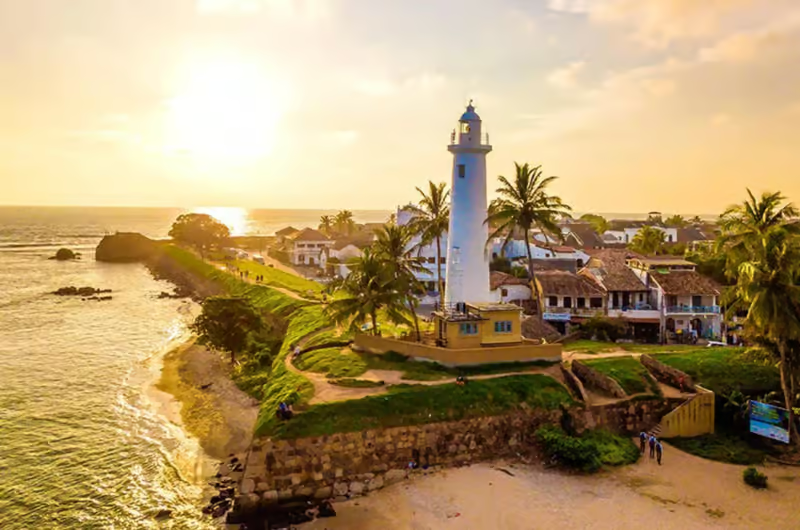
Galle Fort, first fortified by the Portuguese and rebuilt by the Dutch from the mid-seventeenth century, is the finest colonial town in South Asia, a UNESCO World Heritage Site since 1988. Its museums explain the spice trade, the Dutch East India Company and the British period.
Matara has Dutch fort walls, a Dutch-era church and the Star Fort of the 1760s, built after an uprising. Hambantota has a British Martello tower, and the lighthouses at Galle and Dondra Head, completed in 1890, show British engineering. Leonard Woolf served in Hambantota from 1908 to 1911.
- →Galle Fort: Dutch ramparts, churches and museums.
- →Matara: the main fort and the Star Fort.
- →Hambantota: the Martello tower and Leonard Woolf.
Wickramasinghe, Bawa and the tsunami
The twentieth century left its own history on the coast. The Martin Wickramasinghe Folk Museum at Koggala preserves the birthplace of Sri Lanka's best-loved novelist, and Lunuganga near Bentota shows the work of Geoffrey Bawa, the architect who defined tropical modernism.
At Peraliya, near Hikkaduwa, memorials mark the place where the 2004 tsunami struck a crowded train, killing well over 1,000 people. Community museums nearby record the disaster and the rebuilding of the coast.
- →Koggala: Martin Wickramasinghe's birthplace and folk museum.
- →Lunuganga: Geoffrey Bawa's estate.
- →Peraliya: the tsunami memorials and museums.
Planning a history route
A history route along the south coast works well from east to west over three to five days. Start at Tissamaharama and Kirinda, continue to Mulkirigala and Dondra Head, then Matara's forts, Kushtaraja Gala, Kataluwa and Koggala, and end in Galle Fort, with Peraliya and Lunuganga on the way to Colombo.
Lankan Stays & Trails arranges history-focused south coast routes with guides who can explain each layer, from Ruhuna to the Dutch. Reading the Mahavamsa in translation, Woolf's The Village in the Jungle and Wickramasinghe's Madol Doova adds a great deal before the trip.
Frequently asked questions
What are the most historic places on Sri Lanka's south coast?
The most historic places include Tissamaharama and Kirinda from ancient Ruhuna, Kushtaraja Gala at Weligama, Mulkirigala rock temple, Dondra Head, Galle Fort, Matara's forts and the Peraliya tsunami memorials. Together they span more than 2,000 years.
What was the kingdom of Ruhuna?
Ruhuna was an ancient kingdom in the south and south-east of Sri Lanka, centred on the plains around Tissamaharama. It was a power base for kings such as Dutugemunu, who later unified the island, and its stupas and tanks survive near Yala.
Why is Mulkirigala important historically?
Palm-leaf manuscripts found at Mulkirigala in the nineteenth century included a commentary on the Mahavamsa, Sri Lanka's great chronicle. The British scholar George Turnour used them to help translate the Mahavamsa into English in the 1830s.
What happened at Dondra Head?
Dondra Head was home to a great temple complex famous across the Indian Ocean. In the late sixteenth century, Portuguese forces raided and destroyed it. Fragments of the old stonework survive near the modern Vishnu shrine and the British lighthouse of 1890.
When was Galle Fort built?
The Portuguese first fortified Galle in the sixteenth century, and the Dutch rebuilt and greatly expanded it from the mid-seventeenth century, giving it most of its present walls and layout. It became a UNESCO World Heritage Site in 1988.
What books should history lovers read before visiting the south coast?
Useful choices include a translation of the Mahavamsa for ancient history, Leonard Woolf's The Village in the Jungle for colonial-era village life near Hambantota, and Martin Wickramasinghe's Madol Doova for the coast around Koggala in the early twentieth century.
How many days does a south coast history route need?
Three to five days is comfortable. Three days covers Galle, Matara, Mulkirigala and Dondra Head. Five days adds Tissamaharama, Kirinda and the western stretch with Peraliya and Lunuganga, at a pace that leaves time for museums and guides.