
Quick answer
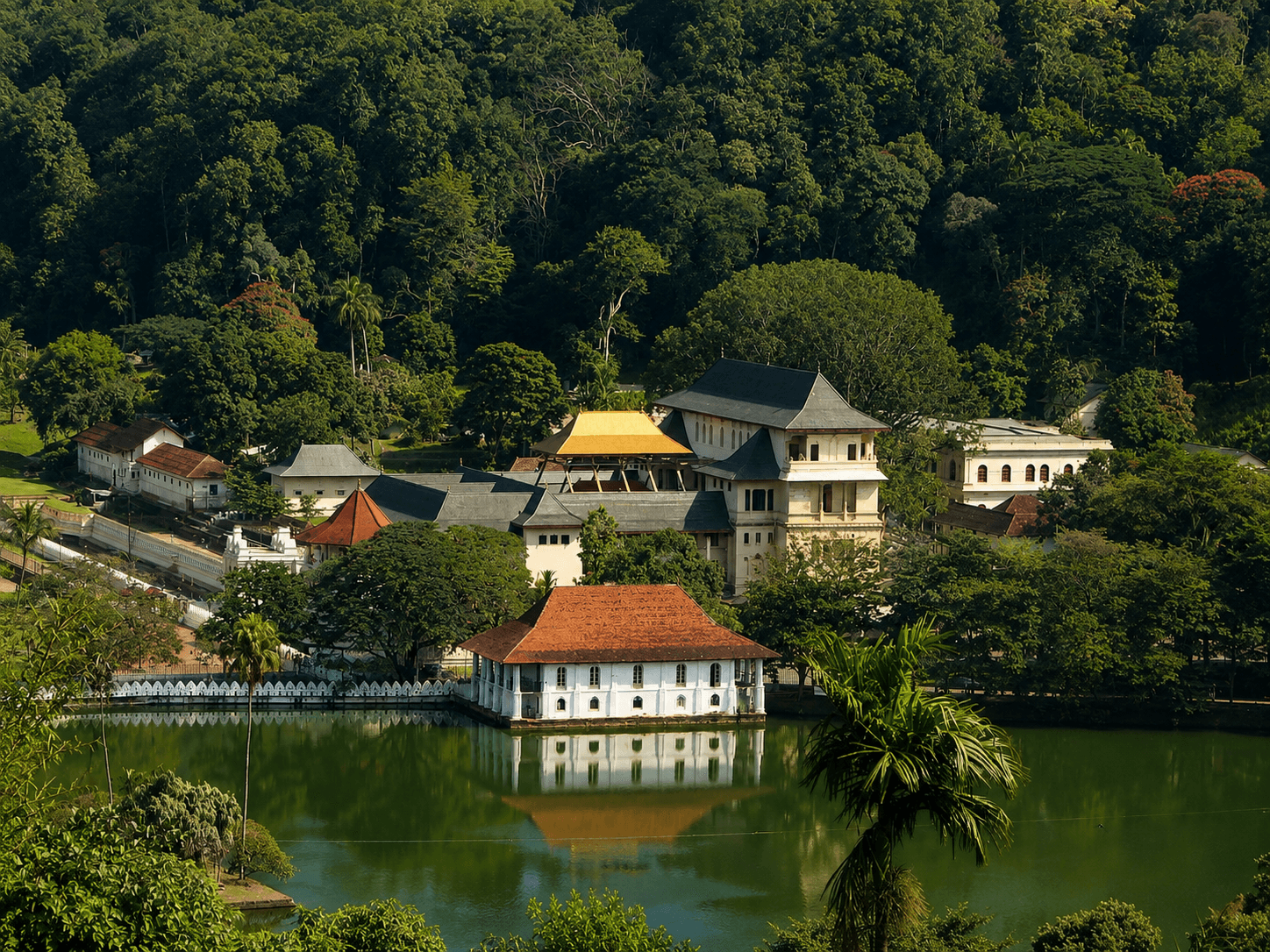
Kandy Lake is an artificial lake in the centre of Kandy, created in 1807 by Sri Wickrama Rajasinghe, the last king of Kandy. The path around it is about 3.4 kilometres and takes 45 to 60 minutes at a gentle pace. The most pleasant stretch is the northern shore beside the Temple of the Sacred Tooth Relic, and the best hours are before 8 in the morning and after 5 in the afternoon, when the heat and traffic fumes are lowest.
Key takeaways
- Kandy Lake was completed in 1807 and is known in Sinhala as Kiri Muhuda, the Sea of Milk.
- The circuit of Kandy Lake is about 3.4 kilometres and almost entirely flat.
- The Walakulu Bemma, or cloud wall, runs along roughly 630 metres of the shore and was left unfinished when the kingdom fell in 1815.
- The Ulpange, the queens' bathing pavilion on the temple side of Kandy Lake, was built in 1806 and later given an upper storey by the British.
- Fishing and swimming are forbidden in Kandy Lake because it lies within the temple's sacred area.
How Kandy Lake came to be
Kandy Lake was created between 1807 and 1812 by Sri Wickrama Rajasinghe, the last king of the Kandyan kingdom. The ground below the palace was a stretch of paddy fields called Tigolwela. The king had it dammed and flooded, and named the result Kiri Muhuda, the Sea of Milk.
The building of Kandy Lake was not popular at the time. Chronicles record that local chiefs objected to the forced labour, and tradition says that those who protested were executed on stakes in the lake bed. The small island in the middle is said to have been the king's summer house, later used by the British as an ammunition store.
The route around the lake
The route around Kandy Lake is simple: keep the water on one side and walk until you return. Most people start at the temple end and go clockwise, along the northern shore first. This stretch has the cloud wall, the queens' bathing pavilion and views back to the golden roof of the shrine.
The southern shore of Kandy Lake follows Sangaraja Mawatha, a main road with buses and lorries. The pavement is continuous and shaded by old trees, although the noise is constant. Malwatta monastery stands on this side, and a lane climbs from here to the Arthur's Seat viewpoint.
- →Start: the temple gate or the corner near the colonial hotel.
- →Distance: about 3.4 kilometres, 45 to 60 minutes without stops.
- →Surface: paved and flat, with a few uneven slabs and tree roots.
- →Shortcut: walk the northern shore to the far end and return the same way, about 2 kilometres.
What to look for along the shore
Kandy Lake's best-known feature is the Walakulu Bemma, the cloud wall. The low white parapet has triangular openings in which oil lamps were lit on festival nights. About 630 metres were built before the British took the city in 1815, and the wall simply stops where the work ended.
The Ulpange stands partly in the water on the temple side of Kandy Lake. Built in 1806 as a bathing pavilion for the king's queens, it gained an upper floor under the British and has served as a library and a police post. Further along, look for the royal summer house island and the spillway at the western end.
- →The cloud wall, best photographed in early light.
- →The Ulpange, the queens' bathing pavilion.
- →The island summer house in the centre of the lake.
- →The view of the temple's golden canopy from the south-east corner.
Birds, monitors and big trees
Kandy Lake supports a surprising amount of wildlife for a city-centre pond. Indian cormorants and little cormorants dry their wings on the overhanging branches, spot-billed pelicans drift in the middle, and black-crowned night herons roost in the trees near the island. Water monitors up to a metre and a half long sun themselves on the bank.
The trees around Kandy Lake are part of the attraction. Rain trees, palms and old mara trees shade most of the path, and fruit bats pass overhead at dusk on their way from Peradeniya. Feeding the fish is common among local families, and the carp gather in dense shoals near the steps.
The best time to walk, and practical notes
The best time to walk around Kandy Lake is early morning, from about 6 to 8, when mist can sit on the water and the air is clean. Late afternoon from 5 is the second choice and suits visitors heading to the evening puja. Midday is hot, and the exhaust on the southern road is at its worst.
A walk around Kandy Lake needs no ticket and no guide. Touts sometimes approach near the temple end with offers of dance tickets or tuk-tuk tours; a polite refusal is enough. Lankan Stays & Trails usually places the lake walk straight after the evening puja, when the wall is lit and the day has cooled.
- →Cost: free.
- →Shade: good on about three-quarters of the route.
- →Toilets: at the temple end, for a small fee.
- →After dark: the temple side is lit and busy until about 8; the far end is quieter.
How the lake fits into a Kandy day
Kandy Lake fits naturally at the start or end of a day. A dawn circuit followed by breakfast and the botanic gardens works well for early risers. An evening half-circuit links the 5 o'clock dance performance, the puja and dinner without needing a vehicle.
Kandy Lake is also the simplest way to orient yourself in the city. The temple and palace lie on the north shore, the market and station are a few minutes west, and the hills with the best hotels and viewpoints rise to the south. Once you have walked the lake, the rest of Kandy makes sense.
Frequently asked questions
How long does it take to walk around Kandy Lake?
The full circuit of Kandy Lake is about 3.4 kilometres and takes 45 to 60 minutes at an easy pace, or a little longer with photo stops. Walking only the northern shore beside the temple and back takes about half an hour.
Is Kandy Lake natural or man-made?
Kandy Lake is man-made. It was created in 1807 by Sri Wickrama Rajasinghe, the last king of Kandy, by damming a stretch of paddy fields below the royal palace. It is fed by a small stream and drains towards the Mahaweli River.
Can you swim or take a boat on Kandy Lake?
Swimming and fishing are not allowed in Kandy Lake, which is part of the temple's protected area. Short boat rides have operated from a jetty at the western end at various times, although the service is not reliable. Ask locally on the day.
Is it safe to walk around Kandy Lake at night?
The northern shore of Kandy Lake near the temple is lit, busy and generally safe until about 8 in the evening. The eastern and southern stretches are darker and quieter. Solo walkers are better doing the full circuit in daylight and keeping to the temple side after dark.
What is the white wall around Kandy Lake?
The white parapet is the Walakulu Bemma, or cloud wall, built for Sri Wickrama Rajasinghe. Its triangular niches held oil lamps on festival nights. About 630 metres were completed before the British captured Kandy in 1815, and it was never finished.
What animals live in Kandy Lake?
Kandy Lake holds carp and other fish, terrapins and water monitors, which are harmless if left alone. Birds include cormorants, pelicans, egrets, kingfishers and night herons. Toque macaques visit from Udawattakele forest and will take food from open bags.