
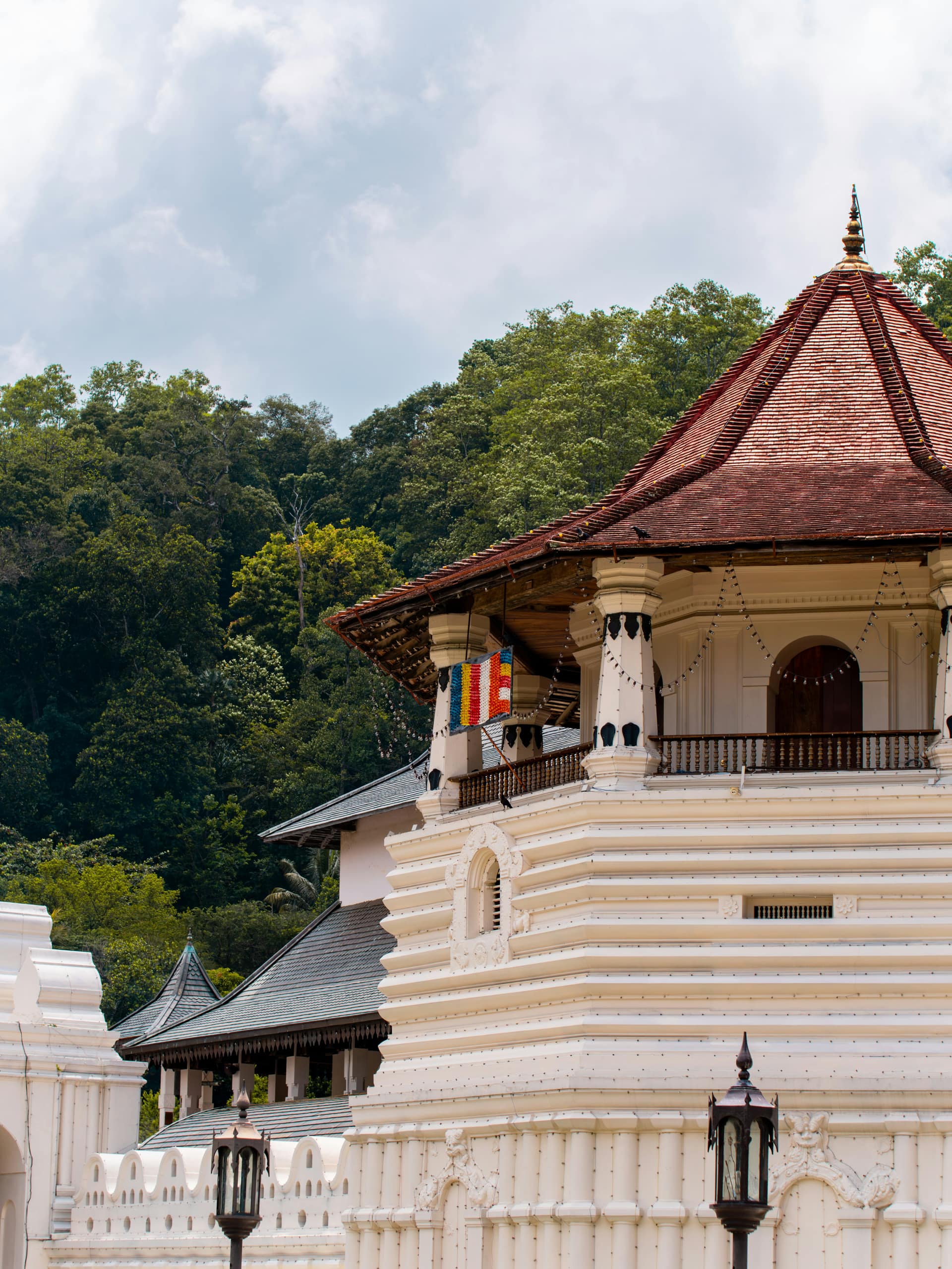
Quick answer
A self-guided walking tour of Kandy covers about four kilometres and takes three to four hours with stops. Start at the clock tower and central market, walk through the bazaar streets to the Kataragama Devale, continue along Dalada Veediya to St Paul's Church and the Natha and Vishnu devales, visit the Temple of the Sacred Tooth Relic and the royal Audience Hall, then the National Museum and the British Garrison Cemetery, and finish on the lake shore. Begin by 8 in the morning to avoid the heat.
Key takeaways
- The historic centre of Kandy measures roughly one kilometre from the clock tower to the temple.
- The walking route described here is about four kilometres long and almost flat until the final climb to the cemetery.
- Dalada Veediya, the main street of Kandy, runs from the clock tower directly to the temple gate.
- St Paul's Church, beside the temple square, was built for the British garrison in the 1840s.
- The sacred area of Kandy, including the temple, the devales and the lake, has been a UNESCO World Heritage Site since 1988.
The route at a glance
The walking tour of Kandy set out here runs west to east, from the commercial town to the sacred quarter, and ends at the lake. That order puts the busiest streets first, while the morning is cool, and saves the shaded lake path for the end.
The route through Kandy needs no map once you have the sequence. All the stops lie on or just off two parallel streets. Pavements are narrow and crowded, so walk in single file where necessary and cross at the signals near the clock tower and the temple.
- →1. Clock tower and central market.
- →2. Bazaar streets and Kataragama Devale.
- →3. Dalada Veediya and the colonial buildings.
- →4. St Paul's Church and the Natha, Pattini and Vishnu devales.
- →5. Temple of the Sacred Tooth Relic and the Audience Hall.
- →6. National Museum and British Garrison Cemetery.
- →7. Kandy Lake and the queens' bathing pavilion.
From the clock tower to the bazaar
The walk begins at the Kandy clock tower, a memorial built in 1950 that has become the city's meeting point. The central market stands next to it. Spend 30 minutes among the fruit and spice stalls while they are at their busiest.
The bazaar streets of Kandy run north of the market: Colombo Street, Kotugodella Veediya and their cross lanes. Hardware shops, goldsmiths, sweet sellers and textile merchants trade from narrow shop-houses. On Kotugodella Veediya, look for the painted gateway of the Kataragama Devale and step inside.
Along Dalada Veediya
Dalada Veediya is the spine of Kandy. Under the kings it was the processional way to the palace, and the Esala Perahera still passes along it. Today it is lined with banks, bakeries and jewellers in buildings from the 1890s to the 1930s.
Colonial Kandy is most visible at the eastern end of Dalada Veediya. A grand hotel with a white arcaded facade faces the lake at the corner, on the site of a governor's residence, and the red-brick law courts and old shop-fronts stand nearby. The temple's white walls close the view.
The sacred quarter
The sacred quarter of Kandy begins at the security checkpoint beside the temple square. Before entering the temple, turn left to St Paul's Church, a Gothic brick church of the 1840s with regimental memorials inside. Its presence beside the holiest Buddhist shrine in the country was deliberate.
The devales come next on a walk through the sacred quarter. The Natha Devale, opposite the temple, is the oldest building in Kandy, and the Pattini shrine shares its compound. Steps lead up to the Vishnu Devale. Then cross to the Temple of the Sacred Tooth Relic, allowing an hour, and the Audience Hall beside it.
- →St Paul's Church: 10 minutes.
- →Natha and Pattini devales: 15 minutes.
- →Vishnu Devale: 10 minutes.
- →Temple, Raja Tusker hall and Audience Hall: 60 to 75 minutes.
Museum, cemetery and lake
The National Museum of Kandy stands behind the temple in the former queens' quarters. Half an hour among the regalia and weapons of the kingdom follows naturally from the temple. From the museum, a signposted lane climbs for two minutes to the British Garrison Cemetery.
The walk ends at Kandy Lake. Return down the lane, pass the temple wall and reach the shore at the queens' bathing pavilion. Follow the cloud wall west along the water to the corner where you began Dalada Veediya, or continue around the full circuit if you have the energy.
Practical notes
Practical preparation for a walking tour of Kandy is mostly about dress and water. You will enter several shrines, so wear clothing that covers shoulders and knees and shoes that slip off easily. Carry water, a hat and small notes for tickets and donations.
A guide is not required for this walk, though one brings the buildings to life. Lankan Stays & Trails offers it as a guided morning with a Kandy-based guide, ending with lunch. Walkers on their own should expect to be approached by touts near the temple and can simply keep walking.
- →Start: 8 in the morning at the clock tower.
- →Duration: three to four hours.
- →Tickets: temple and museum; the devales, church and cemetery are free.
- →Avoid: Sunday mornings for the market, and poya days for a quiet temple visit.
Frequently asked questions
Can you walk around Kandy on your own?
You can walk around the centre of Kandy on your own without difficulty. The main sights lie within a kilometre of each other along Dalada Veediya and the lake. Pavements are narrow and traffic heavy, so allow extra time and cross with care.
How long does a walking tour of Kandy take?
A walking tour of central Kandy takes three to four hours, including about an hour inside the Temple of the Sacred Tooth Relic and shorter stops at the market, the devales, the museum and the Garrison Cemetery. The walking itself is about four kilometres.
Where should a Kandy walking tour start?
The clock tower beside the central market is the best starting point. It is easy to find, close to the bus and railway stations, and lets you walk east along Dalada Veediya towards the temple and the lake with the busiest streets behind you early.
Is Kandy city centre hilly?
The historic centre of Kandy, between the clock tower, the temple and the lake, is almost flat. The hills begin immediately around it. The only climb on the standard walking route is the short lane to the Garrison Cemetery.
Are there guided walking tours in Kandy?
Guided walking tours of Kandy are offered by local guides and tour companies, usually lasting three hours and covering the market, the sacred quarter and the lake. A licensed guide can also be hired at the temple entrance for the shrine itself.
What should I wear for a walking tour of Kandy?
Wear light clothing that covers shoulders and knees, since the route enters the temple and several shrines. Choose shoes that are easy to remove and comfortable on uneven pavements. Add a hat and sunscreen, and carry a small umbrella from October to December.