
Quick answer
Wasgamuwa is better for travellers based around Polonnaruwa, with elephants, sloth bears, buffalo and more than 150 bird species, roughly one and a half to two hours from Polonnaruwa. Maduru Oya is better for travellers heading to the east coast, with elephants near a vast reservoir and the Vedda village of Dambana close by, roughly three hours from Kandy. Both are best in the dry season, roughly May to September, and both see very few jeeps.
Key takeaways
- Wasgamuwa covers roughly 37,000 hectares; Maduru Oya covers roughly 58,800 hectares.
- Both parks were created partly to protect elephant habitat affected by the Mahaweli irrigation scheme.
- Wasgamuwa has better chances of sloth bears and a longer bird list.
- Maduru Oya has a large reservoir and lies near the Vedda village of Dambana.
- Both parks are best in the dry season, roughly May to September.
The verdict
Wasgamuwa is the better choice for most wildlife lovers, with a wider range of animals, better chances of sloth bears and easier access from the Cultural Triangle. Maduru Oya is the better choice for travellers crossing from Kandy to the east coast, or those who want to combine a remote park with a visit to the Vedda community at Dambana.
For a single quiet park, Wasgamuwa usually offers more. For a route east, Maduru Oya fits more naturally.
Wildlife compared
Wasgamuwa's wildlife includes elephants in herds on the grasslands, sloth bears, which are seen more often here than at most parks outside Wilpattu and Yala, water buffalo, spotted deer and more than 150 bird species.
Maduru Oya's wildlife centres on elephants near the reservoir in the dry season, along with buffalo, deer, sambar, crocodiles and waterbirds. Leopards and sloth bears are present but rarely seen.
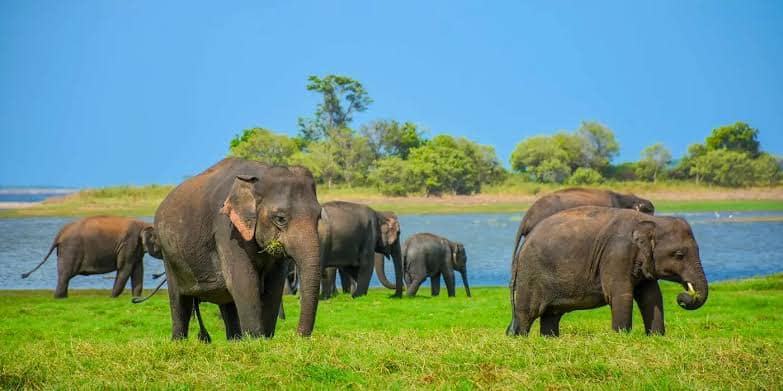
Wasgamuwa's elephants are often seen moving between the forest and the riverside grassland, which gives varied backdrops for photographs. Maduru Oya's are most visible at the reservoir edge, where open water and distant hills make wide, quiet scenes with few other vehicles in the frame.
- →Wasgamuwa: elephants, sloth bears, buffalo and many birds.
- →Maduru Oya: elephants near the reservoir and waterbirds.
- →Both: mugger crocodiles, deer and a good range of raptors.
Landscape compared
Wasgamuwa's landscape is a mix of grassland, scrub, riverine forest and ancient tanks between the Mahaweli and Amban Ganga rivers, with ruins from the Polonnaruwa period.
Maduru Oya is larger and more open, dominated by the Maduru Oya reservoir, with rocky hills, forest and an ancient sluice found during the reservoir's construction.
The two parks also feel different on the ground. Wasgamuwa's tracks wind through mixed forest with frequent stops, while Maduru Oya's longer, straighter tracks open onto wide views over water and rock, and a drive there can feel like crossing an empty country.
Access compared
Wasgamuwa is roughly one and a half to two hours from Polonnaruwa or Habarana and two and a half to three hours from Kandy via Hasalaka. Maduru Oya is roughly three hours from Kandy via Mahiyangana, roughly two hours from Polonnaruwa and three to four hours from Arugam Bay or Batticaloa.
Both have basic facilities, limited public transport and few hotels nearby, so a car with a driver is the practical choice.
Accommodation is the main practical constraint. Wasgamuwa has a few lodges and campsites near its boundary, and Maduru Oya visitors usually stay in Mahiyangana, so both work best with one night nearby rather than a long day trip.
- →Wasgamuwa: best from Polonnaruwa or Kandy.
- →Maduru Oya: best on the way to the east coast.
- →Both: few hotels nearby, so book lodging ahead.
Culture nearby
Maduru Oya lies close to Dambana, home to the Vedda people, Sri Lanka's indigenous community. A respectful visit with a local guide adds a cultural dimension to the safari.
Wasgamuwa has ancient ruins inside the park and lies close to Polonnaruwa's ancient city. Lankan Stays & Trails arranges both parks with drivers who know the rural roads, often combined with Polonnaruwa or the drive east.
Either park pairs well with a night in a simple village guesthouse, which adds home cooking and a slower rhythm to the trip.
Which to choose
Maduru Oya and Wasgamuwa both suit travellers who want quiet parks, and the best choice depends on route and interests.
Neither is ideal for a first safari, as sightings are less predictable than at Udawalawe or Minneriya, but both reward travellers who value solitude.
- →Choose Wasgamuwa for a wider range of wildlife and sloth bears.
- →Choose Maduru Oya for a route to the east coast and a visit to Dambana.
- →Choose Udawalawe or Minneriya if this is your first safari.
Frequently asked questions
Is Wasgamuwa better than Maduru Oya?
For most wildlife lovers, yes. Wasgamuwa has a wider range of animals, better chances of sloth bears and easier access from Polonnaruwa. Maduru Oya suits travellers heading to the east coast or wanting to visit the Vedda village of Dambana.
Which park has more elephants, Maduru Oya or Wasgamuwa?
Both have good elephant numbers in the dry season. Wasgamuwa's herds are spread through grassland and forest, and Maduru Oya's gather near the reservoir. Neither is as predictable as Udawalawe or Minneriya during the gathering.
Can you see sloth bears at Maduru Oya?
Sloth bears live in Maduru Oya but are rarely seen. Wasgamuwa offers better chances, especially roughly in June and July. For the best sloth bear sightings, Wilpattu and Yala are also excellent.
How far is Maduru Oya from Wasgamuwa?
Maduru Oya and Wasgamuwa are roughly two to three hours apart by road, via Mahiyangana or Polonnaruwa. They are rarely visited on the same day. Most travellers choose one based on their route.
What is Dambana?
Dambana is a village near Maduru Oya National Park, home to the Vedda people, Sri Lanka's indigenous community. Visits should be arranged with a local guide, with time for conversation and respect for the community's privacy.
When is the best time to visit Maduru Oya and Wasgamuwa?
Both parks are best in the dry season, roughly May to September, when animals gather near water. From roughly October to January, the north-east monsoon brings heavy rain, and wildlife is harder to see.
Are Maduru Oya and Wasgamuwa good for a first safari?
Neither is ideal for a first safari, as sightings are less predictable than at Udawalawe or Minneriya. Both suit travellers who have seen the main parks and want quiet, remote places with very few jeeps.