
Quick answer
Wasgamuwa National Park is a dry-zone park of roughly 37,000 hectares between the Mahaweli and Amban Ganga rivers, south-east of Polonnaruwa. It is known for elephants, sloth bears, water buffalo and more than 150 bird species, and it sees very few jeeps. It is roughly one and a half to two hours from Polonnaruwa or Habarana and two and a half to three hours from Kandy, and it is at its best roughly from May to September.
Key takeaways
- Wasgamuwa National Park covers roughly 37,000 hectares of dry-zone forest, grassland and tanks between two major rivers.
- Elephants are the main draw, with herds moving between the park and the Mahaweli floodplain in the dry season.
- Sloth bears live in Wasgamuwa and are seen most often roughly in June and July, though sightings are never guaranteed.
- The park usually has only a handful of jeeps on a morning drive, far fewer than Yala or Minneriya.
- Wasgamuwa is roughly one and a half to two hours from Polonnaruwa and two and a half to three hours from Kandy.
What Wasgamuwa National Park is
Wasgamuwa National Park is a protected area in the Matale and Polonnaruwa districts, bounded by the Mahaweli Ganga to the east and the Amban Ganga to the west. Its landscape is classic dry zone: thorny scrub, open grassland, patches of tall forest along the rivers and ancient irrigation tanks that hold water into the dry season.
The name is often explained as coming from the sloth bear, called valasa in Sinhala, and the park is one of the better places on the island for the species. It was declared a national park in 1984, partly to protect elephant habitat displaced by the Mahaweli irrigation scheme.
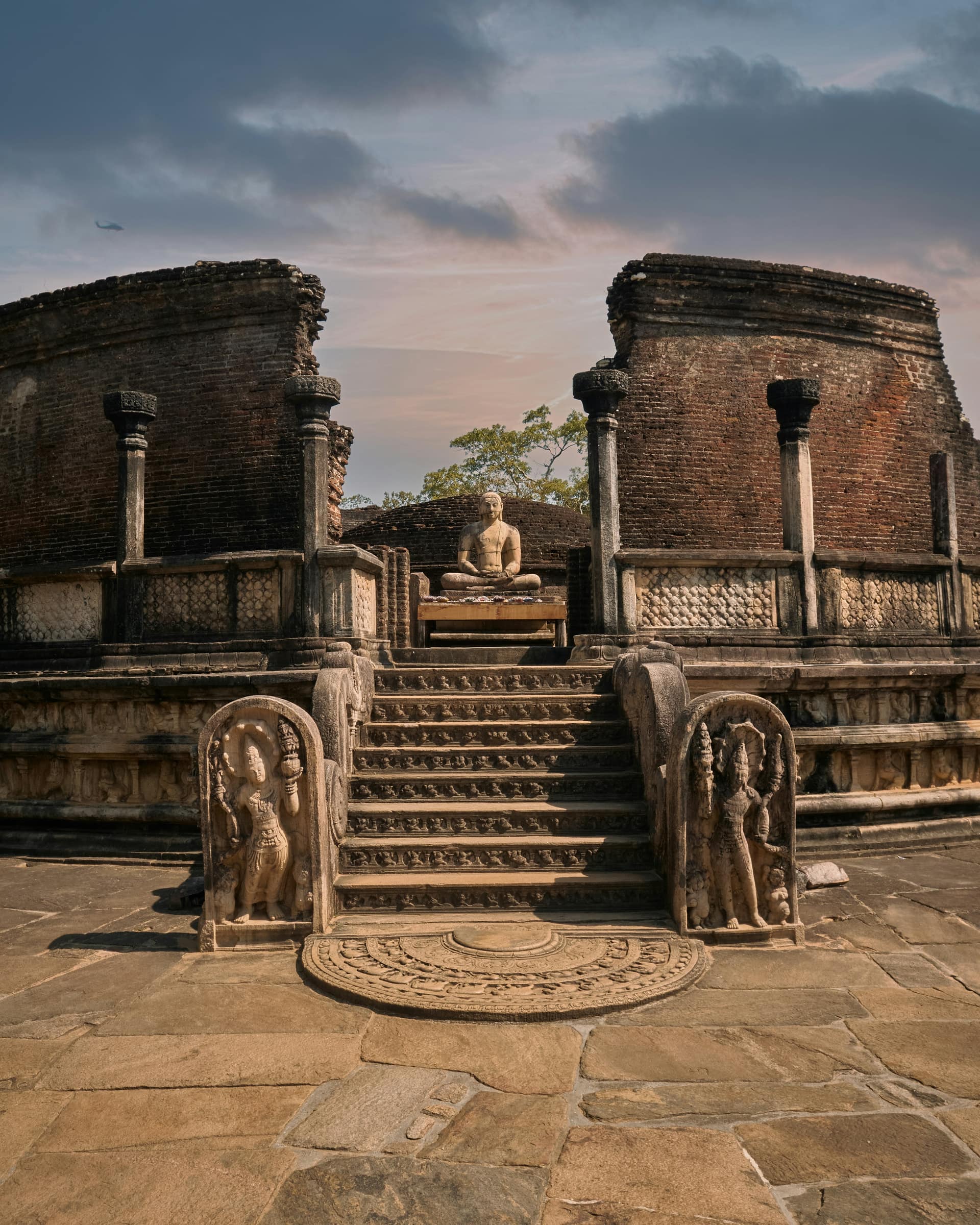
Wasgamuwa has ruins too: brick stupas and old tanks from the Polonnaruwa period are scattered through the forest, a reminder that this was farmed land centuries ago.
What you can see in Wasgamuwa
Wasgamuwa's headline animal is the Asian elephant. Herds of ten to thirty are common on the grasslands near the tanks, and lone bulls feed along the tracks. The park is also good for water buffalo, spotted deer, wild boar and the endemic toque macaque and purple-faced langur in the riverside trees.
Sloth bears are present but shy, and a sighting is luck rather than plan. Leopards live in the park but are rarely seen. The bird list is long, with more than 150 species, including the endemic Sri Lanka junglefowl, crested serpent eagles, lesser adjutants on the tanks and several species of kingfisher.
- →Elephants: herds on the grasslands, most visible in the dry season.
- →Sloth bears: present, best chances roughly in June and July.
- →Water buffalo, spotted deer and wild boar: common on most drives.
- →Birds: junglefowl, raptors, storks and kingfishers on the tanks.
- →Mugger crocodiles: in the tanks and along the rivers.
When to visit Wasgamuwa
Wasgamuwa is best visited in the dry season, roughly May to September, when water shrinks to the tanks and the rivers and animals gather near them. This overlaps with the elephant gathering season at Minneriya and Kaudulla, so the two make a natural pair for travellers based around Polonnaruwa.
From roughly October to January the north-east monsoon brings heavy rain to this part of the island. The park stays open, but grass grows tall, animals disperse and some tracks become muddy. Early morning drives are best in any month, as elephants and birds are most active before the heat builds.
- →May to September: dry season, best for elephants and sloth bears.
- →October to January: wet season, lush and quiet but harder viewing.
- →February to April: a good shoulder period with fewer visitors still.
Getting to Wasgamuwa and booking a safari
Wasgamuwa is reached by road, most often from Polonnaruwa, Habarana or Kandy. From Polonnaruwa or Habarana the drive is roughly one and a half to two hours on rural roads; from Kandy it is roughly two and a half to three hours via Hasalaka. The last stretch passes villages and paddy fields that sit right on the edge of elephant country.
Jeeps are hired at the gate or through your hotel, and the park entry fee is paid on arrival; it is lower than Yala's, but confirm the current rate. A half-day drive of three to four hours is enough for most visitors, while a full day lets you reach the river edges.
- →Book a jeep through a lodge near the park for an early start.
- →Bring water, a hat and binoculars, as shade is limited.
- →Expect few facilities inside the park beyond basic toilets at the gate.
Wasgamuwa compared with the busier parks
Wasgamuwa National Park suits travellers who value quiet and wilderness over guaranteed sightings. Compared with Minneriya, it has fewer elephants on a single grassland but no traffic jams. Compared with Yala, it has far fewer leopards but a more relaxed, unhurried style of safari.
The trade-off is distance. Wasgamuwa takes time to reach and is rarely on a standard itinerary, so it works best for travellers staying two nights near Polonnaruwa or crossing from Kandy to the east coast. Lankan Stays & Trails includes it on quieter dry-season routes for travellers who have already seen the famous parks.
- →Choose Wasgamuwa if you want elephants and birds with very few other jeeps.
- →Choose Minneriya if you travel during the gathering and want the largest herds.
- →Choose Yala if leopards are the main reason for your trip.
Where to stay and how long to spend
Wasgamuwa has a few simple lodges and campsites near the park boundary, and travellers wanting more comfort usually stay in Polonnaruwa or Habarana and make an early start. One night nearby allows an afternoon drive and a dawn drive, which is the best way to see the park.
Wasgamuwa pairs well with Polonnaruwa's ancient city and with Minneriya or Kaudulla, all within a few hours. Travellers heading to Trincomalee or Batticaloa can include it on the way east.
Frequently asked questions
Is Wasgamuwa National Park worth visiting?
Yes, for travellers who want quiet and wilderness. Wasgamuwa has good elephant numbers, sloth bears, buffalo and a long bird list, and you may see only a few other jeeps all morning. It is less reliable for leopards than Yala, so it suits a second park rather than a first.
How do I get to Wasgamuwa National Park?
Wasgamuwa is reached by road. From Polonnaruwa or Habarana the drive takes roughly one and a half to two hours, and from Kandy roughly two and a half to three hours via Hasalaka. Most visitors travel with a driver, as public transport to the gate is slow and infrequent.
Can you see sloth bears in Wasgamuwa?
Sloth bears do live in Wasgamuwa, and the park is one of the better places for them outside Wilpattu and Yala. They are shy and mostly active early and late, so sightings are never guaranteed. The best chances come roughly in June and July, when fruiting trees draw them into the open.
What is the best time to visit Wasgamuwa?
The best time to visit Wasgamuwa is roughly May to September, during the dry season, when animals gather around the tanks and rivers. From October to January the north-east monsoon brings heavy rain, the grass grows tall and wildlife is harder to see, though the park stays open.
How long is a safari in Wasgamuwa?
A standard half-day safari in Wasgamuwa lasts three to four hours, either at dawn or in the afternoon. A full-day drive with a packed lunch lets you reach the river edges and the quieter interior. One night near the park allows both an afternoon and a morning drive.
Are there leopards in Wasgamuwa?
Leopards live in Wasgamuwa, but they are seen far less often than in Yala or Wilpattu because the forest is denser and the cats are shyer. Treat a leopard there as a bonus. Travellers who want a good chance of seeing one should plan at least two drives at Yala.
Is Wasgamuwa better than Minneriya?
They suit different travellers. Minneriya has larger elephant herds during the gathering, roughly July to October, but many jeeps. Wasgamuwa has fewer elephants in one place but a quieter, wilder feel and better chances of sloth bears. Many dry-season visitors do both from Polonnaruwa.