
Quick answer
Kaudulla National Park is a park of roughly 6,900 hectares around the ancient Kaudulla tank, about 20 to 30 minutes from Habarana. It is part of the elephant gathering and often holds the largest herds late in the season, roughly from August to October, when elephants move across from nearby Minneriya. Afternoon jeep safaris of about three hours are the usual way to visit, and drivers choose between Kaudulla, Minneriya and Hurulu on the day based on where the herds are.
Key takeaways
- Kaudulla National Park covers roughly 6,900 hectares around the Kaudulla tank, an irrigation reservoir first built in the ancient period.
- The park was declared in 2002 as part of an elephant corridor linking Minneriya and Somawathiya.
- Elephant numbers at Kaudulla often peak later than at Minneriya, roughly from August to October.
- Kaudulla is about 20 to 30 minutes from Habarana and roughly 45 minutes from Sigiriya.
- Jeep drivers often decide between Kaudulla, Minneriya and Hurulu Eco Park on the morning of the safari.
What Kaudulla National Park is
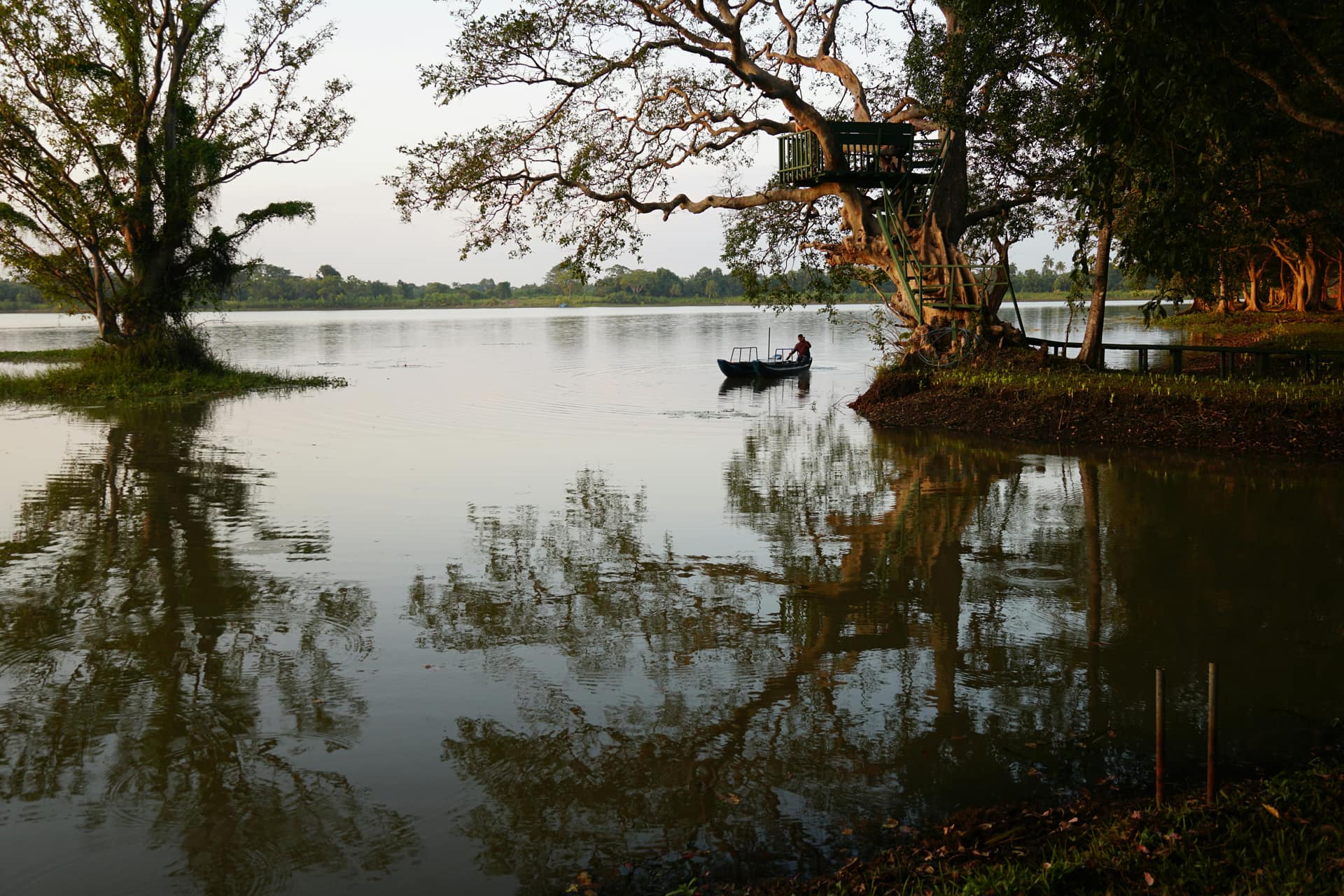
Kaudulla National Park lies in the Polonnaruwa district, north-east of Habarana, and centres on the Kaudulla tank. The tank was built by King Mahasena in the third century and restored in the twentieth century, and its edges are the reason the park exists: as water recedes in the dry season, fresh grass grows on the exposed bed.
Kaudulla was declared a national park in 2002 to secure an elephant corridor between Minneriya National Park and the Somawathiya floodplain. It is smaller and more open than many parks, so herds on the tank bed are easy to see from a distance.
Kaudulla and the elephant gathering
Kaudulla plays a key role in the elephant gathering, the seasonal movement of elephants to the tank beds of Minneriya and Kaudulla during the dry season. Elephants usually arrive at Minneriya first, roughly in July, and as its grass is grazed down many move on to Kaudulla in August and September.
At the peak, herds of more than a hundred elephants can graze, bathe and socialise on the tank bed. Calves stay close to their mothers, young males spar and older bulls move between groups. The behaviour is the main reason to come, as much as the numbers.
The exact timing changes each year with rainfall, so local drivers check daily where the herds are and choose Kaudulla, Minneriya or Hurulu Eco Park on the day.
- →July: herds usually build at Minneriya first.
- →August and September: Kaudulla often holds the largest numbers.
- →October: herds disperse as the north-east monsoon rains begin.
Other wildlife at Kaudulla
Kaudulla National Park has more to see than elephants. The tank attracts painted storks, pelicans, cormorants, herons and fishing eagles, and mugger crocodiles rest on the banks. Spotted deer, sambar and wild boar graze the grassland edges, and toque macaques forage near the tracks.
Leopards and sloth bears are present in the surrounding forest but rarely seen. Birders should look for the grey-headed fish eagle and the lesser adjutant on the tank margins.
- →Waterbirds: storks, pelicans, cormorants and herons.
- →Raptors: fish eagles and serpent eagles.
- →Mammals: spotted deer, sambar and wild boar.
- →Reptiles: mugger crocodiles and land monitors.
How a Kaudulla safari works
Kaudulla safaris are booked by jeep, usually from Habarana, Sigiriya or Polonnaruwa, and most run in the afternoon, from roughly 2 or 3 pm until close to sunset. Elephants come out onto the tank bed in the late afternoon, so this timing gives the best viewing.
The drive from Habarana takes roughly 20 to 30 minutes and from Sigiriya roughly 45 minutes. Park fees are paid at the gate and the jeep price is agreed in advance; confirm current rates, which change. A safari of about three hours is typical.
- →Afternoon safaris give the best chance of large herds on the tank bed.
- →Ask your driver to choose the park on the day, based on recent sightings.
- →Bring binoculars, a hat and water, as there is little shade.
Kaudulla compared with Minneriya
Kaudulla and Minneriya are close neighbours and share the same elephant population. Minneriya is the more famous and usually busier, with herds earlier in the season. Kaudulla tends to be quieter and often has the larger gathering later in the season.
Many travellers do not choose in advance. Experienced drivers watch where the herds are and decide on the day, and both parks give excellent viewing at the right time.
- →Choose Minneriya early in the season, roughly July.
- →Choose Kaudulla later in the season, roughly August to October.
- →Choose Hurulu Eco Park if both are quiet or flooded.
Planning a Kaudulla visit
Kaudulla fits easily into a stay in the Cultural Triangle, as it is within an hour of Sigiriya, Dambulla and Polonnaruwa. A typical plan is a morning at Sigiriya or Polonnaruwa, rest at midday and an afternoon safari at Kaudulla.
Lankan Stays & Trails arranges these safaris as part of Cultural Triangle stays, with drivers who choose between the parks on the day. Outside the gathering season, Kaudulla can still be rewarding, but expect smaller herds.
Frequently asked questions
What is the best time to visit Kaudulla National Park?
The best time to visit Kaudulla is roughly August to October, when elephant numbers usually peak after the herds move across from Minneriya. July can also be good. Outside the dry season, from roughly November to June, elephants are more dispersed and herds are smaller.
How far is Kaudulla from Sigiriya?
Kaudulla National Park is roughly 45 minutes by road from Sigiriya and roughly 20 to 30 minutes from Habarana. Most safaris start from hotels in Sigiriya, Habarana or Polonnaruwa, with the jeep collecting you or meeting you at the park entrance.
Is Kaudulla better than Minneriya?
Neither is always better. Minneriya usually has the larger herds earlier, roughly in July, and Kaudulla often has them later, roughly August to October. Kaudulla is usually quieter. Experienced drivers decide on the day based on where the elephants are feeding.
How many elephants can you see at Kaudulla?
During the peak of the gathering, roughly August to October, Kaudulla can hold more than a hundred elephants on the tank bed at once, in family groups with calves. Outside the season, a safari may see between ten and forty, depending on rainfall and recent movements.
How long is a safari at Kaudulla?
A typical safari at Kaudulla lasts about three hours, usually in the afternoon from roughly 2 or 3 pm until close to sunset. Morning safaris are possible, but elephants usually come onto the open tank bed in the late afternoon, which gives the best viewing.
Can you see leopards at Kaudulla?
Leopards live in the forest around Kaudulla but are rarely seen, as the park is known for elephants rather than cats. Travellers who want leopards should plan time at Yala or Wilpattu. At Kaudulla, the elephants and the waterbirds on the tank are the main attraction.
Is Kaudulla National Park worth visiting outside the gathering season?
Kaudulla can still be worthwhile outside the gathering season, with smaller elephant herds, waterbirds and crocodiles on the tank, and very few other jeeps. But if elephants are the main goal outside roughly July to October, Udawalawe is more reliable.