
Quick answer
Farms near Sigiriya grow rice in paddy fields fed by tanks, vegetables and grains in rain-fed chena plots, and fruit, spices and vegetables in home gardens. There are two rice seasons: Maha, roughly October to March, and Yala, roughly April or May to September. A farm visit, usually two to three hours, may include walking the field bunds, ploughing or planting in season, a home-garden tour and a farm lunch.
Key takeaways
- Rice is grown in two seasons: Maha, roughly October to March, and Yala, roughly April or May to September.
- Paddy fields depend on water from village tanks, many of them centuries old.
- Chena are rain-fed plots of vegetables, pulses and finger millet, traditionally cleared and rotated.
- Home gardens grow coconut, jackfruit, banana, spices and vegetables around each house.
- Farm visits work best in the late afternoon, ending with tea or a meal.
The rice seasons
The rice seasons around Sigiriya follow the monsoons. Maha, the main season, runs roughly from October to March, when the north-east monsoon and inter-monsoon rains fill the tanks. Yala, the smaller season, runs roughly from April or May to September and depends on water stored in the tanks.
That means the fields change through the year. Ploughing and planting happen at the start of each season, the fields turn bright green as the rice grows, then gold before harvest. Between seasons, some fields lie fallow and brown, used by grazing cattle and buffalo.
Ask your host what stage the fields are at when you visit, as it changes what you can see and do.
- →Maha: roughly October to March, the main season.
- →Yala: roughly April or May to September.
- →Green fields: mid-season.
- →Gold fields and harvest: end of each season.
Tanks and water
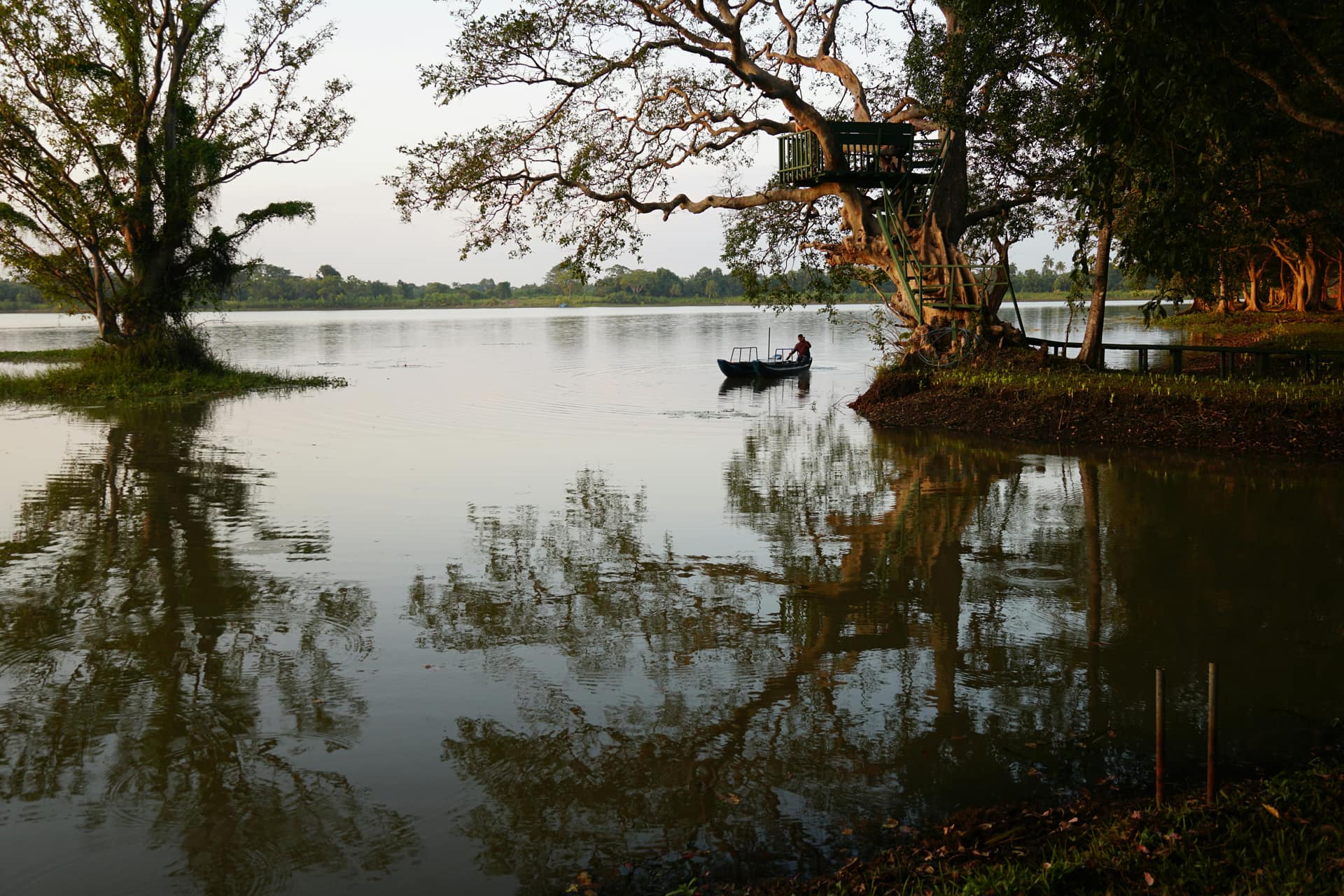
Tanks and water hold the system together. Village tanks, many built centuries ago, store monsoon rain and release it through channels to the fields below. Each tank supports a village, and the larger ones, like Minneriya and Kandalama, support whole regions.
On a farm visit, you may walk along a tank bund and see the sluice and channels that feed the fields. Farmers share water by agreement, and its timing decides when planting begins. The system is one of the oldest continuously working irrigation networks in the world.
Chena and home gardens
Chena and home gardens complete the farming picture. Chena are rain-fed plots, traditionally cleared from scrub, cultivated for a season or two with vegetables, pulses, maize and finger millet, then left to recover. Farmers often build watch huts in the trees beside them to guard against elephants at night.
Home gardens surround almost every house. They grow coconut, jackfruit, mango, banana, papaya, pepper, cinnamon and vegetables, often in layers under taller trees. A walk around one shows how much a family produces for itself.
- →Chena: rain-fed, rotated plots.
- →Crops: vegetables, pulses, maize, finger millet.
- →Watch huts: guarding against elephants.
- →Home gardens: fruit, spices and vegetables.
What a farm visit involves
A farm visit near Sigiriya usually lasts two to three hours. You walk the field bunds with a farmer, learn how rice is planted, tended and harvested, and, in the right season, try your hand at ploughing with buffalo, transplanting seedlings or harvesting. Expect to get muddy.
Many visits include a tour of the home garden, a stop at a watch hut and a meal or tea with the family. Some organic farms near Sigiriya run structured tours with tastings of fruit, herbal drinks and traditional dishes.
Visits that are part of a larger village tour often include a bullock cart ride and a canoe trip on a tank. A dedicated farm visit gives more time with the farmer.
- →Walk the bunds with a farmer.
- →Help with seasonal work.
- →Tour the home garden.
- →Share a meal or tea.
Visiting respectfully
Visiting farms respectfully matters, because these are working fields and homes. Stay on the bunds and paths, as trampling young rice damages the crop. Ask before photographing people, and follow your host's lead on where to walk.
Dress for mud and sun, with a hat, shoes or sandals you can wash and clothes that cover shoulders and knees in homes. Make sure the farmer is paid directly and fairly; ask how the visit is arranged.
- →Stay on bunds and paths.
- →Ask before photographing people.
- →Dress for mud and sun.
- →Ensure fair pay to the farmer.
When to go
When to go on a farm visit near Sigiriya depends on the time of day more than the season. Late afternoon, from about 3.30 pm, is cooler and the light over the fields is beautiful. Early morning also works, before the heat.
At Lankan Stays & Trails, we arrange farm visits with families near Sigiriya and match them to the season, so guests see planting, growing or harvest rather than empty fields.
Frequently asked questions
What crops are grown around Sigiriya?
Rice is the main crop, grown in paddy fields fed by village tanks. Chena plots grow vegetables, pulses, maize and finger millet. Home gardens grow coconut, jackfruit, mango, banana, papaya, pepper, cinnamon and vegetables around each house.
When is rice harvest near Sigiriya?
There are two seasons. The main Maha season runs roughly from October to March, with harvest towards the end, around February and March. The smaller Yala season runs roughly from April or May to September, with harvest around August and September. Timings vary with rainfall.
What do you do on a farm visit near Sigiriya?
You walk the paddy bunds with a farmer, learn about rice growing, help with seasonal work such as planting or harvesting, tour a home garden and often share a meal or tea. Visits last two to three hours.
What is chena farming?
Chena is rain-fed shifting cultivation. Farmers clear a plot of scrub, grow vegetables, pulses, maize and finger millet for a season or two, then leave it to recover. It is an old dry-zone practice, though increasingly regulated today.
Can I try ploughing or planting rice?
In the right season, yes. At the start of Maha or Yala, some visits include ploughing with buffalo or transplanting seedlings. Expect to get muddy. Ask your host what stage the fields are at when you book.
Are there organic farms near Sigiriya?
Yes, several farms near Sigiriya describe themselves as organic and run tours with tastings of fruit and herbal drinks. Ask how they farm and how visits are run, as standards vary and the word organic is used loosely.
Are farm visits suitable for children?
Yes. Children usually love the buffalo, the mud, the watch huts and picking fruit. Keep them on the bunds, protect them from the sun and bring a change of clothes. Late afternoon visits are cooler and more comfortable.