
Quick answer
Parakrama Samudra is a vast reservoir beside Polonnaruwa, built by King Parakramabahu I in the 12th century by linking older tanks, and covering over 20 square kilometres. Its name means the sea of Parakrama. It still irrigates rice fields today. First-time visitors usually see it from the bund road at sunset, after a morning in the ruins. Near its shore, the Potgul Vehera and a stone statue of a bearded figure, possibly Parakramabahu or a sage, are worth a short stop. There is no fee for the bund.
Key takeaways
- Parakrama Samudra was built by Parakramabahu I in the 12th century by linking and enlarging older reservoirs.
- Parakrama Samudra covers over 20 square kilometres, making it one of the largest ancient reservoirs in Sri Lanka.
- The reservoir still irrigates thousands of hectares of rice fields around Polonnaruwa.
- A rock-cut statue of a bearded figure near Potgul Vehera is traditionally identified as Parakramabahu, though some scholars suggest a sage.
- The bund road beside Parakrama Samudra is free to visit and best in the late afternoon.
History
Parakrama Samudra was built by King Parakramabahu I, who reigned in Polonnaruwa from 1153 to 1186, by linking and enlarging several older tanks into one huge reservoir. The name means the sea of Parakrama, reflecting its scale. Parakramabahu is credited with the principle that no drop of rain should reach the sea unused.
The reservoir supplied water for the city and its fields, and supported the wealth that built Polonnaruwa's monuments. After the kingdom's decline, the tank fell into disrepair, and it was restored in the 20th century.
Today it covers over 20 square kilometres and still irrigates thousands of hectares of rice.
Parakrama Samudra is linked with other reservoirs in the region, including Minneriya and Giritale, through channels that move water between them. This network allowed water to be shared across a wide area, supporting rice cultivation on a scale that made Polonnaruwa one of the most productive regions of medieval South Asia.
- →12th century: built by Parakramabahu I.
- →Over 20 square kilometres of water.
- →Restored in the 20th century.
- →Still irrigates rice fields.
Views and sunset
The bund road along Parakrama Samudra gives wide views over the water, with fishermen, herons, egrets and cormorants, and sometimes elephants on the far shore in the dry season. It is free and easy to reach from the ruins.
Late afternoon and sunset are the best times. After a morning cycling Polonnaruwa and a midday rest, a sunset walk on the bund is a calm way to end the day.
Lankan Stays & Trails guides often suggest returning to the bund after an afternoon elephant safari at Minneriya or Kaudulla, on the way back to a Habarana base.
The bund road passes close to the old town and several hotels, and walking a short stretch is easy. Local families gather in the evening, children swim near the steps at the edge of the town section, and fishermen bring in their catch. It is a good place to see everyday Polonnaruwa life alongside its history.
- →Late afternoon light over the water.
- →Birds and fishermen.
- →Free, with easy access.
The statue and Potgul Vehera
Near the southern end of Polonnaruwa, by the water, a rock-cut statue of a bearded figure holding something in his hands is one of the city's most debated pieces. Traditionally identified as Parakramabahu holding a yoke, it may instead show a sage, holding a palm-leaf book.
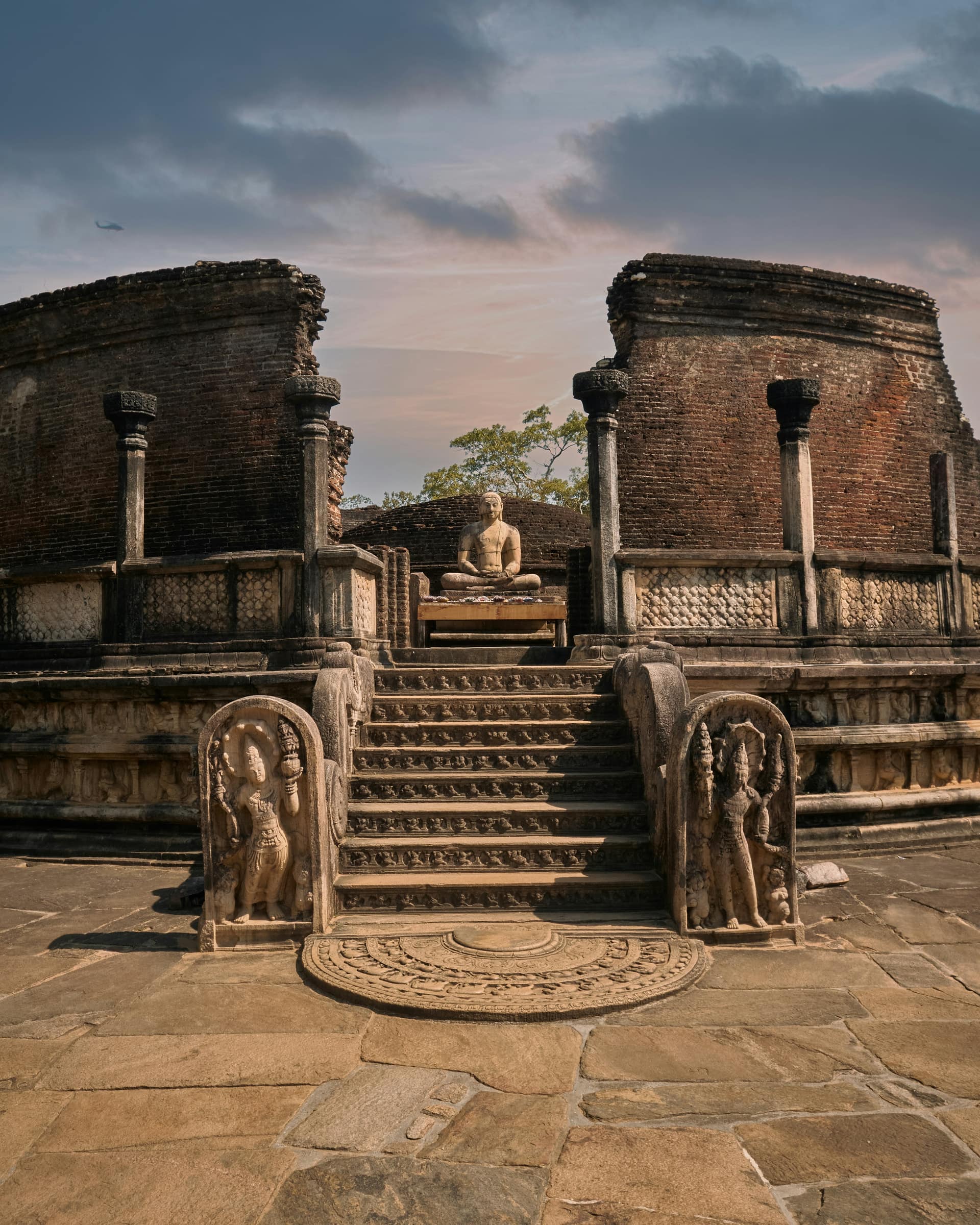
Nearby, the Potgul Vehera is a circular building thought to have been a library for sacred texts. Both are a short stop on the way to or from the ruins.
- →The bearded statue: king or sage.
- →Potgul Vehera: a circular library building.
- →Close to the reservoir's edge.
The engineering
Parakrama Samudra shows the skill of Cultural Triangle engineers. Its long earth bunds hold back water from several catchments, and channels distribute it to fields. Sluices and spillways control levels, using principles developed over a thousand years since Anuradhapura's first tanks.
The reservoir is part of a wider system linking tanks across the dry zone, including Minneriya. Seeing it makes the scale of ancient irrigation clear.
Modern restoration of Parakrama Samudra in the 20th century raised and strengthened the bunds and added new sluices, while keeping the ancient layout. Engineers working on dry-zone irrigation today still study how the original builders chose sites, managed silt and balanced water between linked tanks.
- →Earth bunds across several catchments.
- →Sluices and spillways.
- →Part of a linked tank system.
Visiting tips
Parakrama Samudra is free to visit along the bund road. Combine it with a Polonnaruwa morning: ruins from 7am, rest at midday, then return for sunset. The bearded statue and Potgul Vehera can be seen in about 20 minutes.
Bring insect repellent for the evening, and watch for traffic on the bund road. Some hotels near Polonnaruwa sit right on the water's edge, which makes sunset effortless.
Frequently asked questions
What is Parakrama Samudra?
Parakrama Samudra is a huge reservoir beside Polonnaruwa, built by King Parakramabahu I in the 12th century by linking older tanks. Covering over 20 square kilometres, it still irrigates rice fields today.
How big is Parakrama Samudra?
It covers over 20 square kilometres, making it one of the largest ancient reservoirs in Sri Lanka. Exact figures vary with water levels and the sections included. The bund alone stretches for many kilometres beside the town.
Who is the statue near Parakrama Samudra?
Traditionally, King Parakramabahu I holding a yoke, but some scholars suggest a sage holding a palm-leaf book. The rock-cut statue stands near Potgul Vehera at the southern end of Polonnaruwa.
Is Parakrama Samudra worth visiting?
Yes, as a short, calm stop. The bund road gives wide views over the water, especially at sunset. It is free and easy to combine with a morning at the ruins.
Can you swim in Parakrama Samudra?
It is not recommended. The reservoir is used for irrigation and fishing, crocodiles live in the area, and there are no safe swimming facilities. Enjoy it from the bund. Many hotels nearby have pools instead.
Do I need a ticket for Parakrama Samudra?
No. The bund road is free. The statue and Potgul Vehera are normally accessible without the main ticket, but confirm locally, as access arrangements can change. The bund itself is a public road.
When is the best time to visit Parakrama Samudra?
Late afternoon and sunset, after a morning in Polonnaruwa's ruins and a midday rest. The light is soft, birds gather and fishermen return. Bring insect repellent. After the rains, roughly November to January, the water is at its highest.