
Quick answer
Polonnaruwa is worth visiting in December. The north-east monsoon brings showers, usually in the afternoon, and cloud keeps days cooler than in the dry months, around 28 to 30°C. The ruins are green, the Parakrama Samudra reservoir is full and crowds are lighter than at Sigiriya. Start at opening time, cycle or drive between the main sites in the morning, and keep the museum and covered image houses for any afternoon shower. Half a day to a full day is enough.
Key takeaways
- December is Polonnaruwa's rainy season, with showers mostly in the afternoon.
- Cloud keeps the site cooler and more comfortable than in the dry months.
- The reservoir is full and the landscape is at its greenest.
- Crowds are lighter than at Sigiriya and Dambulla.
- Morning visits work best; save the museum for a shower.
Polonnaruwa's December weather
Polonnaruwa receives most of its annual rain between October and January, carried by the north-east monsoon. December is often one of the wettest months, but the rain usually comes in heavy bursts in the afternoon or evening rather than all day. Mornings are frequently bright, humid and warm.
The cloud cover makes a real difference to comfort. In the dry season, temperatures in the exposed ruins push past 33°C by late morning. In December they usually stay around 28 to 30°C, and overcast spells make walking between sites far easier than in the summer months.
Occasionally a Bay of Bengal depression brings a day or two of steady rain to the whole north-central province. Low roads can flood briefly and parts of the site become waterlogged. These events are uncommon, but a flexible day on any December Cultural Triangle itinerary is sensible.
- →Rain: mostly afternoon and evening bursts.
- →Temperature: around 28 to 30°C, cooler than the dry months.
- →Occasional storms: keep one flexible day.
The ruins in December
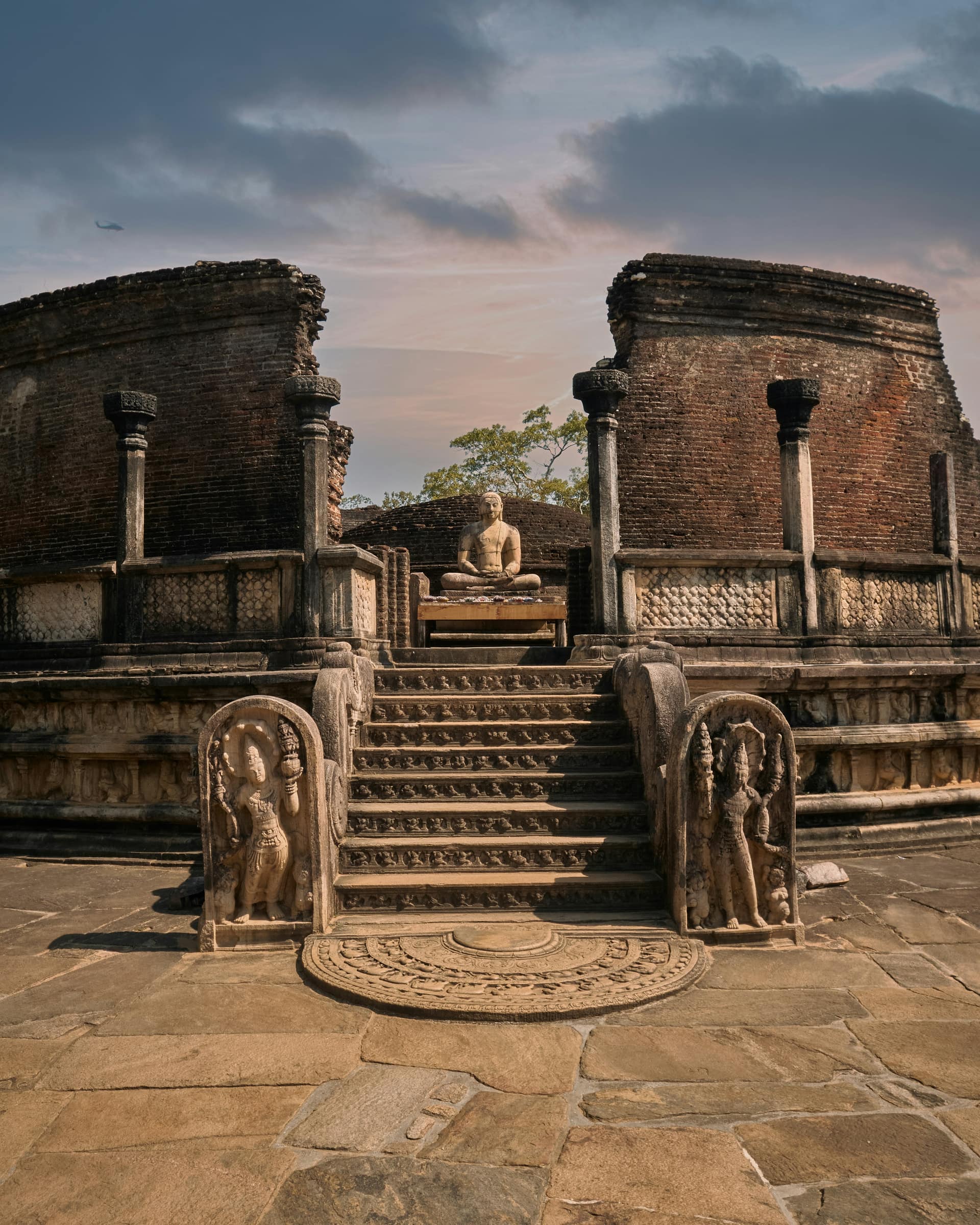
The main sites run north to south along a single road: the Royal Palace and Council Chamber, the Sacred Quadrangle with the Vatadage, the Lankatilaka image house, the Rankoth Vehera and Kiri Vehera stupas, and finally the Gal Vihara, with its four great Buddha figures carved from one granite face. The whole circuit is about six kilometres.
December's green suits the ruins. Grass grows between the brick walls, the trees are in full leaf and the moonstones and guard stones stand out against wet, dark stone. The Gal Vihara figures look particularly fine in the soft light of an overcast morning.
Stone surfaces become slippery after rain, especially on the steps of the Vatadage and around the Gal Vihara. Shoes and hats are removed at the sacred sites, so sandals that slip off easily are best. Wear clothes that cover shoulders and knees, as at all temples.
- →Royal Palace and Council Chamber.
- →Sacred Quadrangle and the Vatadage.
- →Lankatilaka and Kiri Vehera.
- →Gal Vihara rock-cut figures.
Timing your visit
Arrive at opening time. The first three or four hours of the day usually offer the driest, clearest conditions in December, and you will share the site with only a few groups. Begin at the museum near the entrance if it opens early, or leave it for later as a rain shelter.
Bicycles are the classic way to see Polonnaruwa, and many guesthouses rent them. In December, cycling works well in the morning, but carry a rain jacket and be ready to shelter if clouds build. A tuk-tuk or your driver can follow between sites and makes the afternoon easier if it pours.
The Parakrama Samudra reservoir is full in December, and sunset by the bund is lovely on dry evenings. Combine a morning at the ruins with an afternoon elephant safari at Minneriya, Kaudulla or Hurulu, although herds are smaller and more scattered in December than during the summer gathering.
Crowds and combinations
Polonnaruwa is always quieter than Sigiriya, and December, especially early in the month, is a calm time to visit. Even in the holiday weeks, the size of the site spreads visitors out. Most tour groups arrive mid-morning, so an early start means near-empty ruins.
Most travellers visit Polonnaruwa from a base in Sigiriya, Habarana or Dambulla, about an hour away. Staying a night in Polonnaruwa itself, by the reservoir, lets you start the ruins at dawn and see the town's quieter side.
The planners at Lankan Stays & Trails usually pair Polonnaruwa with Sigiriya in December routes, with the rock climbed on one dry morning and Polonnaruwa on the next, leaving afternoons free for showers, a swim at the hotel or a village visit.
- →Base: Sigiriya, Habarana or Dambulla, about an hour away.
- →Overnight by the reservoir for a dawn start.
- →Pair with Sigiriya on separate mornings.
Is it worth it in December?
For history lovers, yes. December's cooler, greener conditions make the ruins more comfortable than at any other time of year, and the main limitation, afternoon rain, is easy to plan around. Travellers who dislike humidity may find it sticky, but they will find the summer heat far harder.
If your route has room for only one ancient city in December, Polonnaruwa is often the better choice over Anuradhapura, because its sites are more compact and can be seen in a single dry morning.
Frequently asked questions
Is Polonnaruwa good to visit in December?
Yes. December brings afternoon showers but cooler, greener conditions than the dry months, and crowds are lighter than at Sigiriya. Start at opening time and see the main sites in the morning, keeping the museum or covered image houses for any afternoon rain. Half a day to a full day is enough.
Does it rain a lot in Polonnaruwa in December?
December is one of Polonnaruwa's wettest months, as the north-east monsoon brings most of its annual rain. Showers usually fall in heavy afternoon or evening bursts, and mornings are often bright. A Bay of Bengal depression can occasionally bring one or two days of steady rain.
Can I cycle around Polonnaruwa in December?
Yes, cycling works well in the morning, when conditions are usually dry. Carry a rain jacket and be ready to shelter if clouds build. A tuk-tuk or your driver following between sites makes the afternoon easier, and the full circuit is about six kilometres.
How hot is Polonnaruwa in December?
Usually around 28 to 30°C, noticeably cooler than the dry months, when it passes 33°C. Cloud cover helps, but the humidity is high, especially after rain. Light, covering clothes, a hat and water make walking between the sites comfortable.
Can I see elephants near Polonnaruwa in December?
Yes, but in smaller numbers than during the July to October gathering. Herds disperse once the reservoirs fill, and drivers choose between Minneriya, Kaudulla and Hurulu depending on recent sightings. An afternoon safari pairs well with a morning at the ruins.
Is Polonnaruwa or Anuradhapura better in December?
For most travellers, Polonnaruwa. Its sites are compact and can be seen in one dry morning, which suits December's showery afternoons. Anuradhapura is larger and more spread out, so it takes longer and is harder to fit around rain. Both are green and quiet this month.
How many hours do I need at Polonnaruwa?
Three to four hours covers the main sites from the Royal Palace to the Gal Vihara, plus the museum. A full day allows a slower pace, lunch and a sunset by the Parakrama Samudra reservoir. In December, aim to finish the outdoor sites before mid-afternoon showers.