
Quick answer
Koneswaram, on Swami Rock above the sea in Trincomalee, is the Sri Lankan temple most linked to Ravana's devotion to Shiva. Tradition says Ravana worshipped here, and a fissure in the cliff, Ravana's Cleft, is said to have been cut by his sword. The temple, destroyed by the Portuguese in the 1620s and rebuilt in the twentieth century, is one of the island's five ancient Shiva temples.
Key takeaways
- Ravana is remembered in Tamil Shaiva tradition as a great devotee of Shiva.
- Koneswaram on Swami Rock in Trincomalee honours that devotion.
- Ravana's Cleft, a fissure in the cliff, is said to be cut by his sword.
- The temple was destroyed in the 1620s and rebuilt in the twentieth century.
- Trincomalee is about 4 to 5 hours from Kandy.
Ravana the devotee
Tradition says Ravana won his boons from Brahma and Shiva through intense austerity. One famous story tells of him trying to lift Mount Kailash, being pinned beneath it by Shiva's toe and singing praise until he was forgiven. The Shiva Tandava Stotram is traditionally attributed to him.
In Tamil Shaiva tradition, this devotion makes Ravana a figure of respect, even admiration, alongside his role as Rama's enemy. Many temples in South India and Sri Lanka keep stories of his worship.
The epic itself shows his learning and grandeur. His tragedy lies in pride and desire, not in a lack of devotion.
On screen
Screen versions have increasingly shown Ravana's devotion to Shiva, and the new film presents him as a powerful king of great learning. Viewers often come away curious about this side of him.
No part of the film was shot at Koneswaram, as far as published reports show. The temple's link to Ravana is through long tradition, honoured by Tamil Hindus of Trincomalee.
For film fans, Koneswaram offers a chance to see where Ravana is remembered as a devotee, which often changes how they think about the character.
Koneswaram on Swami Rock
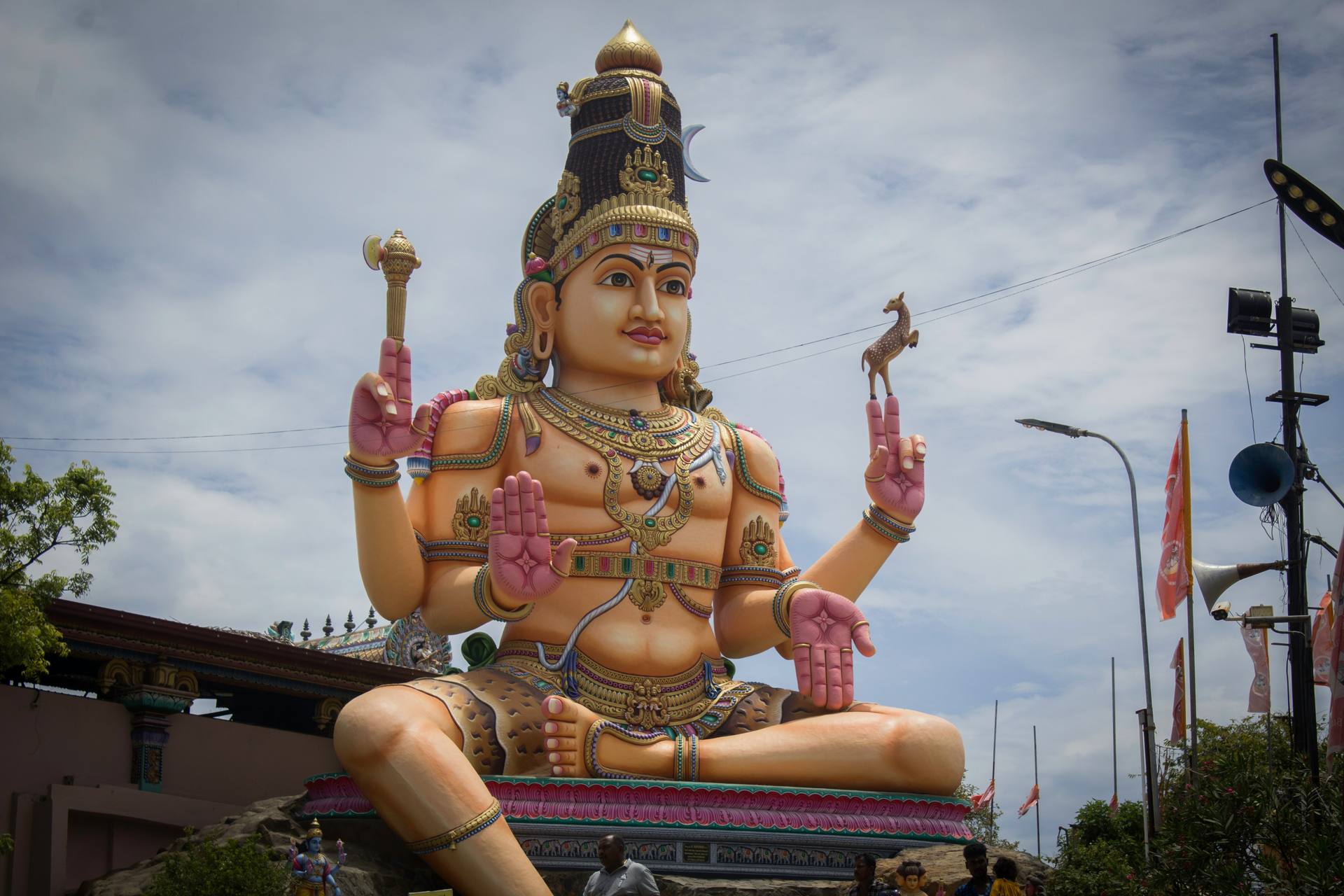
Koneswaram stands on Swami Rock, a headland that drops sharply into the sea at the edge of Trincomalee's Fort Frederick. It is one of the Pancha Ishwarams, the five ancient Shiva temples of Sri Lanka.
The original temple was famous across South Asia and praised in Tamil hymns. Portuguese forces destroyed it in the 1620s, throwing much of it into the sea. The present temple was rebuilt in the twentieth century, and some ancient images were recovered from the water.
Today, the colourful temple, with a large Shiva statue overlooking the bay, draws pilgrims from across the island and from India. Pujas are held several times a day.
- →Location: Swami Rock, Fort Frederick, Trincomalee.
- →Status: one of the five ancient Shiva temples.
- →History: destroyed in the 1620s, rebuilt in the twentieth century.
Ravana's Cleft
Just below the temple, a narrow fissure splits the cliff. Tradition says Ravana cut it with his sword, either in anger or in an attempt to move the temple's lingam for his mother. It is known as Ravana's Cleft or Ravana Vettu.
Visitors can look down into the cleft from a viewpoint near the temple. The sea crashes far below, and the drop is dramatic, so keep children close.
Guides share the different versions of the story, which shows how flexible and alive the tradition remains.
- →Ravana's Cleft: a fissure in the cliff below the temple.
- →Story: cut by Ravana's sword.
- →Safety: keep children close at the edge.
Visiting Koneswaram
Trincomalee is about 4 to 5 hours from Kandy and about 2.5 hours from Sigiriya. Koneswaram is reached through the gate of Fort Frederick, which is a military area, with deer roaming the road.
Dress modestly, remove shoes at the entrance, and men may be asked to remove shirts in the inner shrine. Visit for the evening puja, when lamps are lit against the sea. Lankan Stays & Trails can add Koneswaram and nearby Kanniya to a northern or eastern route.
The east coast is driest from about April to September, when Trincomalee's beaches are at their best too.
- →From Kandy: 4 to 5 hours.
- →Best time: April to September.
- →Visit: evening puja for atmosphere.
Pairing with Kanniya and the beaches
Kanniya hot wells, about 8 km from Trincomalee, are linked to Ravana's devotion to his mother. Tradition says he created the seven wells to perform her last rites.
Trincomalee's beaches at Nilaveli and Uppuveli make a relaxing end to a Ramayana trip, with snorkelling at Pigeon Island.
Combining Koneswaram, Kanniya and the beaches gives film fans a rounded view of Ravana as devotee and son.
Frequently asked questions
Why is Ravana linked to Koneswaram?
Tamil Shaiva tradition holds that Ravana, a great devotee of Shiva, worshipped at Koneswaram. A fissure in the cliff below the temple, Ravana's Cleft, is said to have been cut by his sword, keeping his memory alive at the site.
Was Koneswaram used in the Ramayana movie?
No. As far as published reports show, the film was shot largely on sets in Mumbai. Koneswaram's link to Ravana comes from long tradition, honoured by Tamil Hindus of Trincomalee, not from filming.
What is Ravana's Cleft?
Ravana's Cleft is a narrow fissure in the cliff below Koneswaram, said to have been cut by Ravana's sword. Visitors can look into it from a viewpoint near the temple, keeping children close at the edge.
What is the Shiva Tandava Stotram?
It is a powerful hymn to Shiva traditionally attributed to Ravana. Legend says he composed it while pinned beneath Mount Kailash. Many pilgrims recite it at Koneswaram in his memory.
How do we get to Koneswaram?
Koneswaram is in Trincomalee, about 4 to 5 hours from Kandy and 2.5 hours from Sigiriya. The temple is reached through the gate of Fort Frederick, and the last stretch is a short walk or drive up Swami Rock.
What is the dress code at Koneswaram?
Dress modestly, remove shoes at the entrance, and be ready for men to be asked to remove shirts in the inner shrine. Women should cover shoulders and knees. A light shawl is useful.
Can we combine Koneswaram with a beach stay?
Yes. Nilaveli and Uppuveli beaches are close to Trincomalee, with snorkelling at Pigeon Island. April to September is the best season on the east coast, making it a natural end to a Ramayana trip.