
Quick answer
Climb Sigiriya for the archaeology: the fifth-century rock palace, the frescoes, the mirror wall, the lion's paws and the water gardens, all UNESCO World Heritage listed. Climb Pidurangala for the view of Sigiriya itself, which you cannot see while standing on it. Sigiriya's entry fee is substantially higher; Pidurangala's is nominal. Sigiriya takes about 1.5 to 3 hours; Pidurangala about 1 to 1.5 hours with a rock scramble at the end. If you have two mornings, do Pidurangala at sunrise and Sigiriya the next day at opening.
Key takeaways
- Sigiriya is a UNESCO World Heritage site with frescoes, water gardens, the mirror wall and the lion's paws.
- Pidurangala offers the best view of Sigiriya, which is impossible to get from Sigiriya itself.
- Sigiriya's foreign visitor entry fee is substantially higher than Pidurangala's nominal charge.
- Pidurangala finishes with a genuine rock scramble that is unsuitable for some visitors.
- Pidurangala is a temple site: shoulders and knees must be covered even though it is mainly climbed for the view.
The short answer
If you have one morning and a serious interest in history, climb Sigiriya. If you have one morning and want the best photograph and the best sunrise, climb Pidurangala. If you have two mornings, do Pidurangala first for sunrise, then Sigiriya at gate opening the following day.
Doing both on the same day is possible but hot and tiring, and the second climb will be in the worst of the heat. If you must, do Pidurangala at sunrise, rest through the middle of the day, and take Sigiriya in the late afternoon.
- →History and archaeology: Sigiriya.
- →The view and the photograph: Pidurangala.
- →Two mornings: Pidurangala at sunrise, then Sigiriya at opening.
- →One day only: Pidurangala at dawn, Sigiriya in the late afternoon.
What Sigiriya actually gives you
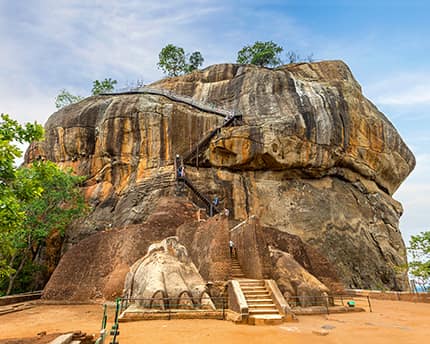
Sigiriya is not a viewpoint with steps attached; it is one of the most remarkable archaeological sites in Asia. King Kasyapa built a palace on the 200-metre summit in the fifth century CE after seizing the throne from his father, and the complex below includes symmetrical water gardens with fountains that still work in the rains, boulder gardens, and terraced approaches.
The climb passes the frescoes, a set of painted figures in a sheltered rock pocket that are among the finest surviving ancient paintings in South Asia, and the mirror wall, a polished surface covered in graffiti verses written by visitors between roughly the sixth and fourteenth centuries. Halfway up, two enormous carved lion's paws flank the final staircase, all that survives of a gateway shaped as a lion.
- →Fifth-century palace complex on a 200-metre rock, UNESCO listed.
- →Frescoes: among the finest surviving ancient paintings in South Asia.
- →Mirror wall: graffiti verses left by visitors from roughly the 6th to 14th centuries.
- →Lion's paws: the surviving fragment of a monumental lion gateway.
- →Symmetrical water gardens at the base, with fountains that still function.
What Pidurangala gives you
Pidurangala is a granite outcrop a kilometre north of Sigiriya, with a monastery at its base that predates Kasyapa's palace. The path climbs through the temple complex, past a large reclining Buddha built partly of brick where the original was damaged, and then onto the rock.
The last section is a genuine scramble over large boulders, with no steps and no handrail, requiring hands as well as feet. At the top is a broad, flat summit with an uninterrupted view of Sigiriya rising from the forest, which is the image everyone has seen and nobody standing on Sigiriya can take. At sunrise, with mist in the trees below, it is one of the great views in Sri Lanka.
- →A kilometre north of Sigiriya, with an older monastery at its base.
- →Reclining Buddha on the way up, partly rebuilt in brick.
- →Final section is a boulder scramble with no steps or handrails.
- →Broad flat summit with the classic view of Sigiriya across the forest.
Difficulty and who each suits
Sigiriya is a staircase climb of roughly 1,200 steps, much of it on modern metal spiral and gantry stairs bolted to the rock face. It is exposed and it involves an open metal spiral staircase to the frescoes that some people find genuinely alarming, but it requires no scrambling and there are handrails throughout. Anyone with a reasonable head for heights and average fitness can do it.
Pidurangala is shorter but rougher. The rock scramble at the top is not technical, but it needs hands, balance and confidence on uneven boulders, and it is unsuitable for very young children, anyone with mobility limitations, or anyone climbing in the dark without a torch. It is not the easy option, despite being the cheap one.
- →Sigiriya: roughly 1,200 steps, metal stairways, handrails, no scrambling.
- →Sigiriya's open spiral staircase to the frescoes troubles some visitors.
- →Pidurangala: shorter, but with an unassisted boulder scramble at the top.
- →Pidurangala is not suitable for small children or limited mobility.
Cost, time and crowds
Sigiriya carries a substantially higher foreign visitor entry fee than almost any other site in Sri Lanka, while Pidurangala charges a nominal amount. Prices change, so confirm currently rather than relying on figures online, and carry cash.
Sigiriya takes 1.5 to 3 hours depending on crowds; the bottleneck is the spiral staircase to the frescoes and the narrow section at the lion's paws, which can queue badly from mid-morning. Pidurangala takes about an hour to an hour and a half. Both are far quieter at opening, and Sigiriya at 7am is a different site from Sigiriya at 10am.
- →Sigiriya: high entry fee for foreign visitors; confirm current pricing.
- →Pidurangala: nominal fee, paid at the temple; carry cash.
- →Sigiriya: 1.5 to 3 hours, with queues at the frescoes and lion's paws.
- →Pidurangala: about 1 to 1.5 hours round trip.
- →Both are dramatically better at gate opening than at mid-morning.
Sunrise: Pidurangala's advantage
Pidurangala can be climbed before dawn and is the classic sunrise spot in the Cultural Triangle. Start around 5am with a head torch, allow 45 minutes to the top, and you will be on the summit as the light comes up behind Sigiriya. It is popular, so expect company, but the summit is broad enough to absorb it.
Sigiriya does not open early enough for sunrise from the summit, so if a sunrise photograph is the goal, Pidurangala is the only option of the two. The trade-off is that you are photographing Sigiriya rather than standing on it.
- →Pidurangala: start around 5am with a head torch for sunrise.
- →Allow about 45 minutes to the summit in the dark.
- →Sigiriya does not open early enough for a summit sunrise.
- →The summit at Pidurangala is broad enough to handle the sunrise crowd.
Etiquette and practicalities
Pidurangala is an active temple site, and the dress code applies from the base: shoulders and knees covered, shoes off at the temple areas. Many visitors treat it purely as a hike and turn up in vests and shorts, which is disrespectful and sometimes refused at the entrance.
At both, start early, carry more water than you think you need, and wear proper shoes. Hornets are a genuine and documented hazard on Sigiriya, with warning signs and crouching shelters on the route: if the alarm is raised, follow instructions immediately, stay still and covered, and do not run or wave.
- →Pidurangala is a temple: cover shoulders and knees, shoes off at the shrine.
- →Carry water; there is no shade on either summit.
- →Proper shoes at both; Pidurangala's boulders are slippery when wet.
- →Hornets are a real hazard at Sigiriya. Follow staff instructions if alerted.
The plan we recommend
Two nights at Sigiriya or Habarana. Day one: Pidurangala at sunrise, then rest, then Dambulla cave temple in the afternoon. Day two: Sigiriya at gate opening with a guide who can explain the frescoes and the water gardens, which are what most people miss while hurrying to the top.
Lankan Stays & Trails sets both climbs at first light and provides a guide for Sigiriya specifically, because the site rewards explanation far more than it rewards speed.
Frequently asked questions
Sigiriya or Pidurangala, which is better?
They offer different things. Sigiriya is the UNESCO-listed archaeological site with frescoes, water gardens and the lion's paws. Pidurangala is a viewpoint giving the classic view of Sigiriya, which you cannot see while standing on it. With two mornings available, do both.
Is Pidurangala easier than Sigiriya?
Shorter, but not necessarily easier. Sigiriya is roughly 1,200 steps on metal stairways with handrails and no scrambling. Pidurangala finishes with an unassisted boulder scramble needing hands and balance, which makes it unsuitable for small children or anyone with mobility limits.
How much does it cost to climb Sigiriya?
Sigiriya carries one of the highest foreign visitor entry fees of any site in Sri Lanka, while Pidurangala charges only a nominal amount at the temple. Prices change periodically, so confirm the current figure locally rather than relying on published numbers, and carry cash.
Can you watch the sunrise from Sigiriya?
No. Sigiriya does not open early enough for a summit sunrise. Pidurangala can be climbed before dawn with a head torch, taking about 45 minutes, and is the classic Cultural Triangle sunrise spot, with the light coming up behind Sigiriya across the forest.
How long does it take to climb Sigiriya?
About 1.5 to 3 hours depending on crowds. The bottlenecks are the open spiral staircase up to the frescoes and the narrow section at the lion's paws, both of which queue badly from mid-morning. Arriving at gate opening makes an enormous difference.
Can you do Sigiriya and Pidurangala on the same day?
Yes, but it is hot and tiring and the second climb falls in the worst heat. If you must, climb Pidurangala at sunrise, rest through the middle of the day, and take Sigiriya in the late afternoon. Two separate mornings is a much better experience.
What should I wear to climb Pidurangala?
Pidurangala is an active temple site, so cover shoulders and knees from the base, and remove shoes at the shrine areas. Visitors in vests and shorts are sometimes refused entry. Wear proper shoes with grip for the boulder scramble at the top.