
Quick answer
Somawathiya and Flood Plains national parks protect the lower Mahaweli River's floodplain north-east of Polonnaruwa, where seasonal lakes called villus attract elephants and waterbirds in the dry season, roughly June to September. Flood Plains covers roughly 17,350 hectares and Somawathiya roughly 37,760 hectares, and both form part of an elephant corridor linking Minneriya, Wasgamuwa and the east. Somawathiya also holds the Somawathi Chaitya, a stupa said to enshrine a tooth relic, and both parks are roughly one to two hours from Polonnaruwa.
Key takeaways
- Flood Plains National Park covers roughly 17,350 hectares along the Mahaweli River between Polonnaruwa and Somawathiya.
- Somawathiya National Park covers roughly 37,760 hectares and contains the Somawathi Chaitya, an important pilgrimage site.
- The parks' seasonal lakes, called villus, hold water into the dry season and attract elephants and waterbirds.
- Both parks lie on an elephant corridor linking Minneriya, Wasgamuwa and the eastern lowlands.
- Visitor numbers are very low, and safaris need to be arranged locally in advance.
What the Mahaweli floodplain parks are
Somawathiya and Flood Plains national parks lie along the lower Mahaweli Ganga, Sri Lanka's longest river, as it flows north-east from Polonnaruwa towards Trincomalee. Flood Plains National Park, declared in 1984, protects the river's floodplain and its villus, the seasonal lakes left behind when floodwater recedes. Somawathiya National Park, declared in 1986, lies further downstream and covers drier forest and riverbank.
Both parks were created as part of the Mahaweli development programme, to protect the floodplain from conversion to farmland and to keep a corridor open for elephants. They link Minneriya and Wasgamuwa to the west with forests to the east, and many elephants use them seasonally.
Wildlife on the floodplain
The Mahaweli floodplain's villus are its wildlife magnets. As they shrink in the dry season, elephants come to drink and feed on the grass that grows on the exposed mud, and waterbirds gather in large numbers. Painted storks, spoonbills, pelicans, herons and egrets are common, and the floodplain is important for migrant waterbirds in the northern winter.
Elephants are the main mammal attraction, with herds moving between the parks and Wasgamuwa. Spotted deer, water buffalo, wild boar and mugger crocodiles are also common, and leopards and sloth bears are present but rarely seen.
- →Elephants: herds at the villus in the dry season.
- →Waterbirds: storks, spoonbills, pelicans and egrets.
- →Migrants: waders and ducks roughly November to March.
- →Reptiles: mugger crocodiles in the villus and river.
The Somawathi Chaitya
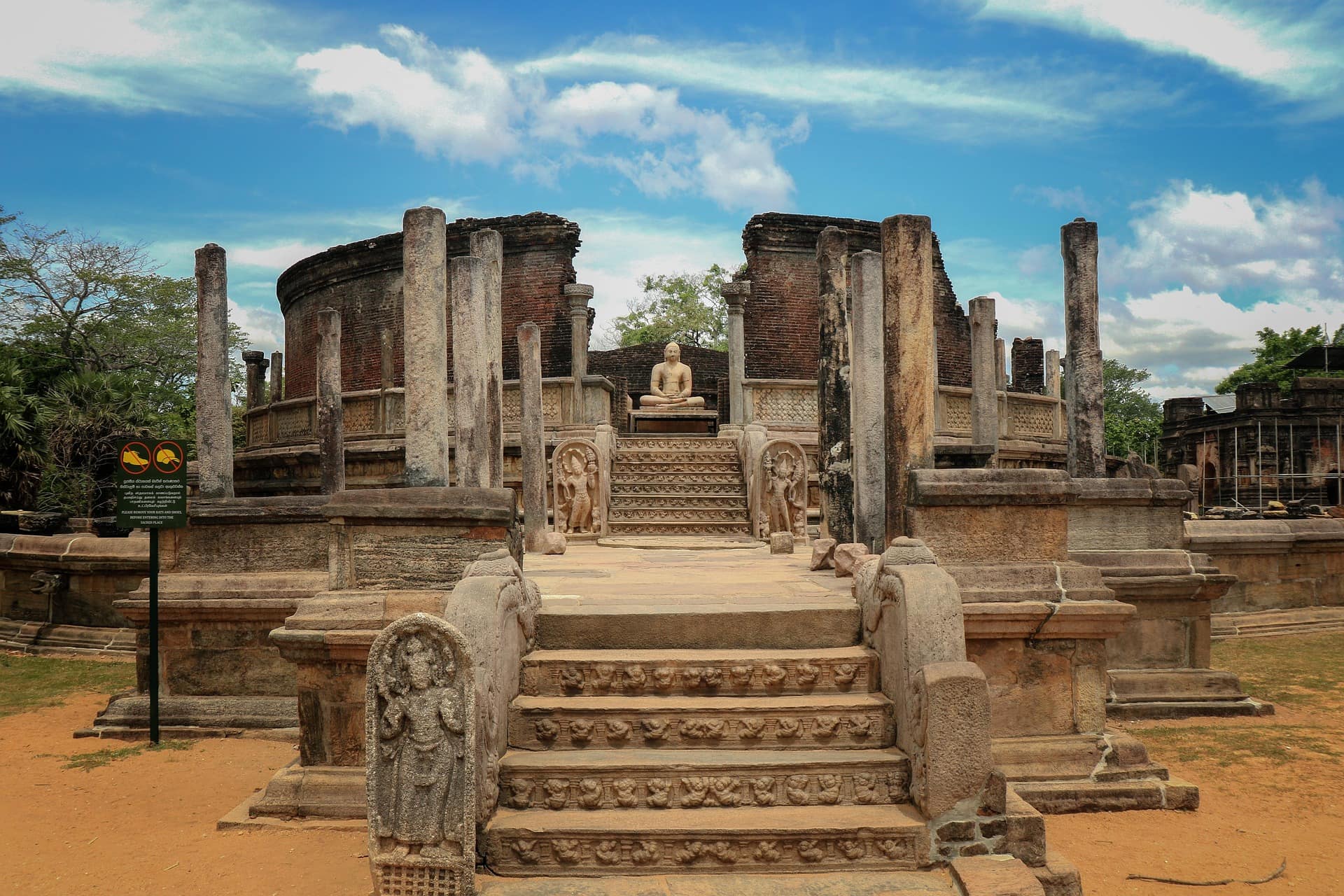
The Somawathi Chaitya, inside Somawathiya National Park, is a stupa said to enshrine a tooth relic of the Buddha. It is an important pilgrimage site, especially on poya days, and the road to it passes through the park, so pilgrims and wildlife share the route.
The stupa has been restored and stands near the Mahaweli River, with forest around it. Visitors should dress respectfully, removing shoes and covering shoulders and knees, and should expect crowds on poya days and at weekends.
When to visit
The best time to visit Somawathiya and Flood Plains national parks is roughly June to September, the dry season in this region, when the villus shrink and elephants gather. From roughly October to January the north-east monsoon brings floods, and parts of the floodplain can become inaccessible.
Migrant waterbirds arrive roughly from November and stay until March, so birders may prefer the early dry season, when the villus still hold water and the migrants are present.
- →June to September: best for elephants at the villus.
- →November to March: best for migrant waterbirds.
- →October to December: flood risk, with some areas closed.
Getting there and arranging a visit
Somawathiya is roughly one and a half to two hours by road from Polonnaruwa via Sungawila, and Flood Plains is closer to Polonnaruwa. Roads are rural and sometimes rough, and public transport is limited.
Safaris are not as organised as at the major parks, so jeeps and access should be arranged in advance through a hotel or driver in Polonnaruwa. Facilities are basic, so bring water and food. Lankan Stays & Trails can arrange these parks for travellers spending extra time around Polonnaruwa in the dry season.
- →Arrange a jeep through a Polonnaruwa hotel or guide.
- →Check access with the park office, especially after rain.
- →Avoid poya days if you want a quiet visit to the stupa.
Who the floodplain parks suit
Somawathiya and Flood Plains national parks suit travellers who have already seen the main parks and want somewhere quieter, birders interested in waterbirds and migrants, and pilgrims or culture lovers visiting the Somawathi Chaitya. They are not the place for a guaranteed leopard or a first safari.
For most travellers, the parks work as a half-day from Polonnaruwa, combined with the ancient city or with Minneriya and Kaudulla in the gathering season.
- →Choose these parks for quiet elephant viewing and waterbirds.
- →Choose Minneriya or Kaudulla for the large gathering herds.
- →Choose Wasgamuwa for a more organised quiet park.
Frequently asked questions
Where are Somawathiya and Flood Plains national parks?
Both parks lie along the lower Mahaweli River, north-east of Polonnaruwa in Sri Lanka's dry zone. Flood Plains is closer to Polonnaruwa, and Somawathiya lies further downstream. Both are roughly one to two hours by road from Polonnaruwa and are part of an elephant corridor.
What are villus?
Villus are seasonal lakes on the Mahaweli floodplain, formed when floodwater recedes. They hold water into the dry season and are surrounded by grassland, which makes them magnets for elephants, deer and waterbirds. Wilpattu also has villus, though there they are natural basins filled by rain.
What is the Somawathi Chaitya?
The Somawathi Chaitya is a stupa inside Somawathiya National Park, said to enshrine a tooth relic of the Buddha. It is an important pilgrimage site, especially on poya days. Visitors should dress respectfully and expect crowds on full-moon days and weekends.
Can you see elephants at Somawathiya?
Yes. Elephants move through Somawathiya and Flood Plains national parks seasonally, and herds are most often seen at the villus in the dry season, roughly June to September. Sightings are less predictable than at Minneriya or Udawalawe, but the parks are much quieter.
When is the best time to visit the Mahaweli floodplain parks?
Roughly June to September is best for elephants, when the villus shrink and animals gather near water. Birders may prefer November to March, when migrant waterbirds arrive. From October to December, floods can make parts of the parks inaccessible, so check before you travel.
How do I arrange a safari at Somawathiya or Flood Plains?
Safaris are less organised than at the main parks, so arrange a jeep in advance through a hotel, guide or driver in Polonnaruwa. Check with the park office about access, especially after rain, and bring water and food, as facilities are basic.
Are these parks good for a first safari?
Not usually. They are quieter and less predictable than Minneriya, Kaudulla or Udawalawe, which are better for a first safari. Somawathiya and Flood Plains suit travellers who have already seen the main parks, birders and those visiting the Somawathi Chaitya.