
Quick answer
The Cultural Triangle's history runs from Anuradhapura, Sri Lanka's first great capital from roughly the 4th century BC to AD 1017, through Sigiriya, King Kashyapa's rock palace in the late 5th century, to Polonnaruwa, the medieval capital of the 11th to 13th centuries. Buddhism arrived at Mihintale in the 3rd century BC and shaped every site. After Polonnaruwa, capitals moved south-west, and Kandy, the Triangle's southern corner, was the last royal capital until the British took it in 1815.
Key takeaways
- Anuradhapura was Sri Lanka's capital for roughly 1,400 years, from around the 4th century BC until its fall in 1017.
- Buddhism arrived in Sri Lanka in the 3rd century BC, when the monk Mahinda met King Devanampiya Tissa at Mihintale.
- Sigiriya was King Kashyapa's royal capital for only about 18 years in the late 5th century AD.
- Polonnaruwa was the capital from the 11th to 13th centuries, peaking under Parakramabahu I, who reigned from 1153 to 1186.
- Kandy was the last independent royal capital of Sri Lanka until the British took control in 1815.
Anuradhapura: the first great capital
Anuradhapura was the first great capital of Sri Lanka, founded in roughly the 4th century BC and capital for about 1,400 years. Its kings built some of the largest stupas in the ancient world, vast monasteries and the great irrigation tanks that still water the dry zone today.
Buddhism arrived in the 3rd century BC, when the monk Mahinda, son of the Indian emperor Ashoka, met King Devanampiya Tissa at Mihintale. Soon afterwards, Mahinda's sister Sanghamitta brought a sapling of the Bo tree under which the Buddha attained enlightenment. It grows in Anuradhapura today as the Sri Maha Bodhi.
Anuradhapura fell in 1017 to the Chola dynasty of south India, and the capital moved to Polonnaruwa.
- →Roughly 4th century BC: Anuradhapura founded as capital.
- →3rd century BC: Buddhism arrives at Mihintale.
- →1st century BC to 4th century AD: Abhayagiri and Jetavana monasteries built.
- →1017: Anuradhapura falls to the Cholas.
Sigiriya: an interlude on the rock
Sigiriya is a short but dramatic chapter in Cultural Triangle history. In the late 5th century AD, King Kashyapa, who had seized the throne from his father, built a palace on top of the rock and gardens around its base. His reign lasted around 18 years before he was defeated by his half-brother, and the capital returned to Anuradhapura.
After Kashyapa, Sigiriya became a monastery again until roughly the 14th century. Its frescoes and mirror wall graffiti, written by visitors over centuries, are among the earliest records of Sinhalese poetry.
Polonnaruwa: the medieval capital
Polonnaruwa became the capital after the Chola conquest. The Cholas ruled from there for several decades, until King Vijayabahu I drove them out around 1070 and kept Polonnaruwa as his capital. The city's golden age came under Parakramabahu I, who reigned from 1153 to 1186.
Parakramabahu built the vast Parakrama Samudra reservoir, palaces and monasteries. His successor Nissanka Malla added many of the buildings around the Sacred Quadrangle and the Rankoth Vehera. Gal Vihara's rock-cut Buddhas date from this period. By the 13th century, invasions and the collapse of irrigation pushed the capital south-west.
- →Around 1070: Vijayabahu I expels the Cholas.
- →1153 to 1186: Parakramabahu I's reign, the golden age.
- →1187 to 1196: Nissanka Malla's building programme.
- →13th century: the capital moves away.
Dambulla, Kandy and the later centuries
Dambulla's cave temple spans much of this history. Monks used the caves from around the 1st century BC, and kings added statues and paintings over many centuries. Most of the paintings visitors see today were painted in the 18th century, under the Kandyan kings.
Kandy, the Cultural Triangle's southern corner, became the last independent royal capital from the 16th century. It held out against the Portuguese and Dutch, and fell to the British in 1815. The Temple of the Sacred Tooth Relic in Kandy is the heir to the relic shrines of Anuradhapura and Polonnaruwa.
- →1st century BC: Dambulla's caves in use by monks.
- →16th century: Kandy becomes a royal capital.
- →18th century: most Dambulla paintings created.
- →1815: Kandy falls to the British.
How the history shows today
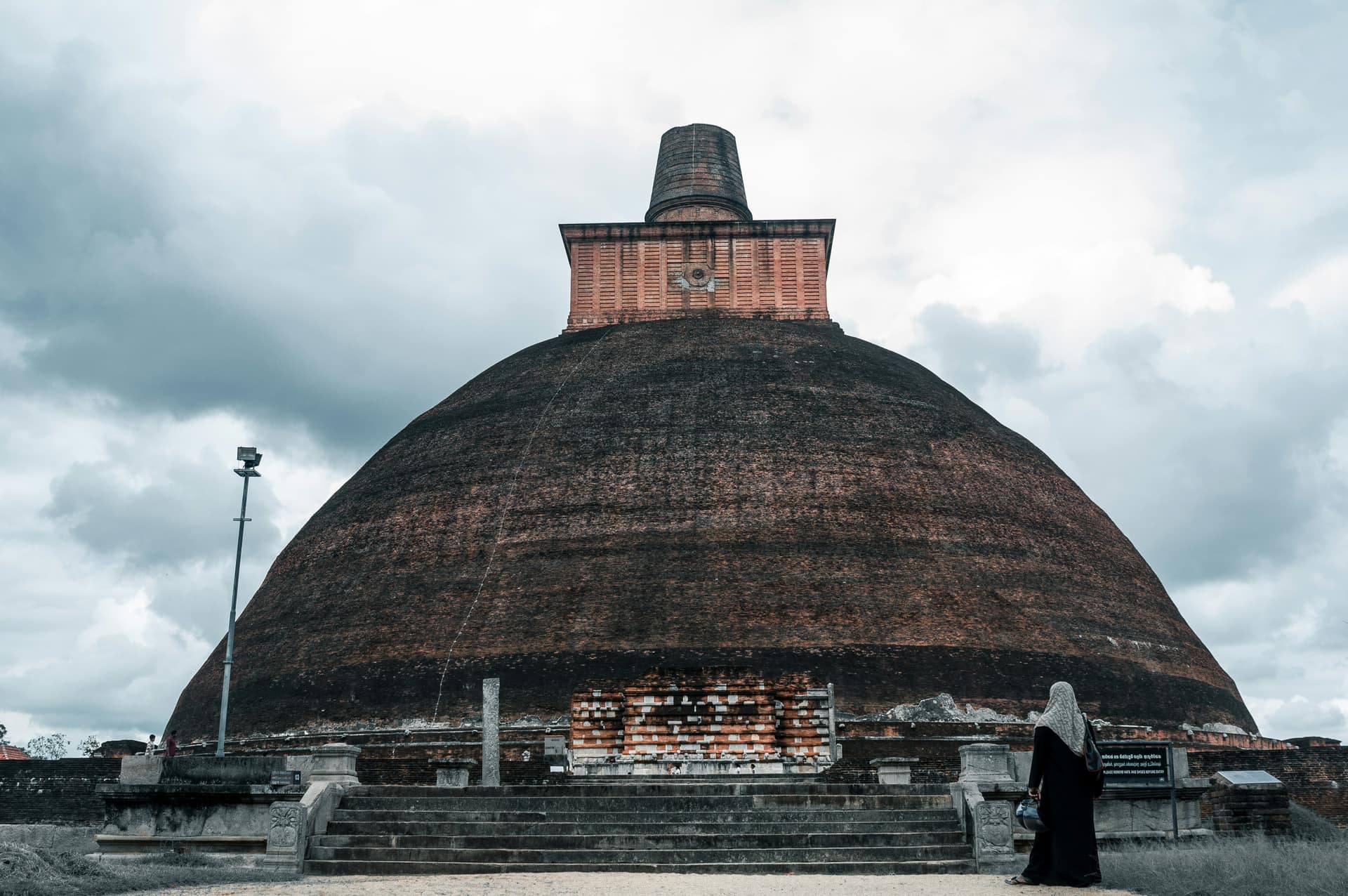
The history of the Cultural Triangle is visible in a clear sequence. Anuradhapura's huge brick stupas and open monastery grounds reflect early Buddhism and a long, stable kingdom. Polonnaruwa's compact, carved stone buildings show a later, more concentrated capital. Sigiriya stands apart as one king's statement.
UNESCO listed Anuradhapura, Polonnaruwa and Sigiriya in 1982, Kandy in 1988 and Dambulla in 1991. Lankan Stays & Trails guides usually suggest visiting in roughly chronological order where the route allows, so the story builds.
Much of this history is still alive. Pilgrims worship at the Sri Maha Bodhi, Ruwanwelisaya and Dambulla every day, and the tanks of the ancient kings still water the rice fields.
Frequently asked questions
What is the history of the Cultural Triangle?
It is the story of Sri Lanka's ancient capitals: Anuradhapura from roughly the 4th century BC to AD 1017, Sigiriya in the late 5th century, Polonnaruwa from the 11th to 13th centuries and Kandy until 1815, all shaped by Buddhism, which arrived in the 3rd century BC.
Which came first, Anuradhapura or Polonnaruwa?
Anuradhapura came first, as capital for about 1,400 years until 1017. Polonnaruwa became the capital after the Chola conquest, flourishing in the 11th to 13th centuries. Visiting Anuradhapura first helps the history make sense.
How old is Sigiriya?
The rock was used by monks from around the 3rd century BC, and King Kashyapa built his palace there in the late 5th century AD. It served as a monastery afterwards until roughly the 14th century.
Why did the capital move from Anuradhapura to Polonnaruwa?
Anuradhapura fell to the Chola dynasty of south India in 1017. The Cholas ruled from Polonnaruwa, which was more defensible and closer to the east, and the Sinhalese kings kept it as their capital after expelling them.
When did Buddhism come to Sri Lanka?
In the 3rd century BC, when the monk Mahinda, son of the Indian emperor Ashoka, met King Devanampiya Tissa at Mihintale, near Anuradhapura. The arrival is celebrated each year on Poson poya, usually in June.
Do I need to know the history before visiting?
It helps a lot. A basic timeline turns the ruins into a story. Visiting the archaeological museums at Anuradhapura and Polonnaruwa before the sites, or hiring a licensed guide, gives the context quickly.