
Quick answer
The culture, wildlife and beach route visits Sri Lanka's ancient capitals in chronological order: Anuradhapura (capital for over a thousand years from around the fourth century BC), Sigiriya (King Kashyapa's fifth-century citadel), Polonnaruwa (the medieval capital of the eleventh to thirteenth centuries) and Kandy (the last Sinhalese kingdom, until 1815). Tissamaharama, capital of the southern kingdom of Ruhuna, follows near Yala. Seeing them in order makes the history easy to follow.
Key takeaways
- Anuradhapura was the island's capital for over a thousand years and is still a major pilgrimage site.
- Sigiriya was the citadel of King Kashyapa in the fifth century AD.
- Polonnaruwa became the capital after Anuradhapura fell, flourishing in the eleventh and twelfth centuries.
- Kandy was the last independent Sinhalese kingdom, falling to the British in 1815.
- Tissamaharama was the capital of Ruhuna, the southern kingdom, in the early centuries.
Why the order matters
Most routes visit the ancient capitals in whatever order suits the roads, often starting with Sigiriya and skipping Anuradhapura. The culture, wildlife and beach route starts with Anuradhapura because it is the furthest north, and the result is that the capitals come in the order they ruled. Each one builds on the last.
Seeing them in order helps travellers notice how architecture, art and religion developed: from Anuradhapura's vast stupas and simple monasteries, to Sigiriya's palace and paintings, to Polonnaruwa's refined carvings and South Indian influences, to Kandy's living temple and wooden architecture.
- →Day 1 and 2: Anuradhapura.
- →Day 3: Sigiriya.
- →Day 4: Polonnaruwa.
- →Days 5 and 6: Kandy.
- →Day 8 to 10: Tissamaharama.
Anuradhapura
Anuradhapura became the capital around the fourth century BC and remained so for over a thousand years. Buddhism arrived during this period, according to tradition through the monk Mahinda at Mihintale, and the city became one of the great religious centres of Asia, with vast monasteries, enormous stupas and the sacred Bo tree.
The city declined after repeated invasions from South India, and was abandoned as the capital around the end of the tenth century. Its stupas, Jetavanaramaya, Abhayagiri and Ruwanwelisaya, are among the largest brick structures of the ancient world, and many are still places of active worship.
Sigiriya
Sigiriya was a brief but dramatic capital. According to the chronicles, King Kashyapa seized the throne in the fifth century AD and built a palace on top of the rock, with water gardens, frescoes and a gateway shaped like a lion. After his defeat, the capital returned to Anuradhapura and Sigiriya became a monastery.
Sigiriya is unusual among the capitals for its secular focus: a royal palace and pleasure gardens rather than a religious centre. Its frescoes of women and the mirror wall's ancient graffiti give a rare glimpse of the period.
Climbing the rock after a day at Anuradhapura makes the contrast obvious. Where Anuradhapura's builders worked on a vast, horizontal scale for monks and pilgrims, Sigiriya's builders worked vertically, for a king, with gardens, pools and galleries designed to impress visitors approaching from below.
- →Fifth-century citadel of King Kashyapa.
- →Water gardens, frescoes and the lion gate.
- →Later a monastery.
Polonnaruwa
Polonnaruwa became the capital after the fall of Anuradhapura, first under South Indian Chola rule and then under Sinhalese kings. It flourished under Parakramabahu I in the twelfth century, who built the great reservoir called the Parakrama Samudra, palaces and temples, and under Nissanka Malla.
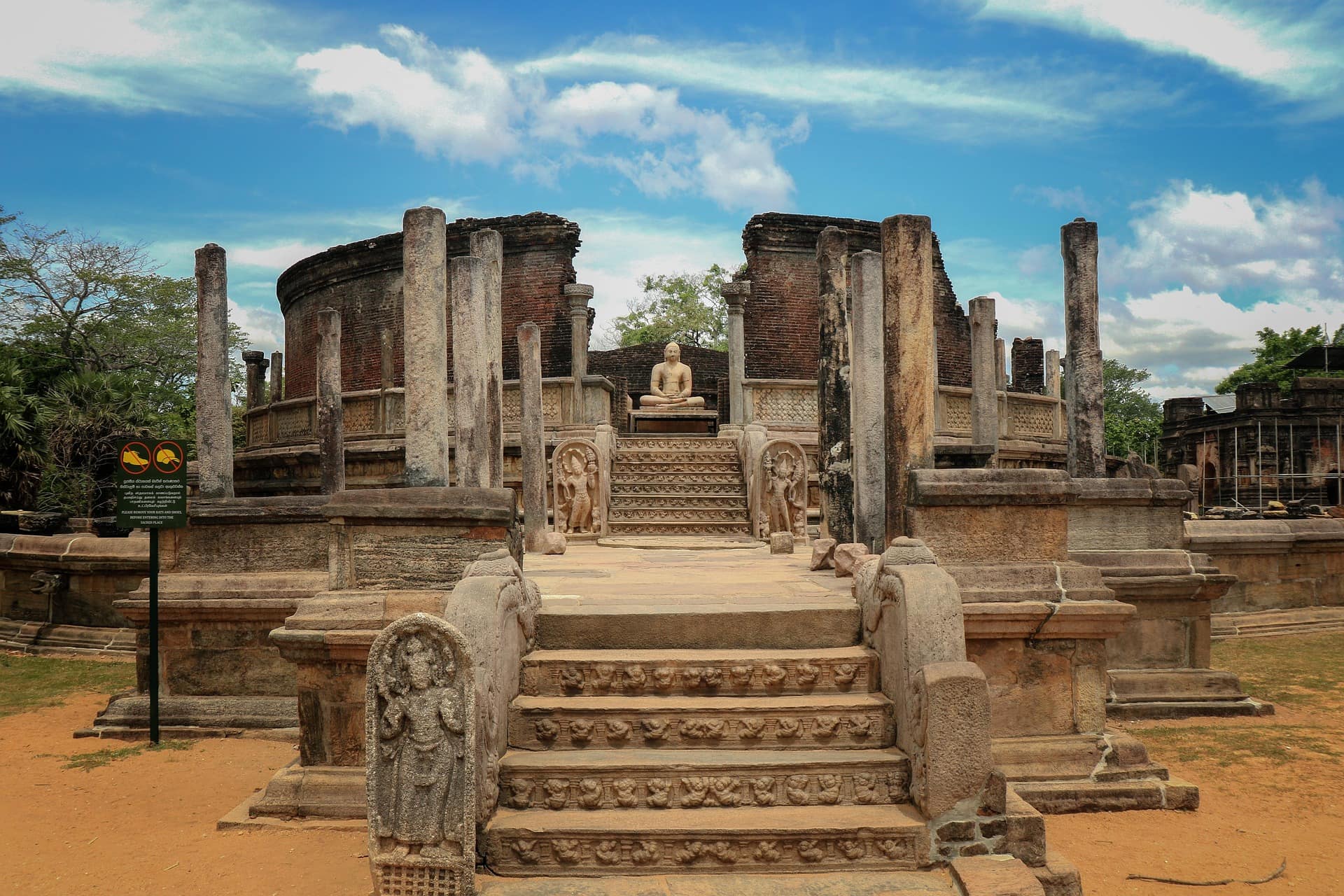
Its ruins are compact and well preserved, with the Sacred Quadrangle, the circular Vatadage and the rock-cut Buddhas of Gal Vihara as highlights. Hindu temples from the Chola period sit alongside Buddhist monuments, showing the city's mixed history.
The capital moved south-west in the thirteenth century, and the dry zone was gradually abandoned.
- →Chola and Sinhalese rule.
- →Parakramabahu I and the great reservoir.
- →Gal Vihara and the Vatadage.
Kandy and Ruhuna
Kandy was the capital of the last independent Sinhalese kingdom, which resisted the Portuguese and Dutch for centuries before falling to the British in 1815. The Temple of the Sacred Tooth Relic, beside the lake, holds the relic that symbolised royal authority, and the Esala Perahera continues traditions from the royal court.
In the south, Tissamaharama was the capital of Ruhuna, a kingdom that often served as a refuge and power base for princes reclaiming the north. Its great stupa and tank date from the early centuries. Lankan Stays & Trails can arrange a guide to explain the connections between the capitals as the route moves south.
Galle Fort, at the end of the route, was never a royal capital, but it tells the story of the colonial powers who challenged Kandy.
- →Kandy: the last kingdom, until 1815.
- →Tissamaharama: capital of Ruhuna.
- →Galle: the colonial chapter.
Frequently asked questions
What are the ancient capitals of Sri Lanka?
The main ones are Anuradhapura, Polonnaruwa and Kandy, with Sigiriya as a brief royal citadel. Earlier and regional capitals include Tissamaharama in the south. Later capitals, such as Dambadeniya, Yapahuwa and Kotte, were less long-lived. This route visits the five most important for visitors.
Why visit the capitals in order?
Seeing them in the order they ruled makes the history easier to follow, and shows how architecture, art and religion developed over two thousand years. This route starts with Anuradhapura in the north and works south, which happens to follow the chronology.
Was Sigiriya a capital?
Briefly. According to the chronicles, King Kashyapa moved the capital to Sigiriya in the fifth century AD and built a palace on the rock. After his death, the capital returned to Anuradhapura and Sigiriya became a monastery.
Which capital is most impressive?
It depends on taste. Anuradhapura is the largest and most sacred, Sigiriya the most dramatic, Polonnaruwa the best preserved and Kandy the most alive. Most travellers find Gal Vihara at Polonnaruwa and the view from Sigiriya the most memorable.
Do I need a guide for the capitals?
A guide is strongly recommended at Anuradhapura and Polonnaruwa, where the ruins are hard to interpret alone. At Sigiriya and Kandy, a guide adds a lot but is less essential. Licensed guides are available at each site.
What was Ruhuna?
Ruhuna was a kingdom in the south of the island, with its early capital at Tissamaharama. It often served as a base for princes who reclaimed the north, including, according to the chronicles, King Dutugemunu. Its stupas and tanks survive near Yala.
How much time does each capital need?
On this route, Anuradhapura gets an evening and a morning, Sigiriya a morning, Polonnaruwa three to four hours and Kandy an evening and a full day. That is enough for the highlights of each. Travellers wanting more depth can add a second Anuradhapura night.