
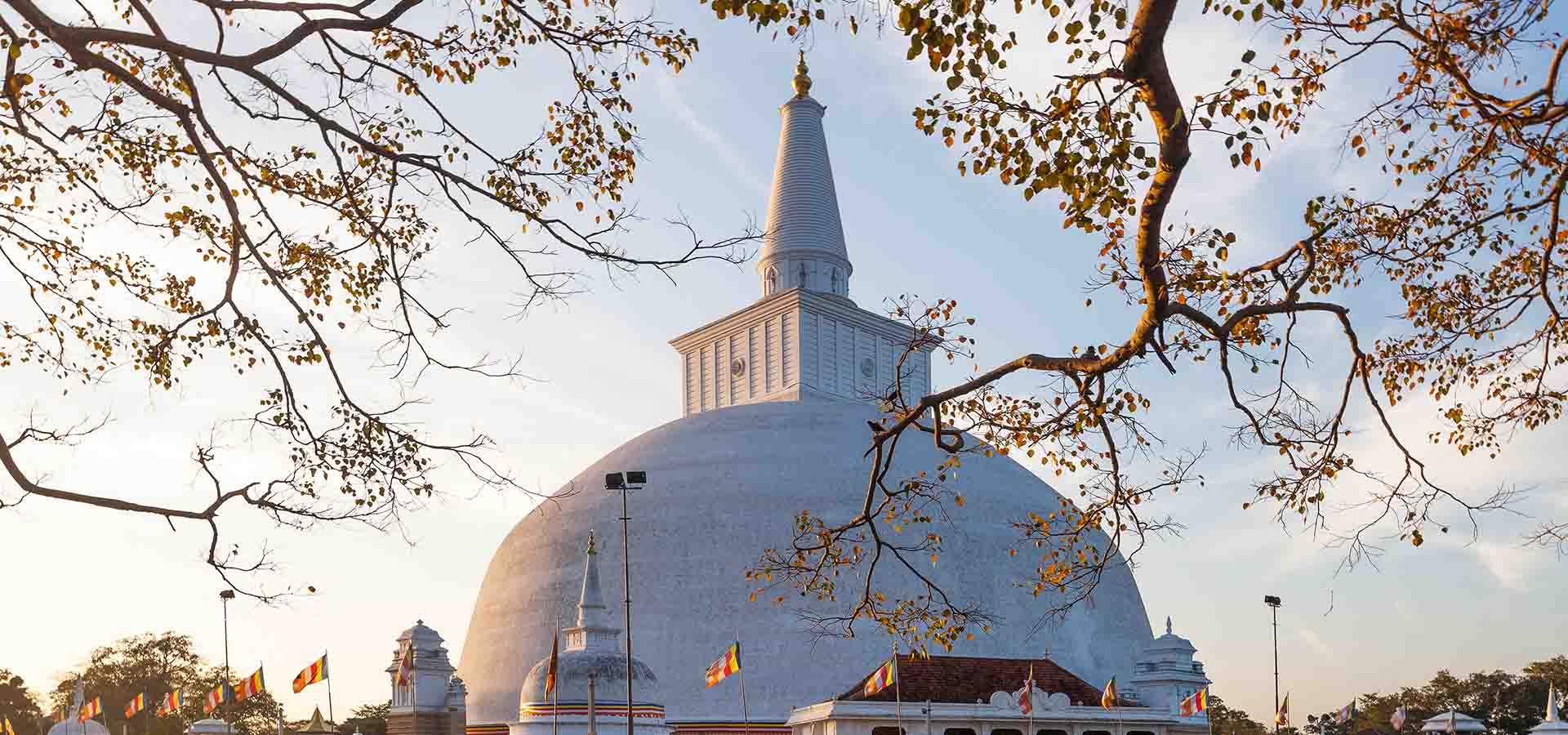
Quick answer
The culture-heavy version of the culture, wildlife and beach route runs Anuradhapura 2, Sigiriya 3, Kandy 2, Udawalawe 1, Tissamaharama 1, Mirissa 2 and Galle Fort 2. It adds Mihintale and Anuradhapura's museums, Kataragama's evening puja and a full day in Galle Fort, and drops the two Tangalle nights and one night near Yala. Wildlife stays strong with three parks and whale watching, and the beach comes from Mirissa and Unawatuna near Galle.
Key takeaways
- The nights split as Anuradhapura 2, Sigiriya 3, Kandy 2, Udawalawe 1, Tissamaharama 1, Mirissa 2 and Galle Fort 2.
- The second Anuradhapura night allows Mihintale, the museums and the outlying monasteries.
- Two nights inside Galle Fort turn the colonial town into a full chapter rather than a departure-day stop.
- Tangalle is dropped and Yala gets one afternoon and an optional dawn drive instead of a full day.
- Whale watching from Mirissa and three safari parks keep the wildlife strand intact.
Who this version suits
Travellers who find themselves reading every information board, who want time in museums and who would rather see a monastery at dawn than spend another afternoon on a lounger will enjoy this version. It suits history lovers, photographers of architecture and travellers on a second trip who want depth.
The trade is beach time. Instead of two quiet nights at Tangalle and two at Mirissa, the coast is Mirissa and Galle, both busier and more urban. Travellers who want long, empty beaches should keep the standard route.
- →History and archaeology lovers.
- →Architecture photographers.
- →Second-time visitors wanting depth.
- →Not ideal for those craving empty beaches.
The route, night by night
The first change is at the start. Two nights in Anuradhapura give the evening of day 1 at Sri Maha Bodhi, a full day 2 for the sacred city and Mihintale, and a relaxed drive to Sigiriya on day 3. Sigiriya keeps three nights, so the rock, Polonnaruwa and the elephant safari shift by a day.
Kandy keeps two nights, then the long drive to Udawalawe follows. One night at Tissamaharama allows an afternoon Yala drive and the evening at Kataragama, with an optional dawn drive the next morning before heading to Mirissa. Two nights in Mirissa cover the whales, and the last two nights are inside Galle Fort.
- →Anuradhapura 2: the sacred city, Mihintale and the museums.
- →Sigiriya 3: the rock, Polonnaruwa, elephants and Ritigala.
- →Kandy 2: the Temple of the Tooth and the three temples.
- →Udawalawe 1 and Tissamaharama 1: elephants, Yala and Kataragama.
- →Mirissa 2: whales and the beach.
- →Galle Fort 2: ramparts, museums and lanes.
What the extra culture adds
Mihintale is the most significant addition. It is where Buddhism is said to have arrived on the island, and its long stairway, ruined monastery and summit views make a powerful morning. The Anuradhapura museums, including the Abhayagiri museum and the archaeological museum, add context to the ruins.
At Sigiriya, the extra time allows Ritigala, a forest monastery on a jungle-covered mountain near Habarana, with ruined meditation platforms in near silence. In Kandy, the three temples of Embekke, Lankatilaka and Gadaladeniya replace the botanic gardens. On the coast, the two Galle Fort nights allow the maritime museum, the old Dutch hospital, sunset on the ramparts and quiet early-morning walks.
Kataragama's evening puja, Tissamaharama's stupa and Mulkirigala rock temple, on the road between Tissamaharama and Mirissa, complete the picture.
- →Mihintale and the Anuradhapura museums.
- →Ritigala forest monastery.
- →The three temples west of Kandy.
- →Kataragama, Tissamaharama and Mulkirigala.
- →Galle Fort at sunset and dawn.
What it gives up
The main loss is Tangalle, the quietest and most relaxing beach stop on the standard route, and the Rekawa turtle watch that goes with it. The second night near Yala also goes, so Yala gets an afternoon drive and an optional dawn drive rather than a full day, which lowers the chances of a leopard.
The beach days are also busier. Mirissa and the beaches around Galle, such as Unawatuna and Jungle Beach, are lively in season. Travellers who want both depth and quiet should consider extending to three weeks instead.
Timing and practicalities
The culture-heavy version suits the same window as the standard route, roughly December to April, with January to March the most comfortable for long days at the ancient sites. Poya days add atmosphere but also crowds; Vesak in May and Poson in June are spectacular at Anuradhapura and Mihintale but fall outside the main season.
A good licensed guide matters more in this version than any other. Lankan Stays & Trails can arrange specialist guides at Anuradhapura, Polonnaruwa and Galle, and adjust the order of sites to avoid the heat and the crowds.
Costs are similar to the standard route, with slightly higher entry fees from the extra sites and possibly higher hotel prices inside Galle Fort.
Frequently asked questions
How is the culture-heavy version different from the standard route?
It adds a second night in Anuradhapura and two nights inside Galle Fort, and drops the two Tangalle nights and one night near Yala. The result is more history, including Mihintale, Ritigala and a full day in Galle, with slightly less wildlife and quieter beach time.
Does the culture-heavy version still include Yala?
Yes. Yala gets an afternoon drive on arrival and an optional dawn drive the next morning before you leave for Mirissa. That is less than the standard route's full day, so leopard chances are lower, but Udawalawe, the Cultural Triangle elephants and the whales remain.
Is two nights in Galle Fort too many?
Not for history lovers. Two nights allow sunset and early morning on the ramparts, the museums, the lanes and a beach afternoon at Unawatuna or Jungle Beach. The fort is quiet in the early morning and evening, when day visitors have left.
What is Ritigala?
Ritigala is an ancient forest monastery on a jungle-covered mountain near Habarana, with ruined meditation platforms, paths and ponds. It was used by ascetic monks and is now quiet and atmospheric. It takes a few hours from Sigiriya and suits travellers who enjoy archaeology and nature together.
Do I need a guide for the culture-heavy version?
A guide is recommended at the main sites, especially Anuradhapura, Polonnaruwa, Ritigala and Galle Fort. Licensed guides bring the ruins to life and help plan visits around the heat. Some driver-guides are well informed, but a specialist adds a great deal at the ancient cities.
Can I make it culture-heavy without losing Tangalle?
Only by giving up something else, usually the Udawalawe night. That keeps one Tangalle night but means one fewer safari park. Alternatively, extend to three weeks, which allows both depth and quiet beaches.