
Quick answer
The best places to visit in Sri Lanka's North Western Province are Kalpitiya, for dolphins, kitesurfing and lagoon life; Wilpattu National Park for leopards and quiet safaris; Yapahuwa's rock fortress and stone staircase; Kurunegala's Ethagala rock; the ruined capitals of Panduwasnuwara and Dambadeniya; the Ridi Vihara silver temple; Munneswaram temple near Chilaw; and the Anawilundawa wetlands. Visit roughly December to April for the coast.
Key takeaways
- The province has two districts, Kurunegala and Puttalam.
- Kalpitiya's dolphin season runs roughly November to April; kitesurfing peaks in two windy seasons.
- Wilpattu's main entrance is reached from the Anuradhapura side; parts of the park lie in Puttalam district.
- Kurunegala sits roughly halfway between Colombo and the Cultural Triangle.
- Yapahuwa was a royal capital in the thirteenth century.
Wayamba, the overlooked province
Sri Lanka's North Western Province runs from the coast north of Negombo inland to the edge of the Cultural Triangle. Puttalam district holds the lagoons, salt pans and fishing towns of the coast; Kurunegala district holds rice land, coconut estates and rocky hills crowned with temples.
Its history is surprisingly rich. After Polonnaruwa fell, Sri Lanka's kings moved south-west through a series of capitals, several of which lie here: Dambadeniya, Yapahuwa and Kurunegala itself. Their remains are modest compared with Anuradhapura but almost always quiet.
Most travellers pass through on the road between the airport and Sigiriya, or on the coast road to Wilpattu. Even one well-chosen stop changes how the journey feels.
- →Coast: Kalpitiya, Puttalam lagoon, Chilaw, Anawilundawa.
- →Inland: Kurunegala, Yapahuwa, Panduwasnuwara, Ridi Vihara.
- →Wild: Wilpattu's western reaches.
Kalpitiya and the lagoon coast
Kalpitiya is a long peninsula between the Puttalam lagoon and the sea. From roughly November to April, boats head out at dawn to find large pods of spinner dolphins, sometimes hundreds strong. In the windy months, the lagoon becomes one of Asia's best-known kitesurfing spots.
Further south, Chilaw is home to Munneswaram, an ancient Shiva temple linked with the Ramayana story, and to a lively fish market. The Anawilundawa wetland sanctuary, a chain of old village tanks near Chilaw, is excellent for herons, storks and kingfishers in the early morning.
Life on this coast revolves around fishing and salt. Watching the boats come in at dawn is as memorable as any formal sight.
- →Kalpitiya: dolphins at dawn, kitesurfing in the windy months.
- →Munneswaram: one of the island's great Shiva temples.
- →Anawilundawa: birds on old village tanks.
Wilpattu National Park
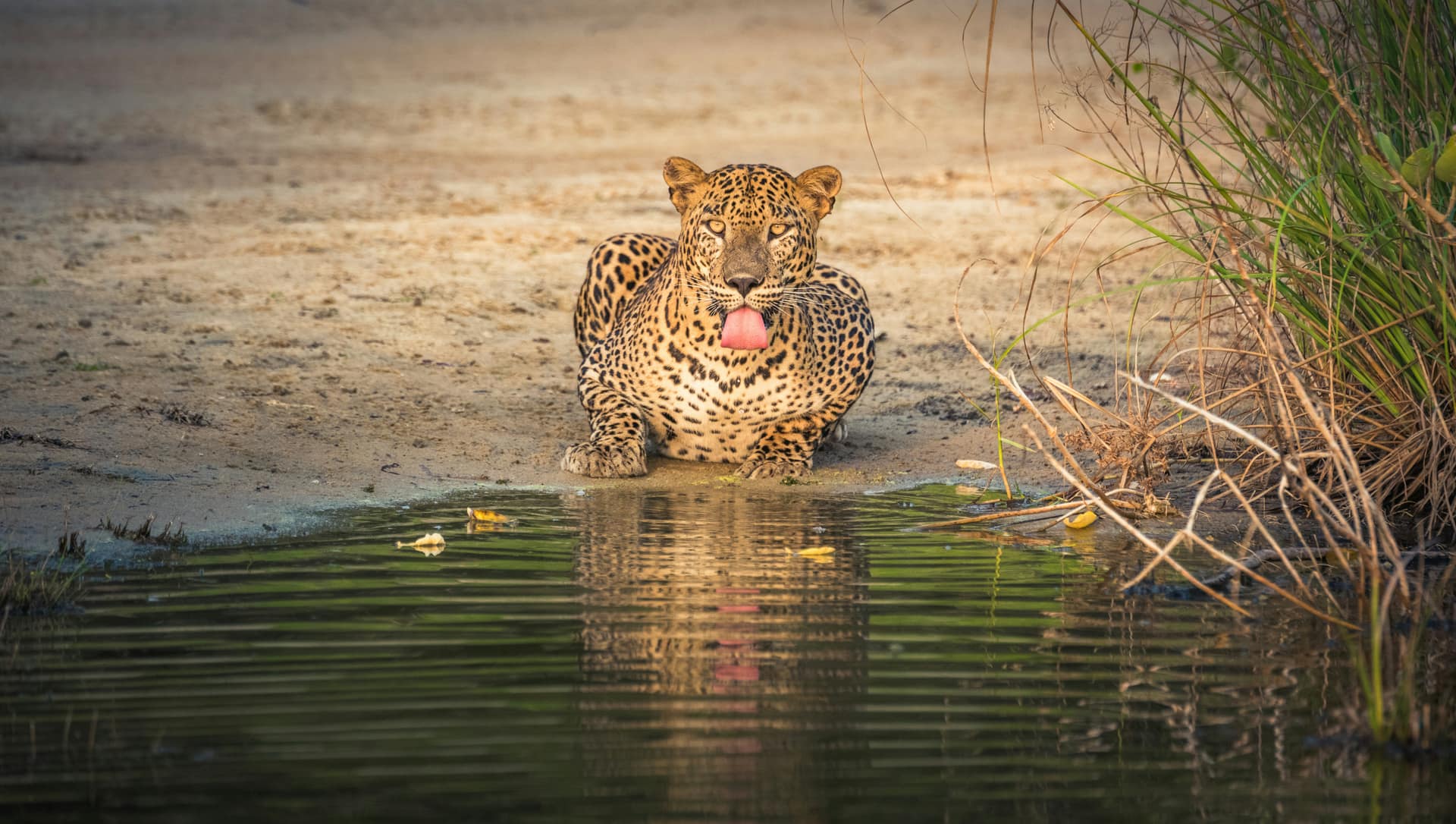
Wilpattu is Sri Lanka's largest national park, a forest of natural lakes called villus. It is known for leopards, sloth bears and a calm atmosphere very different from Yala's crowds. The park straddles the North Western and North Central provinces; the main entrance at Hunuwilagama is approached from the Anuradhapura side, while some lodges and the coastal side are reached from Kalpitiya and Puttalam.
Because the park is large and the tracks are slow, a full-day safari is worthwhile. Sightings are less frequent than in Yala's busiest block, but each one tends to be unhurried.
Kurunegala and the old capitals
Kurunegala is a busy market town under a ring of giant boulders. Ethagala, the Elephant Rock, has a huge white Buddha on its summit and views over the town's lake. Kurunegala was itself a royal capital for a short period in the late thirteenth and early fourteenth centuries.
Yapahuwa, roughly an hour north, is the province's showpiece: a rock fortress with an ornate stone staircase guarded by carved lions, where the Tooth Relic was kept in the thirteenth century. Dambadeniya, south-west of Kurunegala, has a temple and the remains of another royal seat.
Panduwasnuwara, near Wariyapola, has the foundations of a twelfth-century palace and monasteries. Ridi Vihara, the Silver Temple, has a cave shrine with fine Dutch tiles and a quiet setting among the rocks. Arankele, a forest monastery with stone walkways, is one of the island's most peaceful places.
- →Yapahuwa: the lion staircase.
- →Ethagala: Kurunegala's rock and Buddha.
- →Ridi Vihara and Arankele: rock temple and forest monastery.
When to go and how to fit it in
The coast of the North Western Province is best roughly December to April, when the sea is calm for dolphin trips. Inland sites work year-round, though midday heat is strong from roughly March to September.
Kurunegala is roughly two to three hours from Colombo and roughly two from Sigiriya, so a stop at Yapahuwa or Ethagala fits easily into the airport to Cultural Triangle drive. Kalpitiya is roughly three to four hours from Colombo and pairs naturally with Wilpattu.
Lankan Stays & Trails can route a trip so that this province becomes part of the journey rather than a blur through the window: Kalpitiya and Wilpattu at the start, or Yapahuwa on the way to Anuradhapura.
- →Coast: roughly December to April.
- →Kurunegala from Colombo: roughly two to three hours.
- →Kalpitiya plus Wilpattu: two to three nights together.
Frequently asked questions
Is Kalpitiya worth visiting?
Kalpitiya is worth visiting for dolphin trips from roughly November to April, kitesurfing in the windy seasons and a quiet lagoon atmosphere. It suits travellers who enjoy nature more than nightlife. It pairs well with Wilpattu, which is roughly an hour or two away.
What is Yapahuwa famous for?
Yapahuwa is famous for its ornate stone staircase guarded by carved lions, leading up a rock fortress where Sri Lanka's kings kept the Tooth Relic in the thirteenth century. It is quiet, rarely crowded and easy to add to a drive between Colombo and Anuradhapura.
Which entrance should I use for Wilpattu?
Most safaris use Wilpattu's main entrance at Hunuwilagama, reached from Anuradhapura or from lodges just outside the park. Travellers staying in Kalpitiya often use operators who drive round to the same entrance. Ask your operator which entrance and route they use before booking.
What is there to see in Kurunegala?
In Kurunegala you can climb or drive up Ethagala, the Elephant Rock, for its white Buddha and views, and walk around the lake. Nearby are Ridi Vihara, the Arankele forest monastery, Panduwasnuwara's ruins and the old capital of Dambadeniya. Yapahuwa lies roughly an hour north.
When can I see dolphins at Kalpitiya?
Dolphins are usually seen at Kalpitiya from roughly November to April, when the sea is calm enough for boats. Trips leave at dawn and the pods can be very large. Conditions vary daily, so build a spare morning into your plan.
Can I visit the North Western Province on the way to Sigiriya?
You can visit the North Western Province on the way to Sigiriya. The main road from Colombo passes through Kurunegala, so Ethagala, Ridi Vihara or Yapahuwa make good stops. Each adds roughly one to two hours, depending on the site.