
Quick answer
Kalpitiya, on Sri Lanka's north-west coast about three hours from Colombo, has two kitesurfing seasons: the main one from roughly May to September driven by the south-west monsoon, and a shorter, lighter season from about December to March. Its huge flat-water lagoon makes it unusually good for learners, while the ocean side suits wave riders. Kalpitiya is also the base for spinner dolphin watching and for diving the Bar Reef Marine Sanctuary, both best in the calmer December to April window.
Key takeaways
- Kalpitiya's main kitesurfing season runs roughly May to September, with a second lighter season from about December to March.
- The Kalpitiya lagoon is large, shallow and flat, which makes it one of Asia's best places to learn to kite.
- Spinner dolphins gather offshore in large pods, best seen in the calm season from around December to April.
- The Bar Reef Marine Sanctuary is Sri Lanka's largest coral reef system and is dived in the calm season.
- Kalpitiya is roughly three hours by road from Colombo, north past Chilaw and Puttalam.
The two wind seasons
Kalpitiya's reputation rests on wind reliability. The main season runs from around May to September, when the south-west monsoon generates strong, steady cross-shore wind that builds most afternoons and holds for hours. This is the period that draws kiters from Europe, Australia and across Asia, and it is when the schools and camps are fully staffed.
There is a second, shorter season from roughly December to March, driven by the north-east monsoon. The wind is lighter and less consistent than in the main season, which suits some learners better, and it coincides with calmer seas and better conditions for dolphins and diving. October and November, in the inter-monsoon, are the quiet months.
- →Main season: roughly May to September. Strong, consistent afternoon wind.
- →Second season: roughly December to March. Lighter, less consistent, calmer sea.
- →Quiet months: October and November, during the inter-monsoon.
- →Wind typically builds through the day and peaks in the afternoon.
The lagoon, and why beginners love it
The Kalpitiya lagoon is the peninsula's real asset. It is enormous, shallow enough to stand in across large areas, and almost entirely flat, which removes the two things that make learning to kitesurf difficult elsewhere: chop and depth. A beginner who falls simply stands up, resets the kite and starts again.
That combination of dependable wind and forgiving water is why Kalpitiya has become a teaching destination rather than only a riding one. Schools run multi-day courses with radio helmets and boat support, and progression is fast. There are also downwinder routes across the lagoon and out to sandbanks and islands that make excellent intermediate days.
- →Large, shallow, flat-water lagoon, standable across much of its area.
- →Ideal for first-time kiters and for practising transitions and jumps safely.
- →Downwinders across the lagoon to sandbanks and islands for intermediates.
- →Ocean side offers waves and chop for more experienced riders.
Spinner dolphins and whales
Kalpitiya is one of the best places in Sri Lanka to see spinner dolphins, which gather offshore in pods that can number in the hundreds and sometimes more. They are named for the corkscrew leaps they make clear of the water, and a large pod moving at speed is one of the more remarkable wildlife sights in the country.
The dolphin season is broadly the calm-sea period from about December to April, which is the opposite of the main kite season. Sperm whales and, less often, blue whales are recorded off this coast too, though sightings are far less reliable than at Mirissa or Trincomalee. Choose an operator that keeps a respectful distance, does not chase or encircle pods, and does not allow swimming with them.
- →Spinner dolphin season: roughly December to April, in calm seas.
- →Pods can number in the hundreds; early morning departures are standard.
- →Choose operators who keep distance and do not chase or encircle the pods.
- →Whale sightings occur but are far less reliable than Mirissa or Trincomalee.
The Bar Reef Marine Sanctuary
Bar Reef, offshore from Kalpitiya, is the largest coral reef system in Sri Lanka and a designated marine sanctuary. It holds substantial reef fish diversity and, in good conditions, some of the best visibility in the country. Like most Indian Ocean reefs it has suffered bleaching events, and recovery is uneven across the system.
Diving and snorkelling here are seasonal and depend on sea state, which means the calm months from roughly December to April. It is a boat trip rather than a shore entry, and it should be arranged through an established operator, because currents can be significant and the reef is a protected area with rules about anchoring and contact.
Getting there and where to stay
Kalpitiya is roughly three hours by road from Colombo, heading north past Negombo, Chilaw and Puttalam and then out along the peninsula. It is also a reasonable link between Colombo and Wilpattu National Park or Anuradhapura, which is how it most often fits into a wider itinerary.
Accommodation is concentrated in kite camps and lodges along the lagoon side, ranging from simple cabanas to comfortable tented and boutique properties. It is a low-key, spread-out place rather than a resort strip: expect to eat where you sleep, and expect the main season to book out. Facilities scale down considerably outside the kite seasons.
- →Around three hours from Colombo via Negombo, Chilaw and Puttalam.
- →Pairs naturally with Wilpattu National Park and Anuradhapura.
- →Accommodation is mostly kite camps and lodges on the lagoon side.
- →Book main-season stays well ahead; facilities reduce in the off months.
Beyond the wind
The peninsula rewards a slow day. Dutch-era fort remains at Kalpitiya town, a working Catholic and Muslim fishing culture, salt pans, and dolphin-watching sandbanks all sit within easy reach. The Wilpattu National Park entrance is roughly two hours away, making a safari day trip feasible.
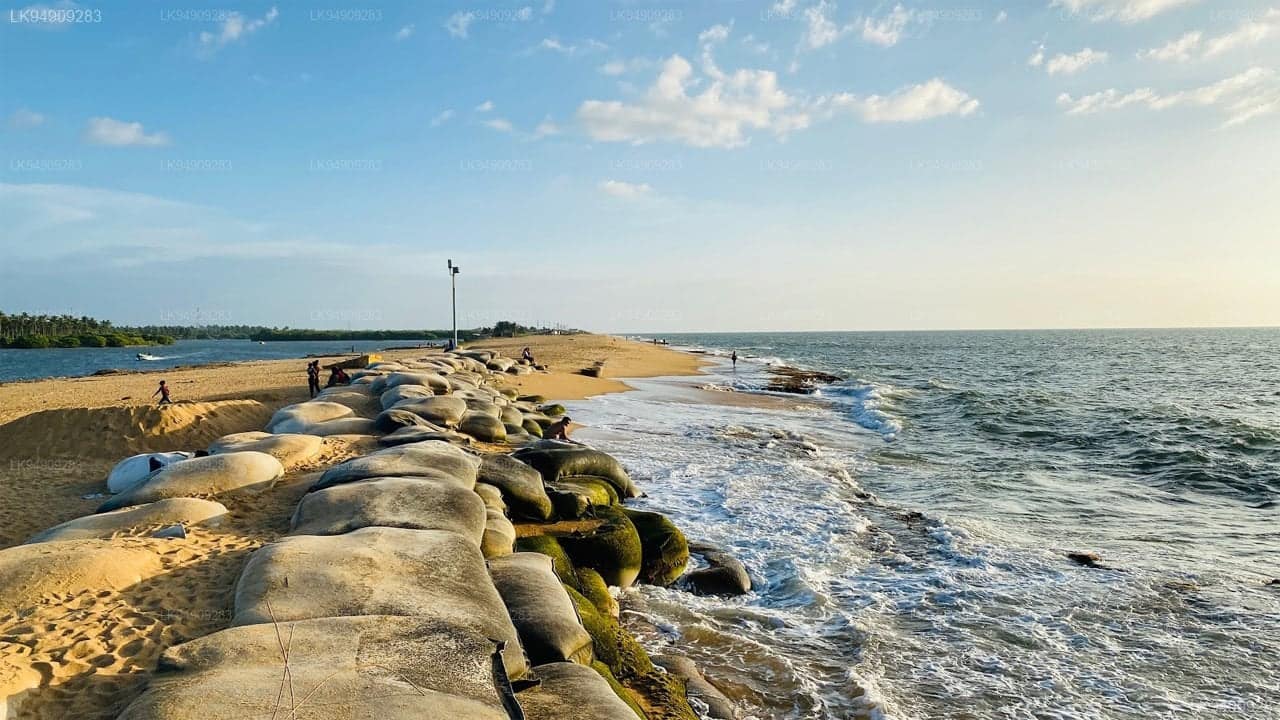
Do not expect swimming beaches in the south coast sense. The ocean side is exposed and often rough during the main kite season, and the lagoon, while calm, is a working waterway. Kalpitiya is a place you go for wind, dolphins and wide skies rather than for lying on sand.
Planning a Kalpitiya trip
Decide first whether you are coming for wind or for water clarity, because the two seasons barely overlap. May to September is the kite trip. December to April is the dolphin and diving trip, with lighter kiting attached.
Lankan Stays & Trails routes Kalpitiya into north-west itineraries alongside Wilpattu and Anuradhapura, and books kite schools and dolphin boats that follow proper distance protocols.
Frequently asked questions
When is the kitesurfing season in Kalpitiya?
The main season runs from about May to September, driven by strong, steady south-west monsoon wind that builds each afternoon. A second, lighter season runs from roughly December to March under the north-east monsoon. October and November are the quiet inter-monsoon months.
Is Kalpitiya good for learning to kitesurf?
It is one of Asia's best places to learn. The lagoon is enormous, shallow enough to stand in over large areas, and almost entirely flat, which removes chop and depth from the equation. Schools run multi-day courses with radio helmets and boat support.
Can you see dolphins in Kalpitiya?
Yes. Spinner dolphins gather offshore in pods that can number in the hundreds, best seen in the calm season from roughly December to April. Trips leave early in the morning. Choose an operator that keeps a respectful distance and does not chase or encircle the pods.
How far is Kalpitiya from Colombo?
Roughly three hours by road, heading north through Negombo, Chilaw and Puttalam before turning out along the peninsula. It also sits conveniently between Colombo and Wilpattu National Park or Anuradhapura, so it fits neatly into a north-west itinerary.
What is the Bar Reef in Sri Lanka?
Bar Reef, offshore from Kalpitiya, is Sri Lanka's largest coral reef system and a designated marine sanctuary with high fish diversity. It is dived and snorkelled by boat during the calm season, roughly December to April. Like most Indian Ocean reefs it has suffered bleaching damage.
Are there beaches at Kalpitiya?
There is plenty of sand, but Kalpitiya is not a swimming-beach destination in the way the south coast is. The ocean side is exposed and often rough during the main kite season, and the lagoon is a working waterway. Come for wind, dolphins and space rather than sunbathing.
Can you kitesurf in Sri Lanka in December?
Yes. Kalpitiya's second season runs roughly December to March on north-east monsoon wind. It is lighter and less consistent than the May to September main season, which some learners prefer, and it coincides with calmer seas for dolphin watching and diving.