
Quick answer
At Sri Lanka's busiest sites, arrive at opening or before. Climb Sigiriya from around seven when it opens, reach the Nine Arch Bridge shortly after dawn, leave Nuwara Eliya well before dawn for Horton Plains, depart accommodation around half past four or five for a Yala safari, and visit Galle Fort after five in the afternoon. Confirm current opening hours locally, as they are adjusted periodically.
Key takeaways
- Sigiriya opens around seven in the morning; arriving then gives cooler stone and shorter queues on the narrow upper stairs.
- The Nine Arch Bridge crowds build from mid-morning around each scheduled train crossing.
- Horton Plains needs a start well before dawn, since cloud typically fills the valley by mid-morning.
- Safari drives leave accommodation around half past four or five in the morning to reach the gate at opening.
- Galle Fort is the exception that rewards late rather than early, transforming after five in the afternoon.
Why timing matters more than anything else
Three things build through a Sri Lankan morning, and all of them degrade the experience of a site. Heat builds at lower elevations, and at exposed sites such as Sigiriya and Polonnaruwa the stone itself begins radiating it. Cloud builds at altitude, which is what removes the view at Horton Plains and sometimes at Ella. Crowds build everywhere.
Because all three move in the same direction, a single decision, starting early, addresses all of them at once. This is unusual. At most destinations avoiding crowds and avoiding heat require different strategies; in Sri Lanka they are the same strategy.
The corollary is that a first trip which schedules its major sites for mid-morning has made one repeated mistake rather than several separate ones, and correcting it costs nothing but sleep.
- →Heat, cloud and crowds all build through the morning.
- →One decision, starting early, addresses all three at once.
- →At exposed sites the stone itself begins radiating heat by mid-morning.
- →Mid-morning scheduling is one repeated mistake, not several separate ones.
Sigiriya and the Cultural Triangle
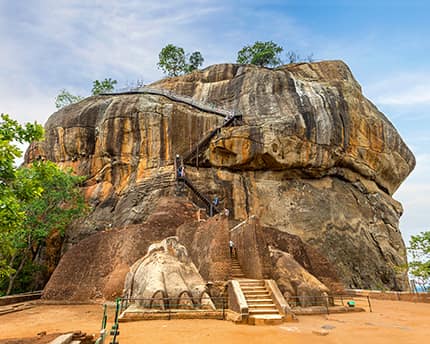
Sigiriya opens around seven in the morning, and arriving at opening is the single most valuable timing decision on a Sri Lanka itinerary. The rock has almost no shade, the climb is roughly 1,200 steps, and the upper metal stairways are one-way and narrow, so queues there slow everyone considerably once the site fills.
Pidurangala, for those climbing it instead or as well, is usually done for sunrise, which means starting in the dark with a torch. It takes roughly forty-five minutes and ends in a boulder scramble.
Polonnaruwa and Anuradhapura are both dry-zone sites with very little shade between monuments. Aim to be at the entrance at opening and finished by late morning, with the middle of the day spent elsewhere. Dambulla is the exception: the caves are indoors, so a late afternoon visit is both cooler underfoot and better lit.
- →Sigiriya: arrive at opening, around seven; the upper stairs are one-way and narrow.
- →Pidurangala: start in the dark with a torch for sunrise, roughly forty-five minutes up.
- →Polonnaruwa and Anuradhapura: at the entrance at opening, finished by late morning.
- →Dambulla: late afternoon is cooler underfoot and better lit inside the caves.
The hill country
Horton Plains is the most timing-critical site in Sri Lanka. Cloud typically fills the valley from mid-morning onwards, which hides the World's End view entirely, and visitors arriving at nine or ten frequently see nothing but white. Leaving Nuwara Eliya well before dawn is not enthusiasm, it is the only way the walk works.
The Nine Arch Bridge at Ella follows a different pattern, driven by trains rather than cloud. Crowds build around each scheduled crossing from mid-morning, and several hundred people can gather. Shortly after dawn the bridge is often nearly empty. Confirm crossing times locally on the day, as timetables shift.
Little Adam's Peak is best at sunrise for the same reason, and it has the additional advantage of being cool for the climb. The walk takes roughly 45 to 90 minutes return, so a dawn start still leaves a full day afterwards.
- →Horton Plains: leave Nuwara Eliya well before dawn or lose the view to cloud.
- →Nine Arch Bridge: shortly after dawn, before crowds gather for train crossings.
- →Confirm train crossing times locally on the day; timetables shift.
- →Little Adam's Peak at sunrise is quiet and cool, and still leaves a full day.
The safari parks
Safari drives are the earliest start on a Sri Lanka itinerary. Most morning drives leave accommodation around half past four or five in the morning to reach the park gate for opening, and this is driven by wildlife behaviour rather than by queuing.
Animals move at dawn and dusk and rest through the heat of the day, so a drive that starts at nine is a fundamentally worse drive rather than merely a busier one. At Yala the queue of jeeps at the gate before opening is itself considerable, which adds a second reason.
Afternoon drives follow the same logic in reverse, generally leaving in the mid-afternoon and running until the park closes. For travellers doing two drives, the dawn and the late afternoon are the two windows that matter, and the middle of the day is genuinely not worth spending in a jeep.
- →Morning drives leave accommodation around half past four or five.
- →Animals move at dawn and dusk and rest through the heat of the day.
- →A nine o'clock drive is a worse drive, not just a busier one.
- →Afternoon drives run from mid-afternoon until the park closes.
Galle, the site that rewards late
Galle Fort is the exception to everything above, and it is worth knowing because it changes how a coastal day is planned. The fort carries coach groups and day visitors through the middle of the day, and the heat reflects off the stone streets.
From around five in the afternoon the day visitors leave, the light turns gold on the ramparts, and the town becomes the place people describe. The rampart walk at sunset takes roughly an hour and is what most visitors remember from Galle.
This is the strongest practical argument for staying inside the walls rather than visiting as a day trip, because the good version of Galle happens at a time when day visitors have already left. Early morning inside the fort is also quiet and pleasant, which is the other half of the same argument.
- →Galle Fort is busiest and hottest through the middle of the day.
- →From around five in the afternoon the day visitors leave and the light improves.
- →The rampart walk at sunset takes roughly an hour.
- →This is the main argument for sleeping inside the walls.
Building early starts into an itinerary
The practical way to make early starts happen is to build them into the schedule rather than leaving them as intentions, and to stay close enough to each site that the start is feasible. A dawn arrival at Sigiriya from a hotel forty minutes away requires a considerably more heroic alarm than from one fifteen minutes away.
It also means accepting a quiet middle of the day. A trip that starts at six and sightsees until seven in the evening is exhausting; one that starts at six, stops at eleven, and resumes at four is sustainable for a fortnight. Lankan Stays and Trails schedules first trips that way deliberately, because it is how the sites are best seen and how the traveller still enjoys day ten.
Frequently asked questions
What time should I climb Sigiriya?
At opening, typically around seven in the morning. The rock has almost no shade and the upper metal stairways are one-way and narrow, so queues slow everyone once the site fills. Confirm current opening hours locally, as they are adjusted periodically.
What time should I visit the Nine Arch Bridge?
Shortly after dawn. Crowds build around each scheduled train crossing from mid-morning, and several hundred people can gather. Confirm crossing times locally on the day rather than relying on published timetables, which shift more than visitors expect.
How early do you need to leave for Horton Plains?
Well before dawn from Nuwara Eliya. Cloud typically fills the valley from mid-morning and hides the World's End view entirely, so visitors arriving at nine or ten frequently see nothing. This is the most timing-critical site in Sri Lanka.
What time do safari drives start in Sri Lanka?
Most morning drives leave accommodation around half past four or five to reach the gate for opening. This is driven by wildlife behaviour rather than queues: animals move at dawn and dusk and rest through the heat of the day.
When is the best time to visit Galle Fort?
After five in the afternoon, which makes it the exception to Sri Lanka's early-start rule. Day visitors leave around then, the light turns gold on the ramparts, and the rampart walk at sunset takes roughly an hour. Early morning inside the fort is also quiet.
Is it worth getting up early to sightsee in Sri Lanka?
More than almost anywhere. Heat, cloud and crowds all build through the morning, so one decision addresses all three. The difference between arriving at seven and ten at most major sites is larger than the difference between any two hotels you could choose.
How should I structure a sightseeing day in Sri Lanka?
Start around six, stop by about eleven, and resume around four. Attempting to sightsee straight through from six until seven in the evening is exhausting over a fortnight, while a break through the hottest part of the day is sustainable and matches how sites are best seen.