
Quick answer
During the Esala Perahera, do your sightseeing in Kandy between 7 in the morning and about 1 in the afternoon, then rest and be in your seat by roughly 5. Streets on the procession route close from mid-afternoon and pavements fill hours earlier. Mornings suit the Royal Botanic Gardens at Peradeniya, the three temples loop or Udawattakele forest. The Temple of the Sacred Tooth Relic stays open with tighter security and heavy crowds, and elephants can be seen resting and being bathed near the temple and the devales.
Key takeaways
- The Kandy Esala Perahera runs for about ten nights, in two stages called the Kumbal Perahera and the Randoli Perahera.
- Roads along the procession route in Kandy typically close from about 3 or 4 in the afternoon on procession days.
- Spectators on the pavements often claim their places by midday for a procession that begins around 7 or 8 at night.
- Dozens of elephants take part in the Esala Perahera, and they spend the daytime resting in and around the temple grounds.
- The Perahera ends with a daytime procession and the water-cutting ceremony at Getambe, on the Mahaweli River.
The rhythm of a Perahera day
A Perahera day in Kandy has a rhythm unlike any other. The city sleeps late after the previous night's procession. From mid-morning, families arrive with mats and food to hold places on the pavements. By mid-afternoon the route is fenced and the centre is on foot only.
The procession itself begins after dusk at a time fixed by astrologers, usually between 7 and 8.30, and takes two to four hours to pass. Everything you do by day should be arranged so that you are rested, fed and seated well before then.
- →7.00 to 1.00: sightseeing and outings.
- →1.00 to 4.00: lunch and rest at your hotel.
- →4.00 to 5.00: travel to your seat before roads close.
- →7.00 onwards: the procession.
What to do in the mornings
Mornings during the Perahera are the time to leave the centre of Kandy. The Royal Botanic Gardens at Peradeniya are unaffected by closures and pleasantly empty. The three temples loop, Degaldoruwa and the tea museum are equally easy to reach before noon.
Morning walks in Kandy also work well in festival week. Udawattakele forest and the lake circuit are open, and along the lake you may pass elephants being led to water. Be back at your hotel by 1, since traffic into the city thickens steadily through the day.
- →Botanic gardens: two hours from opening.
- →Three temples loop: back by 12.30.
- →Udawattakele or the lake: on foot from central hotels.
- →Avoid: long day trips that return after 2.
The temple and the devales by day
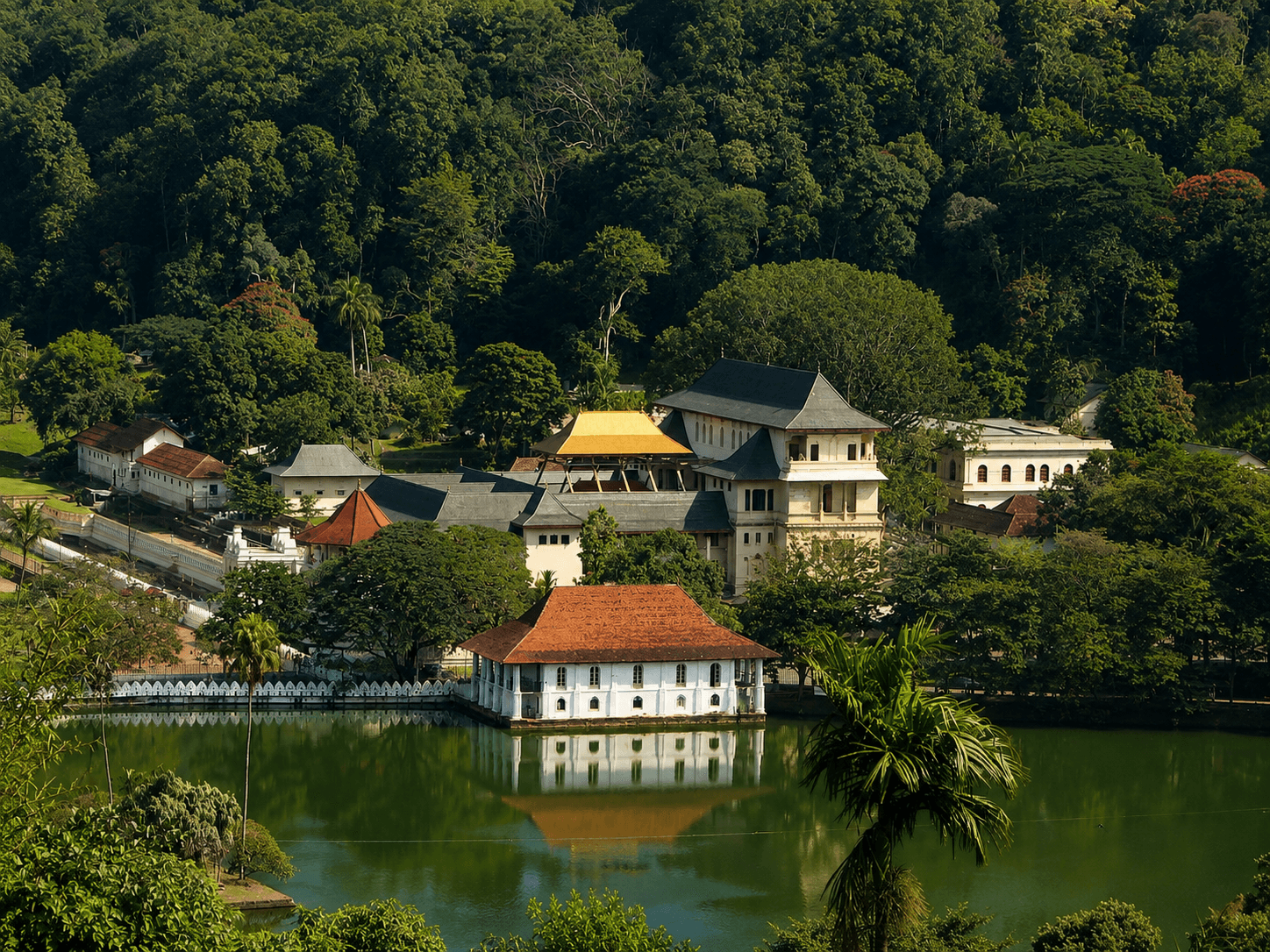
The Temple of the Sacred Tooth Relic remains open during the Perahera, with pujas at the usual hours. Security is tighter, queues are long and parts of the precinct are given over to preparations. The dawn puja is the calmest time to go.
The four devales are at the centre of the festival and are fascinating by day. Each has its own procession, and their compounds fill with drummers, dancers and attendants preparing costumes and regalia. Watch quietly from the edges and ask before taking photographs.
Seeing the elephants, and the welfare question
Elephants are visible all over central Kandy during the Perahera. By day they rest in the shade near the temple, the devales and the lake, eating palm fronds and being washed by their mahouts. Seeing them at close range, unadorned, is a different experience from the lit procession.
The use of elephants in the Perahera raises real welfare concerns, including chaining, noise, heat and long periods of standing. The tradition is deeply valued in Sri Lanka, and opinions among visitors differ. Keep your distance, never touch or feed the animals, and do not pay for photographs with them.
- →Keep at least several metres away, and further from tuskers.
- →Do not use flash near elephants.
- →Follow the instructions of mahouts and police at once.
Road closures, seats and getting home
Road closures shape every Perahera day in Kandy. The streets on the route, including Dalada Veediya, shut to vehicles from about 3 or 4 in the afternoon, and police cordons extend outwards as crowds grow. If your hotel is outside the centre, leave for your seat by 4.
Getting home after the procession is the least pleasant part. Tens of thousands of people leave at once, and vehicles cannot move for an hour or more. Lankan Stays & Trails books seats within walking distance of a pick-up point outside the cordon, and tells guests to expect a late night.
- →Reserve seats in advance; balcony and gallery seats are sold by buildings on the route.
- →Carry water, snacks and a light rain jacket.
- →Use the toilet before you sit; facilities are limited.
- →Agree a meeting point with your driver, away from the route.
The final days and the day procession
The final nights of the Perahera, the Randoli processions, are the grandest and the most crowded. The last night falls on the Esala full moon, which is also a poya day, so alcohol is not sold and the temple is busier still.
The festival closes the following day in daylight. Before dawn the devale processions go to Getambe on the Mahaweli for the water-cutting ceremony, and in the afternoon a final day perahera returns through the city. It is shorter, easier to watch and good for photographs.
Frequently asked questions
What is there to do in Kandy during the day at Perahera time?
During the day at Perahera time, visit the botanic gardens, the three temples loop or Udawattakele forest in the morning, watch preparations at the devales, and see the elephants resting near the temple. Return to your hotel by early afternoon to rest before the procession.
Is the Temple of the Tooth open during the Perahera?
The Temple of the Sacred Tooth Relic is open during the Esala Perahera and holds its daily pujas. Expect heavier security, larger crowds and some restricted areas. The dawn puja is the easiest time to visit in festival week.
What time do roads close in Kandy for the Perahera?
Roads on the Perahera route in Kandy usually close to vehicles from about 3 or 4 in the afternoon on procession days, and earlier on the final nights. Exact times are set by the police each year. Plan to be at your seat by 5.
What time does the Kandy Perahera start each night?
The Kandy Perahera starts after dark at an auspicious time set for each night, usually between 7 and 8.30 in the evening. It takes two to four hours to pass any one point, depending on the night and your position on the route.
Can I see the Perahera elephants during the day?
The Perahera elephants can be seen during the day resting in shaded areas near the temple, the devales and the lake, and sometimes being bathed. Watch from a respectful distance. Do not approach, touch or feed them, and follow the directions of their mahouts.
Is there a daytime Perahera in Kandy?
A daytime procession, the day perahera, is held on the afternoon after the final night, following the water-cutting ceremony at Getambe. It is shorter and less crowded than the night processions and suits families and photographers.