
Quick answer
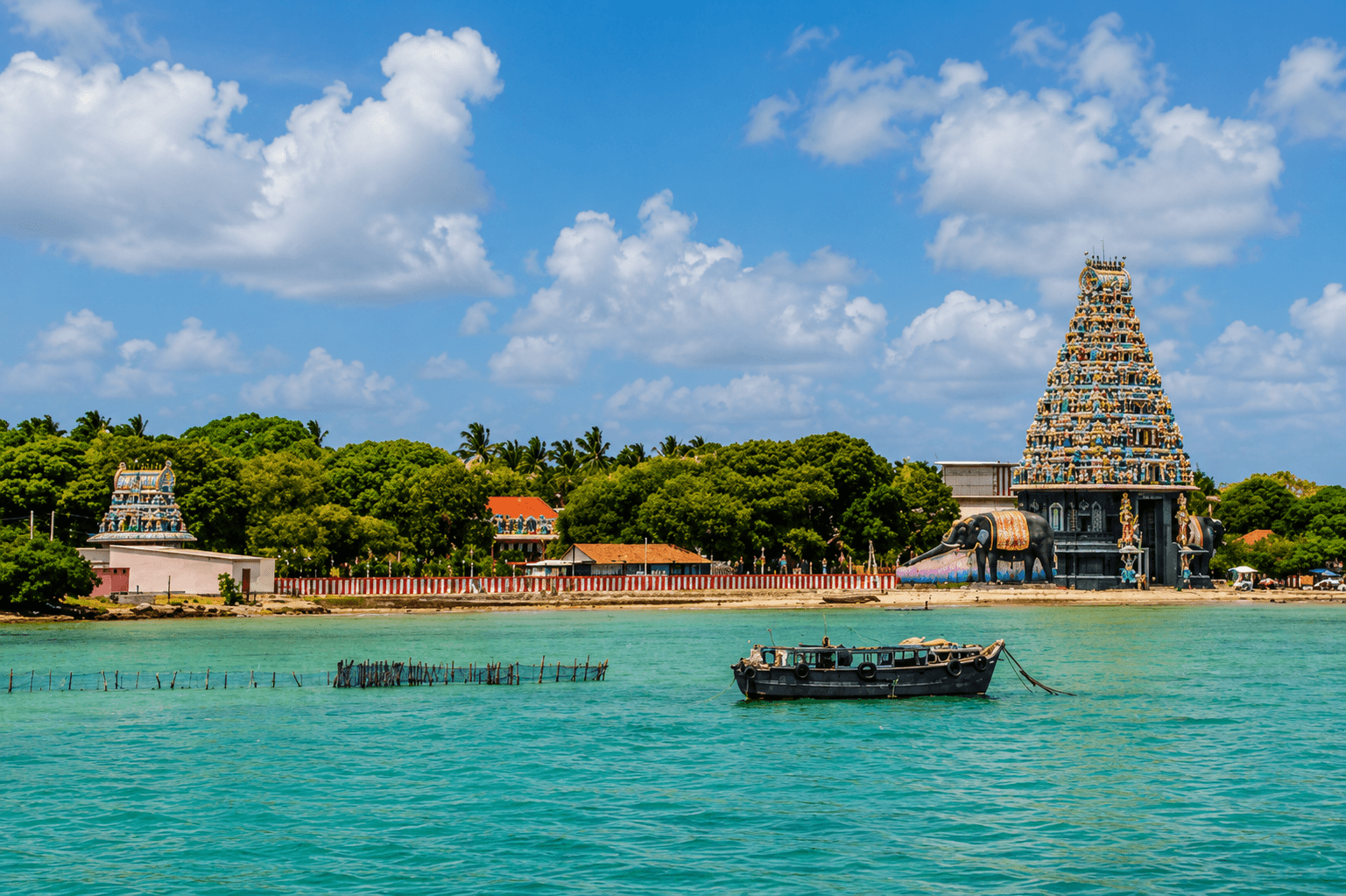
Naguleswaram is an ancient Shiva temple at Keerimalai, on the north coast of the Jaffna peninsula, roughly 20 kilometres from Jaffna town. It is one of the five Pancha Ishwarams. Beside it, the Keerimalai spring feeds sea-front bathing pools, linked by legend to a sage cured of a mongoose face. Families perform rites for ancestors here, especially on Aadi Amavasai. A visit takes one to two hours, and Jaffna is roughly 2 hours from Mannar.
Key takeaways
- Naguleswaram is one of the five Pancha Ishwarams, the ancient Shiva temples on Lanka's coasts.
- The Keerimalai spring feeds separate bathing pools for men and women beside the sea.
- Legend says a sage was cured of a mongoose face by bathing here, giving the temple its name.
- Aadi Amavasai brings large crowds for rites for ancestors, usually in July or August.
- Its Ramayana link is indirect, so most pilgrims visit it as part of a Shaiva circuit.
The mongoose-faced sage
The temple's name comes from a legend about a sage named Nakula, cursed to bear the face of a mongoose. After bathing in the Keerimalai spring and worshipping Shiva, he was cured, and the shrine became known as Nakuleswaram, the temple of the Lord worshipped by Nakula. Keerimalai itself is often explained as mongoose hill.
A second tradition tells of a Chola princess, Maruthapuravalli, cured of a horse-like face after bathing here, who later founded the Maviddapuram Kandaswamy temple nearby. Both stories make healing the heart of Keerimalai's meaning, and many visitors bathe hoping for relief from illness or misfortune.
The Ramayana connection is slight. Some accounts place Keerimalai on Rama's return path, but priests generally speak of it as a Pancha Ishwaram rather than a Ramayana site. Indian pilgrims add it because a Shaiva journey around the island feels incomplete without the northern shrine.
The Keerimalai spring and pools
The spring rises in stone-lined pools right beside the sea, separated from the waves by a low wall. The water is fresh and cool, even though the ocean is a few metres away. There are separate pools for men and women, and local families bathe here throughout the day.
Pilgrims bathe before entering the temple, as a form of purification. Men usually bathe in a veshti, women fully clothed in the enclosed women's pool. Changing areas are basic, so bring a towel, dry clothes and a bag for wet things. Footwear is left outside the pool area.
The pools can be slippery, and the steps are uneven. Elderly pilgrims may prefer to sprinkle water from the edge rather than step down. Children should be supervised, especially near the sea wall, where the waves can be strong in the windy season.
- →Separate men's and women's pools.
- →Fresh, cool spring water beside the sea.
- →Bring towel, dry clothes and a bag for wet things.
Rites for ancestors
Keerimalai is one of the most important places in Sri Lanka for rites for the dead. Families come to perform tarpanam and other ceremonies for parents and ancestors, often guided by priests who sit near the pools. The custom resembles the rites performed at Rameswaram, Gaya or the ghats of the Ganga.
The busiest day is Aadi Amavasai, the new moon of the Tamil month of Aadi, usually in July or August, when thousands bathe and offer rites. Thai Amavasai, in January or February, also draws crowds. Outside those days, rites can be arranged on most mornings through a priest.
Indian families who wish to perform a rite should tell their guide in advance, so a priest can be found and the right items prepared. Bring white or plain clothing, and expect to offer a dakshina. Many families find it deeply meaningful to remember their elders at the northern tip of the island.
- →Aadi Amavasai: usually July or August, the busiest day.
- →Thai Amavasai: usually January or February.
- →Arrange a priest in advance through your guide.
The temple today
Naguleswaram was destroyed by the Portuguese in the seventeenth century and later rebuilt. The temple suffered further damage during the civil conflict, when the area was inside a high security zone, and was restored after access reopened. Today it is active, with daily pujas and a growing number of visitors from the south and from India.
The temple follows Shaiva Agamic rites, and the inner sanctum holds the lingam. The usual customs apply: shoes off, shoulders and knees covered, men shirtless inside. Photography is normally restricted inside the sanctum, but the gopuram and courtyard can usually be photographed.
The Maviddapuram Kandaswamy temple, linked to the princess legend, is a short drive away, and many pilgrims visit both. Keerimalai is also close to the Kankesanthurai harbour, the Sri Lankan end of the passenger ferry from Nagapattinam when it is operating.
- →Daily pujas in the Shaiva Agamic tradition.
- →Maviddapuram Kandaswamy temple a short drive away.
- →Kankesanthurai harbour close by.
Planning a visit
Keerimalai is roughly 20 kilometres north of Jaffna town, about 30 to 40 minutes by car. A morning visit combines well with Nallur Kandaswamy temple in Jaffna in the afternoon, and with the Jaffna islands and Nainativu on another day. Allow one to two hours at Keerimalai, more for a rite.
Jaffna is about 2 hours from Mannar and about 5 to 6 hours from Trincomalee. Flights have operated between Chennai and Jaffna, which can make the north an easy first stop for South Indian pilgrims; check current schedules. The north is driest from roughly February to September.
Lankan Stays & Trails builds northern pilgrimages that join Naguleswaram, Thiruketheeswaram and Koneswaram with Ram Setu, using Tamil-speaking guides. Tell us if your family wishes to perform a rite for ancestors, and we will arrange a priest and timing.
Frequently asked questions
Where is Naguleswaram temple?
Naguleswaram is at Keerimalai, on the north coast of the Jaffna peninsula, roughly 20 kilometres from Jaffna town. It takes about 30 to 40 minutes by car. Most visitors combine it with Nallur temple in Jaffna and the nearby Maviddapuram Kandaswamy temple.
Is Naguleswaram part of the Ramayana trail?
Its Ramayana link is slight, and priests describe it mainly as one of the five Pancha Ishwarams. Indian pilgrims add it to complete a Shaiva circuit with Munneswaram, Koneswaram and Thiruketheeswaram, often alongside Ram Setu in Mannar.
Can we bathe in the Keerimalai spring?
Yes. The spring feeds separate pools for men and women beside the sea, and pilgrims bathe before entering the temple. Men usually bathe in a veshti and women fully clothed. Bring a towel and dry clothes, as changing areas are basic.
Can we perform rites for ancestors at Keerimalai?
Yes. Keerimalai is one of Sri Lanka's main places for tarpanam and rites for the dead. Priests are available on most mornings, and Aadi Amavasai in July or August is the busiest day. Arrange a priest in advance through your guide.
How do we get to Keerimalai from India?
Fly to Colombo and drive or take the train north, or check for flights between Chennai and Jaffna, which have operated in recent years. A passenger ferry from Nagapattinam to nearby Kankesanthurai has also run intermittently; confirm its current status before planning.
What does the name Naguleswaram mean?
It means the temple of the Lord worshipped by Nakula, a sage said to have been cured of a mongoose face after bathing in the Keerimalai spring. Keerimalai is often explained as mongoose hill, from the same legend.
What should we wear at Naguleswaram?
Cover shoulders and knees and remove shoes at the entrance. Men are usually asked to remove shirts in the inner sanctum. For bathing, bring a veshti or a set of clothes you do not mind getting wet, and a change for the temple.