
Quick answer
Polonnaruwa in January is mostly dry, with occasional early-month showers, green landscapes and fresh mornings before the heat builds to about 29 to 30°C. Cycle the ancient city from opening time, see the Royal Palace, the Sacred Quadrangle and the Gal Vihara, and finish at the Parakrama Samudra reservoir at sunset. Dress modestly for the shrines and remove shoes and hats at sacred sites.
Key takeaways
- January is mostly dry and green in Polonnaruwa.
- Early mornings are fresh and ideal for cycling.
- The Gal Vihara is the highlight of the ancient city.
- Modest dress is needed at the shrines.
- Polonnaruwa is quieter than Sigiriya.
Polonnaruwa's weather in January
Polonnaruwa lies in the dry zone of the Cultural Triangle. In January, the north-east monsoon is fading here, and most days are dry, with occasional showers in the first half of the month. Days reach about 29 to 30°C, and mornings are fresh.
After the rains of November and December, the landscape is green, the reservoirs are full and the ruins look their best. Birds are abundant around Parakrama Samudra.
The heat builds quickly after ten, and the ruins have limited shade. Start at opening time and plan to finish by midday, or return for a second visit in the late afternoon.
- →Mostly dry, about 29 to 30°C.
- →Green landscapes and full reservoirs.
- →Fresh mornings, hot middays.
The ancient city
The ruins are spread over a large area, grouped around the Royal Palace, the Sacred Quadrangle and the northern monuments. Start at the Archaeological Museum near the ticket office, which explains the layout and history.
The Royal Palace of King Parakramabahu once rose several storeys, and its thick brick walls still stand. Nearby, the Council Chamber has carved elephant and lion friezes.
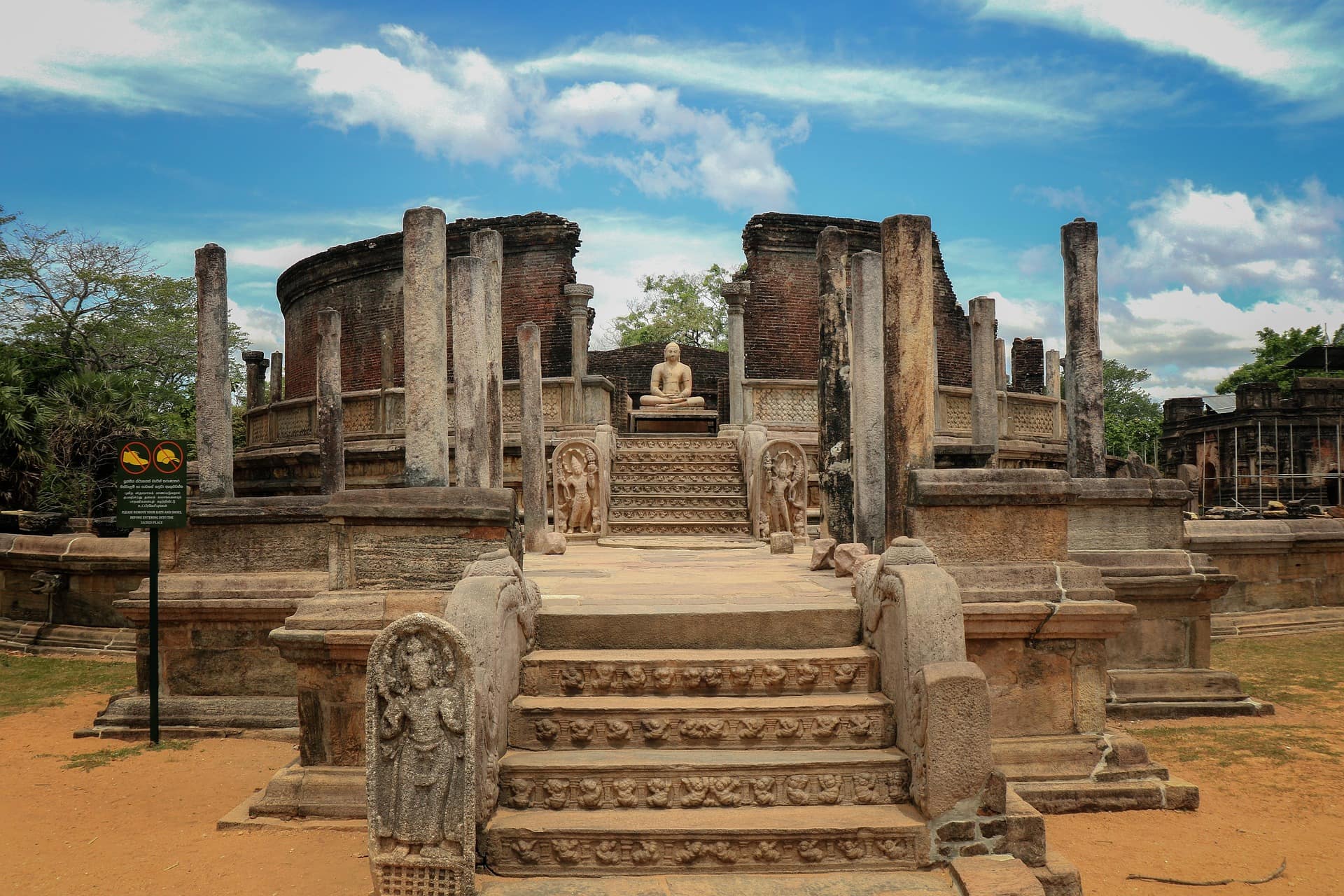
The Sacred Quadrangle is the most concentrated group of buildings, with the circular Vatadage, the Hatadage and the Gal Pota, a huge stone inscription. Shoes and hats come off at many of these shrines.
- →Archaeological Museum first.
- →Royal Palace and Council Chamber.
- →Sacred Quadrangle and Vatadage.
The Gal Vihara and northern sites
The Gal Vihara is Polonnaruwa's masterpiece: four Buddha images carved into a single granite rock face, including a seven-metre standing figure and a fourteen-metre reclining Buddha. Visit early, when the light is soft and the site is quiet.
The Rankoth Vehera and Kiri Vehera are large stupas in the northern area, and the Lankatilaka, an image house with towering walls and a headless standing Buddha, is one of the most impressive buildings in the city.
The Gal Vihara is an active place of worship. Remove shoes, dress modestly and never pose with your back to the Buddha images for photos.
Cycling the ruins
Cycling is the most popular way to explore Polonnaruwa. Bicycles can be hired in town or from guesthouses, and the flat roads between the ruins are easy to ride.
January's fresh mornings are ideal for cycling. Start at opening time, carry water and a hat, and plan rest stops in the shade. Many travellers cover the main sites in three to four hours.
Lankan Stays & Trails can arrange a local guide to cycle with you, which adds depth to the history and saves time finding the less-known sites.
- →Hire bikes in town.
- →Start at opening time.
- →Three to four hours for the main sites.
Parakrama Samudra
Parakrama Samudra, the great reservoir built by King Parakramabahu, lies on the western edge of the ancient city. It is a vast lake that still supplies water to the surrounding farms.
In January, the reservoir is full after the rains, and its banks are busy with birds, including herons, egrets, cormorants and migrant waders. Sunset over the water is one of Polonnaruwa's best moments.
The bund road along the reservoir is a pleasant place to walk or cycle in the late afternoon, when the heat eases and local families come out.
- →Full reservoir in January.
- →Birds and migrant waders.
- →Sunset walks along the bund.
Planning a visit
Most travellers visit Polonnaruwa as a day trip from Sigiriya or Habarana, about an hour away. An overnight stay allows an early start and a sunset at the reservoir.
Polonnaruwa is quieter than Sigiriya and Dambulla, even in January. It combines well with a safari at Minneriya or Kaudulla in the afternoon, though the large elephant gathering takes place later in the year.
Bring cash for the entry ticket, water and snacks. Thin socks protect your feet on hot stone at the shrines.
Frequently asked questions
Is Polonnaruwa worth visiting in January?
Yes. January is a good time to visit Polonnaruwa, with mostly dry weather, green landscapes and fresh mornings that suit cycling. The ruins are less crowded than Sigiriya. Start early to avoid the midday heat, and allow three to four hours for the main sites.
Does it rain in Polonnaruwa in January?
Occasionally, especially in the first half of the month, as the north-east monsoon fades. Showers are usually short. Most days are dry and sunny, with temperatures of about 29 to 30°C. Late January is usually drier than early January.
How long do I need in Polonnaruwa?
Three to four hours covers the main sites by bicycle or with a driver. A full day allows a more relaxed pace, a museum visit and sunset at Parakrama Samudra. Many travellers visit as a day trip from Sigiriya or Habarana.
Can I cycle around Polonnaruwa?
Yes. Cycling is the most popular way to explore the ancient city. Bikes can be hired in town or from guesthouses, and the roads between the ruins are flat. Start at opening time in January, carry water and plan rest stops in the shade.
What should I wear to Polonnaruwa?
Wear light, modest clothing that covers your shoulders and knees, since many ruins are active shrines. Shoes and hats must be removed at sacred sites. A hat, sunscreen and thin socks for hot stone are useful in January's strong sun.
Is Polonnaruwa better than Anuradhapura?
Polonnaruwa is more compact and easier to explore in a day, with well-preserved buildings and the stunning Gal Vihara. Anuradhapura is older and more spread out, with huge stupas and an active pilgrimage atmosphere. Many travellers with limited time choose Polonnaruwa.
Can I combine Polonnaruwa with a safari?
Yes. Minneriya and Kaudulla national parks are close, and an afternoon safari after a morning at the ruins is a popular combination. In January, elephants are spread out rather than gathered in large herds, which happens later in the year.