
Quick answer
Ramboda Falls is a waterfall of about 109 metres on the Kandy to Nuwara Eliya road at Ramboda, roughly 55 kilometres south of Kandy. The drive takes one and a half to two hours. The falls drop in tiers above and below the road, with the lower section seen from a bridge and from the terraces of roadside restaurants, and the upper section reached by a steep 15-minute path. With a tea factory and the Sri Bhakta Hanuman Temple nearby, Ramboda makes a five to six hour trip from Kandy.
Key takeaways
- Ramboda Falls is about 109 metres high, placing it among the dozen tallest waterfalls in Sri Lanka.
- Ramboda lies at roughly 950 metres above sea level, about 55 kilometres from Kandy and 25 from Nuwara Eliya.
- The Ramboda road tunnel, opened in 2008, is about 225 metres long and was the longest road tunnel in the country when built.
- The Sri Bhakta Hanuman Temple at Ramboda houses a granite statue of Hanuman roughly five metres tall.
- Ramboda Falls is fullest from October to January and thinnest from February to April.
Where Ramboda Falls is
Ramboda Falls lies in the Kotmale valley, where the main road to Nuwara Eliya begins its steepest climb. The water comes from the Panna Oya, a tributary of the Kotmale River, and falls across a rock face that the road crosses at mid-height.
The setting of Ramboda is as impressive as the waterfall. Tea estates cover the valley sides, the Kotmale reservoir shines below, and several other falls streak the opposite slope. The village is a string of shops, tea centres and small hotels along the road.
How to see the falls
Seeing Ramboda Falls is easy at the lower level. The road bridge crosses the stream between the two main sections, and the lower fall is visible from the bridge and from the gardens of a hotel below, which visitors may enter for a small fee or the price of a drink.
The upper section of Ramboda Falls needs a short, steep walk. A stepped path climbs beside the stream from the road for about 15 minutes to a viewing point near the base of the upper drop. The steps are uneven and slippery when wet.
- →Lower falls: from the bridge and hotel terraces, no walking needed.
- →Upper falls: 15 minutes up a steep path; shoes with grip.
- →Distant view: from the Hanuman temple road on the opposite hillside.
- →Time: 30 to 45 minutes for both levels.
The Hanuman temple
The Sri Bhakta Hanuman Temple stands on a hill above Ramboda, a few minutes' drive off the main road. It was built by the Chinmaya Mission and opened around 2001. The granite image of Hanuman, the monkey god of the Ramayana, is roughly five metres tall.
Ramboda is linked by local tradition to the Ramayana, as a place where Hanuman searched for Sita. The temple is a stop on Ramayana pilgrimage routes from India. Its terrace gives one of the best views of the Kotmale reservoir and the hills. Shoes are removed, and the shrine closes for a period in the middle of the day.
Tea estates and factories nearby
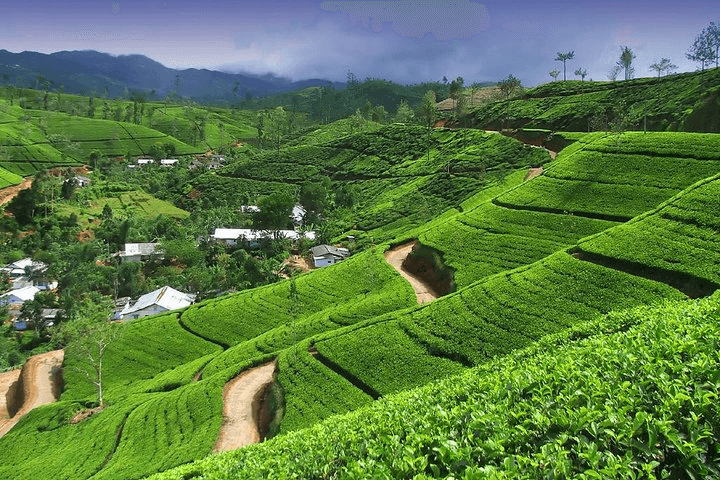
Ramboda sits in the middle of some of the most photogenic tea country in Sri Lanka. The estates here are at 900 to 1,500 metres, between the mid-grown teas of Kandy and the high-grown teas of Nuwara Eliya. Pluckers work the slopes beside the road on most mornings.
Tea factories near Ramboda welcome visitors with free tours and tasting rooms. The largest are a few kilometres above the village on the way to Nuwara Eliya, and others stand near Pussellawa on the way from Kandy. A weekday morning visit shows the machinery working.
- →Factory tour: 30 to 45 minutes, usually free.
- →Tasting: a cup of the estate's tea, often with cake for sale.
- →Best time: 8 to 11 in the morning, Tuesday to Saturday.
A half-day plan from Kandy
A half-day to Ramboda from Kandy works best with a 7 o'clock start. The road south through Peradeniya and Gampola is slow in the rush hour, and the falls are in shade by late afternoon. The whole trip takes five to six hours.
The plan for Ramboda can be extended in either direction. Ambuluwawa is close to the route at Gampola and can be added on the way back. Travellers moving on to Nuwara Eliya simply treat Ramboda as their main stop. Lankan Stays & Trails times the tea factory first, while it is working, and the falls second.
- →7.00: leave Kandy.
- →8.45: tea factory near Pussellawa or Ramboda.
- →10.00: Ramboda Falls, upper and lower.
- →11.00: Hanuman temple and the reservoir view.
- →1.00: back in Kandy, or lunch on the road.
When to go and what to bring
The best months for Ramboda Falls depend on what you want. From October to January the falls are at full volume and the hills are intensely green, with frequent rain. From February to April the weather is driest and clearest, and the falls shrink to a ribbon.
Ramboda is cooler than Kandy by about five degrees, and showers arrive quickly at any time of year. Bring a light jacket, shoes that can get wet and something for car sickness if you are prone to it. The bends above Pussellawa are continuous.
Frequently asked questions
How far is Ramboda Falls from Kandy?
Ramboda Falls is about 55 kilometres south of Kandy on the A5 road to Nuwara Eliya. The drive takes one and a half to two hours through Gampola and Pussellawa. Buses between Kandy and Nuwara Eliya pass the falls and will stop there.
How tall is Ramboda Falls?
Ramboda Falls is about 109 metres tall. It falls in several tiers, with the main upper drop above the road and a lower section beneath the bridge. It ranks among the taller waterfalls in Sri Lanka, though several others exceed it.
Can you walk to the top of Ramboda Falls?
A stepped path leads from the main road towards the base of the upper section of Ramboda Falls in about 15 minutes. It does not reach the very top. The steps are steep and uneven, and are best avoided during or just after heavy rain.
Is Ramboda Falls worth a trip from Kandy?
Ramboda Falls is worth the trip from Kandy if you combine it with a tea factory and the surrounding scenery, and if you are not travelling on to Nuwara Eliya. If your route continues up the same road, see it on the way instead of as a return trip.
What is the best time to see Ramboda Falls?
The falls are most powerful from October to January, during and after the heaviest rains. For clear skies and dry paths, February to April is better, though the flow is weaker. Mid-morning gives the best light on the rock face.
Is there an entrance fee for Ramboda Falls?
There is no fee to view Ramboda Falls from the road bridge or to walk the public path. The hotel below the road charges non-guests a small amount to enter its garden viewpoint, usually waived if you buy a drink or a meal.