
Quick answer
The Vibhishana devale is a shrine to Vibhishana, Ravana's righteous brother, within the Kelaniya Raja Maha Vihara temple complex, roughly 10 kilometres from central Colombo. Sri Lankan tradition says Vibhishana was crowned king of Lanka at Kelaniya after Ravana's defeat, and he is worshipped as a guardian deity. Hindu pilgrims can visit respectfully within the Buddhist temple, allowing 30 to 60 minutes, usually as a half morning from Colombo.
Key takeaways
- Vibhishana is honoured as a guardian deity of Sri Lanka, with a devale at Kelaniya.
- Tradition says he was crowned king of Lanka at Kelaniya after Ravana's fall.
- The shrine stands within Kelaniya Raja Maha Vihara, a major Buddhist temple.
- Kelaniya is roughly 10 kilometres from central Colombo, an easy half morning.
- Buddhist etiquette applies across the temple grounds, including white or light clothing.
Vibhishana in the Ramayana
Vibhishana is Ravana's younger brother, remembered for his devotion to dharma. In the Yuddha Kanda he urges Ravana to return Sita and make peace. When Ravana refuses and insults him, Vibhishana leaves Lanka and seeks refuge with Rama, who accepts him despite the doubts of his allies.
Vibhishana's knowledge of Lanka helps Rama win the war, and after Ravana's death, Rama crowns him king. Valmiki presents him as a model of righteousness who chose truth over family loyalty, and many Hindu families admire him greatly, even naming children after him in some regions.
In Sri Lanka, Vibhishana's place is even larger. He is revered as one of the island's guardian gods, protecting Lanka and its people. His worship has been part of Sinhala Buddhist religious life for centuries, alongside other deities honoured in devales.
- →Urged Ravana to return Sita and make peace.
- →Joined Rama and was crowned king of Lanka.
- →Revered in Sri Lanka as a guardian deity.
The coronation at Kelaniya
Sri Lankan tradition holds that Vibhishana's coronation took place at Kelaniya, on the banks of the Kelani river. Some accounts say Lakshmana performed the ceremony on Rama's behalf. The tradition gives Kelaniya a special place in the island's Ramayana map, close to the modern capital.
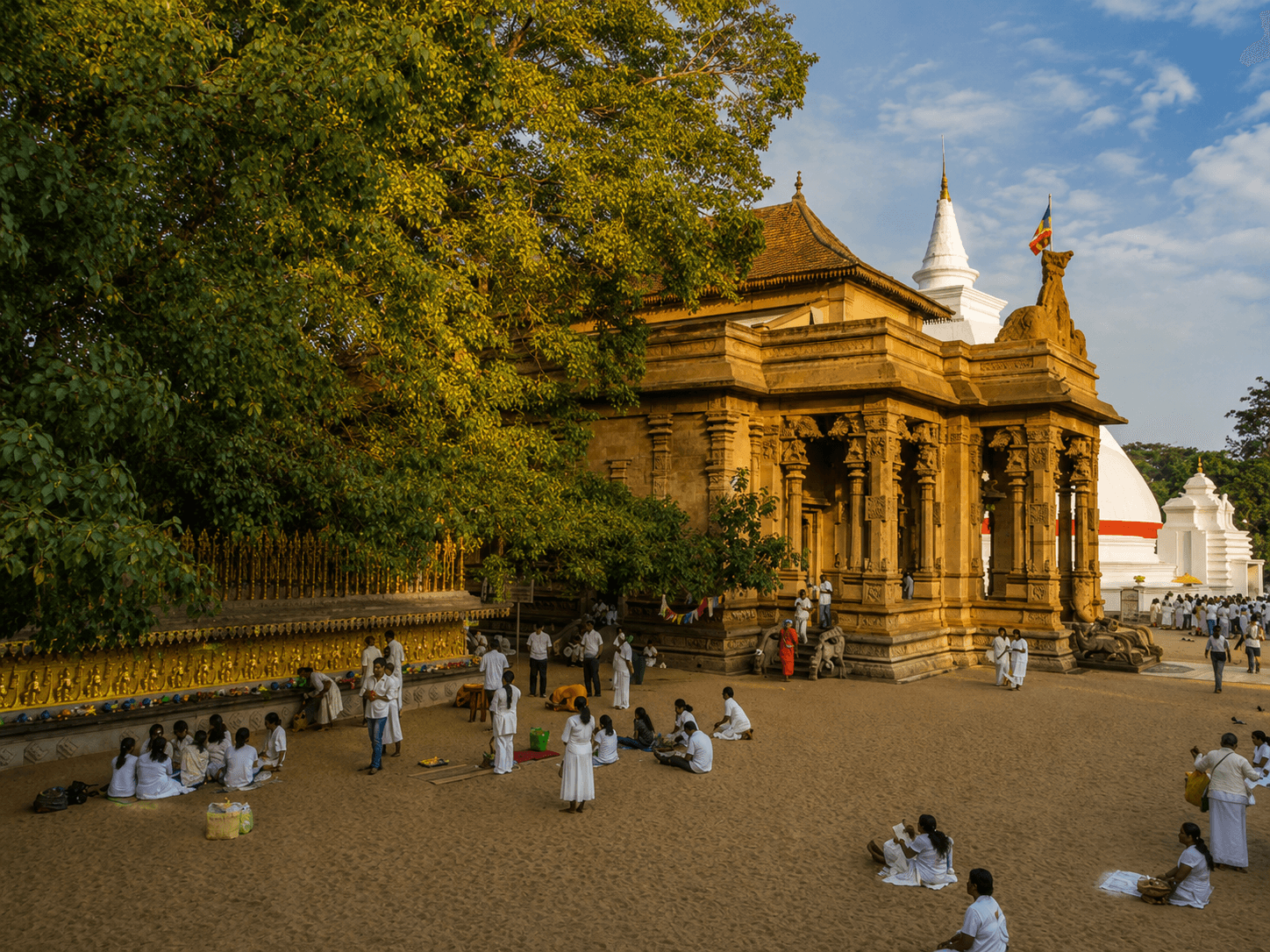
Kelaniya is also one of the most sacred Buddhist sites in Sri Lanka, believed to have been visited by the Buddha himself. The great temple, Kelaniya Raja Maha Vihara, holds a stupa, a bodhi tree, an image house with famous murals and several devales, including the shrine to Vibhishana.
The two traditions sit comfortably together. Buddhist devotees visit the stupa and image house, then pray at the devales for worldly help, while Hindu pilgrims come specifically to honour Vibhishana. The temple's murals even include scenes connected to the island's ancient history and legends.
Visiting the Vibhishana devale
The Vibhishana devale stands within the temple grounds, and staff or your guide can point it out. Inside, an image of Vibhishana is honoured with flowers, lamps and offerings. A kapurala, the priest who serves at devales, may perform a short ritual and receive offerings on behalf of devotees.
Hindu pilgrims usually offer flowers, light a lamp and say a prayer to Vibhishana, perhaps reciting the verses in which Rama accepts him. A small donation is customary. Because the shrine is part of a Buddhist temple, rituals may differ from those in a kovil, so follow the kapurala's guidance.
Many families also visit the main stupa and the image house to see the murals, which take an hour or more to appreciate properly. Elders appreciate that the grounds are level and spacious, with shaded areas for resting.
- →Image of Vibhishana honoured with flowers and lamps.
- →A kapurala may perform a short ritual.
- →Combine with the stupa, bodhi tree and murals.
Etiquette in a Buddhist temple
Kelaniya is an active Buddhist temple, and visitors are expected to follow its customs. Shoes and hats are removed at the entrance to the grounds, not only at shrines. White or light-coloured clothing is preferred, with shoulders and knees covered. Sarees, salwar kameez and kurtas in pale colours are ideal.
Walk clockwise around the stupa and bodhi tree, keep voices low and do not turn your back to a Buddha image for photographs. Photography inside the image house may be restricted. On poya days, the monthly full moon holidays, the temple is especially busy with devotees dressed in white.
The temple's stone and sand grounds become very hot at midday, so mornings and late afternoons are best. Carry socks if you are sensitive to heat, as these are usually acceptable on the outer grounds, though not inside shrines.
- →Shoes and hats off at the temple entrance.
- →White or light clothing; shoulders and knees covered.
- →Walk clockwise; respect Buddha images.
Planning a Kelaniya visit
Kelaniya is roughly 10 kilometres north-east of central Colombo, a drive of 20 to 40 minutes depending on traffic. It fits easily into a first or last morning in Colombo, or on the way from the airport. Allow 30 to 60 minutes for the Vibhishana shrine, and up to two hours for the whole temple.
The Duruthu Perahera in January, a procession of elephants, dancers and drummers, is the temple's greatest festival, with dates that change each year. Poya days are crowded but atmospheric. Weekday mornings are quietest for pilgrims wishing to pray at the devale without crowds.
Lankan Stays & Trails includes Kelaniya and the Vibhishana shrine on Ramayana routes that begin or end in Colombo. Ask for a guide who can explain both the Buddhist and Ramayana traditions, so that the visit is meaningful to everyone in your family.
Frequently asked questions
Is there a Vibhishana temple in Sri Lanka?
Yes. A devale dedicated to Vibhishana stands within the Kelaniya Raja Maha Vihara temple complex, roughly 10 kilometres from central Colombo. Vibhishana is honoured in Sri Lanka as a guardian deity, and devotees pray to him for protection.
Why is Vibhishana worshipped in Sri Lanka?
Vibhishana is remembered as Ravana's righteous brother who joined Rama and was crowned king of Lanka. Sri Lankans revere him as a guardian of the island, and his worship has been part of Sinhala Buddhist religious life for centuries.
Was Vibhishana crowned at Kelaniya?
Sri Lankan tradition says Vibhishana's coronation took place at Kelaniya, on the banks of the Kelani river, with some accounts saying Lakshmana performed the ceremony. The tradition is honoured locally and gives Kelaniya a place on the Ramayana trail.
Can Hindus pray at the Vibhishana shrine?
Yes. Hindu pilgrims are welcome to offer flowers, light a lamp and pray at the devale. The shrine is part of a Buddhist temple and is served by a kapurala, so follow local guidance on rituals and leave a small donation.
What should we wear at Kelaniya temple?
Wear white or light-coloured clothing that covers shoulders and knees. Remove shoes and hats at the temple entrance. Pale sarees, salwar kameez and kurtas are ideal. Mornings are best, as the grounds become very hot at midday.
How far is Kelaniya from Colombo?
Kelaniya is roughly 10 kilometres north-east of central Colombo, about 20 to 40 minutes by car depending on traffic. It also lies on the way between the city and the airport, so many families visit on their first or last day.
When is the best time to visit Kelaniya?
Weekday mornings are quietest for prayer at the Vibhishana devale. The Duruthu Perahera, usually in January with changing dates, is spectacular but very crowded. Poya days are also busy and atmospheric, with devotees dressed in white.